

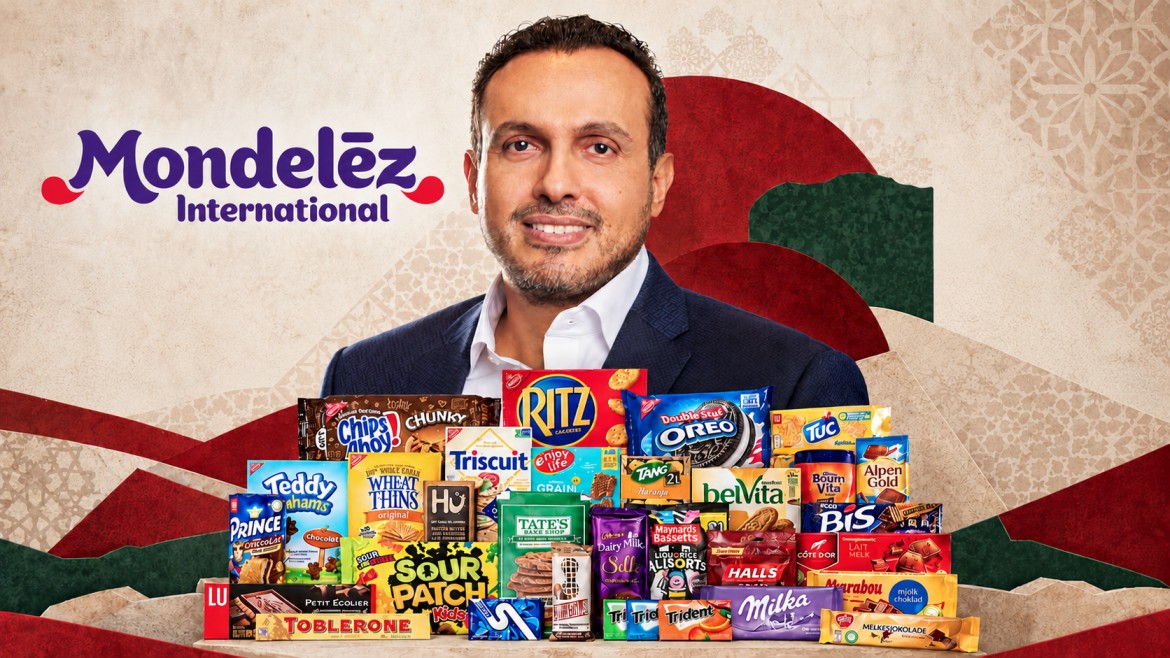
Mondelēz International has appointed Adyl Laraki as its new General Manager for Northwest Africa. He will take charge of the company’s operations in Morocco, Algeria, Tunisia and Mauritania from 1 October 2026. Laraki will be based in Casablanca. His job will be to grow the business in the four markets, improve cooperation between them and find new opportunities for the company.
The appointment puts a local executive with more than 20 years of international business experience in charge of the regional operation. Laraki has worked in consumer goods, digital commerce and agriculture, including senior positions at Procter & Gamble and OCP Nutricrops.
He spent more than 20 years at Procter & Gamble after joining the company in 2002. His work covered commercial development, brand growth, profit and loss, distribution and major customer partnerships.
His P&G career included positions in Morocco, Northwest Africa, Europe, Australia, New Zealand and the Philippines. He later became Senior Vice-President of Sales and General Manager of Digital Commerce for Asia, the Middle East and Africa.
Laraki then joined OCP Nutricrops, where he served as CEO Europe from 2023 to 2026. He led the development of the European business, with a focus on specialised and higher-value agricultural solutions and closer cooperation across the agricultural sector.
He has an engineering degree from the École Hassania des Travaux Publics (EHTP). He completed the Wharton Executive Education Global C-suite Program in 2025. He speaks Arabic, French and English.
Laraki said the new position was personally important to him and that he wanted to work with the company’s teams to maintain growth, develop the region and support the next generation of local talent.
“Taking charge of Mondelēz International’s operations in Northwest Africa is deeply meaningful to me,” Laraki said. “I look forward to working with our teams to maintain our momentum, accelerate regional development, and help nurture the next generation of local talent.”
Ihab Amin, president of Mondelēz International’s MENAP business unit, sees Laraki’s knowledge of the region and international experience as important for the company’s next stage of growth. His mandate includes expanding brands, supporting innovation and strengthening operations across the four countries.
Mondelez Maroc has operated in Morocco since 2001. Its main industrial site is in the Ain Sebaâ industrial area of Casablanca.
The facility covers more than 15,000 square metres and has the largest Oreo manufacturing line in Africa. It produces tens of thousands of tonnes of biscuits each year for the local market and export markets in North and West Africa.
The operation employs nearly 1,000 people directly. It also supports more than 3,000 indirect jobs through logistics and distribution.
The company reaches more than 80,000 traditional retail outlets across Morocco, including small grocery shops known locally as hanouts. It also sells through modern retail channels.
The Casablanca operation produces Oreo and Bimo products. Mondelez Maroc also distributes Milka, Clorets, Trident and Halls.
The business has its roots in Kraft Foods Morocco, which was established in 2001 after Kraft Foods acquired Nabisco assets.
In 2013, Mondelēz acquired the remaining 50% of BIMO from SNI, formerly Groupe ONA, for about 1.3bn dirhams ($140m).
BIMO, or Société Industrielle de Biscuiterie pour le Moyen-Orient, had previously been jointly owned by Kraft Foods and SNI, with each holding 50%.
The acquisition gave Mondelēz full control of BIMO and its manufacturing assets and brands. These include Merendina, Tango, Togai and Golden.
BIMO was later consolidated into Mondelez Maroc.
Mondelez Maroc is now a wholly owned subsidiary of Mondelēz International. Its legal form is a Société Anonyme, or S.A. Its Casablanca commercial register number is 29629.
The company has share capital of more than 1.37bn dirhams, around $135m. Mondelēz International is the ultimate owner, through intermediate holding companies including Mondelēz Nederland and Mondelēz Europe investment entities.
There are no local retail shareholders or local joint-venture partners in the Moroccan company.
Laraki’s new role covers Morocco, Algeria, Tunisia and Mauritania. The four markets have a combined population of more than 100 million.
Mondelēz sees Northwest Africa as one of its growth areas within its wider Asia, Middle East and Africa business.
The company wants to make better use of production and logistics infrastructure in the region. That includes the Casablanca factory and the Tanger Med port, which can support exports to other African and regional markets.
Cross-border trade remains a major challenge.
The land border between Morocco and Algeria has been closed for years. Goods moving between the two countries therefore need to use sea routes or routes through third countries.
Currency rules and import controls in Algeria and Tunisia can also make it harder to source raw materials and manage payments across borders.
The company also needs to deal with rising prices and consumers who are more careful about spending. Smaller and lower-priced packs, including single-serve products, are part of the response to these pressures.
Mondelēz International generated about $38.5bn in revenue in 2025. It operates in roughly 150 countries.
Its portfolio includes Oreo, LU, Ritz, Clif Bar, Tate’s Bake Shop, Cadbury Dairy Milk, Milka and Toblerone.
Its gum and confectionery brands include Halls, Clorets, Trident, Sour Patch Kids and Swedish Fish.
The company is listed on Nasdaq under the ticker MDLZ. Its shares are mainly held by institutional investors and index funds.
About 88% to 89% of its shares are held by large institutional investors. These include Vanguard, with about 7% to 9.9%, BlackRock with about 8.2%, Capital Research with about 3.9% to 5.4%, State Street with about 4.6% and JPMorgan Chase with about 4.7%.


