

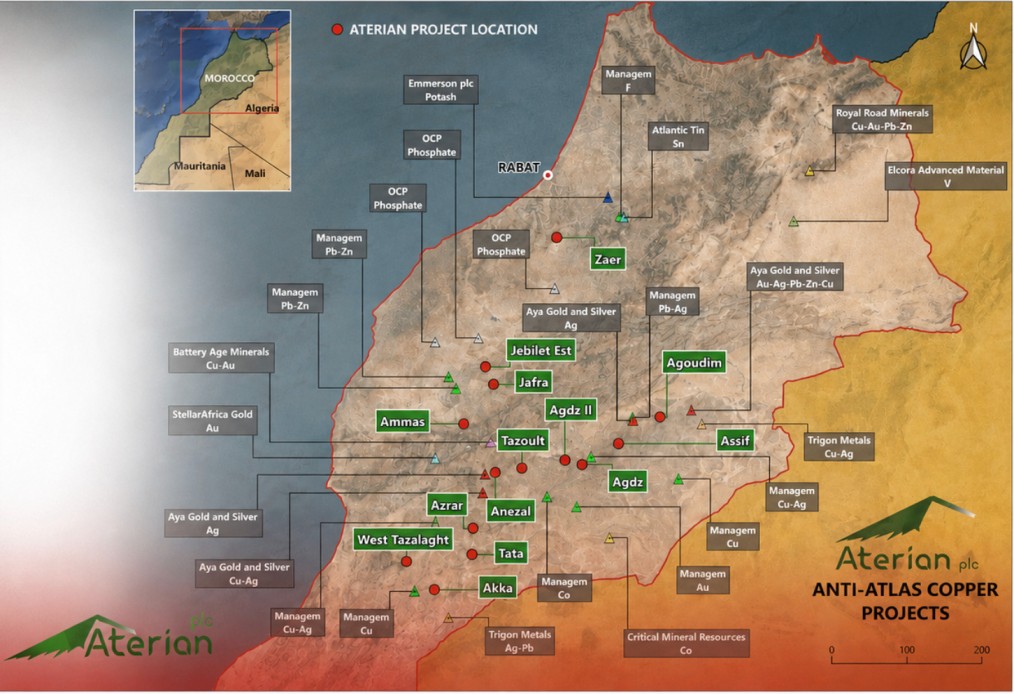
Aterian has found copper and silver mineralisation in three areas of its Agdz exploration project in the Anti-Atlas, as the company looks at where to carry out further tests and possible drilling. The British mining exploration company announced the results on Monday, 16 November, following a programme of 17 trenches covering a total of 480 metres.
The strongest results came from Amzwaro South, where the company traced a mineralised fault over about 350 metres. The fault runs north-north-east and remains open along its length, meaning it could extend further. Geologists have also identified the possibility of parallel faults nearby.
Three trenches at Amzwaro South returned notable copper and silver grades. Trench 26AGTR-002 recorded 3.1 metres containing 0.7% copper and 23.2 grams of silver per tonne, between depths of 17.9 and 21 metres.
Trench 26AGTR-004 returned two mineralised sections. The first measured 1.4 metres, with 0.8% copper and 15 grams of silver per tonne, between 5.9 and 7.3 metres. The second measured 1.8 metres, with 0.7% copper and 17.9 grams of silver per tonne, between 10.7 and 12.5 metres.
Trench 26AGTR-016 also recorded two sections. One measured 5.5 metres, grading 0.5% copper and 5.2 grams of silver per tonne, between 4.5 and 10 metres. The other measured two metres, with 0.9% copper and 18 grams of silver per tonne, between 25 and 27 metres.
The results form part of an exploration programme designed to find mineral deposits hidden beneath surface soil, investigate unusual readings from geophysical surveys and identify geological structures that could help guide future drilling.
Aterian carried out the work with French company Lithosquare, which funded the programme in full through its partnership with the company.
The 17 trenches averaged 28 metres in length and reached depths of up to 1.5 metres. Four were dug directly to investigate geophysical anomalies, while nine underwent systematic sampling using a diamond saw. The remaining eight were not systematically sampled because the rocks were deeply weathered or showed too little visible mineralisation.
Some of the geophysical anomalies appear to be linked to weathered intrusive rocks or heavily fractured areas containing low concentrations of secondary copper. These findings have helped Aterian identify which anomalies are less promising and refine its search for potential deposits.
Results from other exploration areas
The company also reported copper and silver mineralisation at Makarn North.
Trench 26AGTR-007 returned 3.5 metres grading 0.1% copper and 2.3 grams of silver per tonne, between 3.8 and 7.2 metres.
Trench 26AGTR-013 recorded 2.4 metres containing 0.4% copper and 2.6 grams of silver per tonne, between 12.1 and 14.5 metres.
Results from trenches 26AGTR-005 and 26AGTR-012 were insignificant. Trenches 26AGTR-006 and 26AGTR-014 were excluded from systematic sampling.
At Daoud, trench 26AGTR-009 returned two mineralised sections. The first measured 1.1 metres, grading 0.3% copper and 15 grams of silver per tonne, between 26.8 and 27.9 metres. The second measured 0.9 metres, with 0.7% copper and four grams of silver per tonne, between 31.5 and 32.4 metres.
Trench 26AGTR-008 returned insignificant results, while trenches 26AGTR-010 and 26AGTR-011 were not systematically sampled.
Geologists also found weaker mineralisation in partially weathered faults beneath the surface soil.
The company calculated its reported mineralised intervals using a minimum grade of 0.2% copper. The calculations can include up to two metres of separate sections of rock below that grade, allowing short, lower-grade gaps to be included when measuring a mineralised interval.
A project covering 50.4 sq km
Aterian owns 85% of the Agdz project, with Lithosquare holding the remaining 15%.
The project covers 50.4 sq km across two mining licences. The main Agdz licence covers 34.5 sq km, while the neighbouring Agdz East licence accounts for 15.9 sq km.
The site is in the Drâa-Tafilalet region, about 35km east of Ouarzazate. It is also located around 14km south-west of the Bouskour copper and silver mine and 80km south-west of the Imiter silver mine. Both mines belong to Moroccan mining group Managem.
Aterian plans to compare the trench results with a ground magnetic survey that has already been completed, as well as a hyperspectral study funded through its partnership with Lithosquare.
The company intends to dig more trenches to test whether the Amzwaro South fault continues further, fill gaps between existing trenches and improve its understanding of the area’s geological structures.
These results will help it decide where potential drilling should take place.
Aterian executive chairman Charles Bray said the work had provided “a clearer target” at Amzwaro South.
How the samples were tested
Afrilab laboratory prepared 122 trench samples, including 14 samples used for quality control.
The laboratory first crushed the rock until 70% of the material could pass through a screen with openings of two millimetres. It then ground the fine material until 85% could pass through a much finer, 75-micrometre screen.
All 122 samples were tested for 40 elements using inductively coupled plasma atomic emission spectroscopy, a laboratory technique used to measure the chemical composition of rocks.
A smaller group of 43 samples, including quality-control material, also underwent a 50-gram fire assay to test for gold. The process used gravimetric finishing to measure the gold content.
The quality-control checks included five duplicate field samples, four blank samples and five certified reference materials supplied by Australian company Geostats. Together, the 14 checks accounted for 12% of the material sent to the laboratory.
Aterian also collected 29 composite rock-chip samples from the trenches and exposed rock outcrops. These samples will help the company study the area’s geology and the overall composition of its rocks.


