

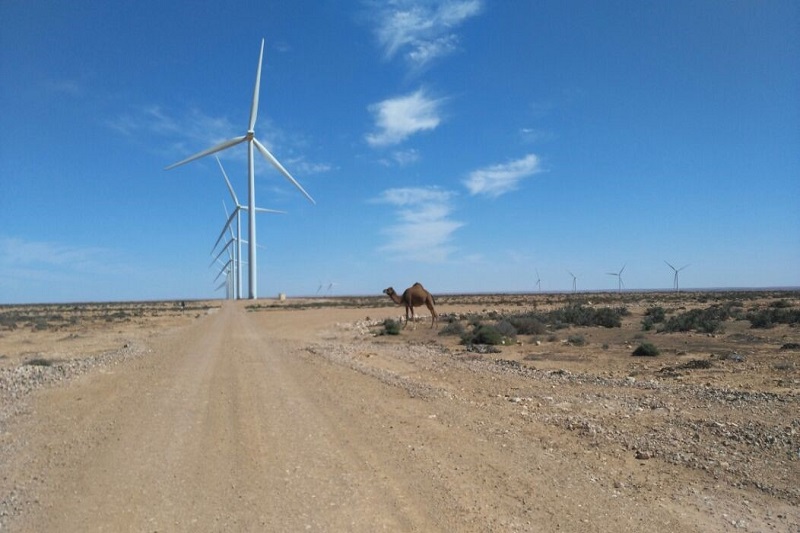
A wind farm in Boujdour could produce electricity at a fraction of the cost of similar projects elsewhere in Morocco, according to a new study, strengthening the case for the southern provinces as a major centre for renewable energy. Wind turbines in Boujdour could operate at 62.9% of their maximum capacity, compared with 42.3% in Essaouira and about 22% in Al Hoceima, El Jadida and Meknes, the study found.
The research, carried out by scientists from the University of Fez and France’s University of Pau, compared wind conditions and electricity production costs at five locations across the country.
Producing one kilowatt-hour (kWh) of electricity in Boujdour costs between 1.3 and 1.6 US cents, according to the findings. The same amount costs between 2.48 and 3.11 cents in Essaouira, rising to as much as 7.18 cents in Al Hoceima and 10.30 cents in Meknes, depending on the turbine used.
The researchers examined nine types of wind turbines, with capacities ranging from 750 kilowatts to 3.6 megawatts. They tested the models at heights of 50 and 80 metres, using measurements collected in the field, satellite data and the wind atlas produced by the Moroccan Agency for Sustainable Energy (MASEN).
The height of the turbines made a significant difference to their financial viability. At most of the locations studied, reducing the tower height from 80 to 50 metres made wind projects unprofitable. Boujdour was the only exception.
A hypothetical 30MW wind farm in Boujdour could generate around 165 gigawatt-hours of electricity every year. The project could also make an estimated net profit of $43.5m over its lifetime, the study said.
The findings come as several large wind projects are already operating or expanding in the area.
The 300MW Boujdour wind farm, developed by Enel Green Power and Nareva, required an investment of about 3.9bn dirhams ($390m) and began operating in 2023. It forms part of the country’s 850MW Integrated Wind Programme.
The Aftissat wind farm, about 50km south of Boujdour, has also expanded. Its original 200MW capacity has been increased by a further 200MW, bringing the total to more than 400MW. The expansion uses turbines made by GE Renewable Energy, including models with a capacity of 3.6MW.
Morocco added 192MW of renewable energy capacity in 2025, bringing its total to 4,851MW. Wind power accounts for 2,452MW of that capacity, while renewable sources now represent 39.6% of the country’s total installed electricity capacity.
The government aims to increase that share to 52% by 2030.
But the researchers warn that having strong and reliable winds does not automatically make a project viable. Limited connections to the national electricity grid, particularly in the southern provinces, remain a major obstacle. Land acquisition, permits and the protection of migratory bird routes also pose challenges.
The state-owned electricity and water utility ONEE is working to expand the network and transport more electricity from the south to other parts of the country.
In late 2025, the utility launched a prequalification tender for a 1,000km ultra-high-voltage transmission line. The project is designed to carry up to 2GW of electricity from Boujdour to the Tensift region, near Marrakech, and is expected to become operational in December 2028.
A separate double-circuit 400kV transmission line is under construction. It is expected to increase the southern network’s capacity by a further 900MW, mainly to carry electricity from new wind farms.
The southern high-voltage network already transports more than 1,500MW through 225kV and 400kV lines.
Plans are also advancing for a much larger electricity project: a 3GW high-voltage direct-current connection between Dakhla and Casablanca. The project is expected to operate under a 30-year public-private partnership.
Wind power could also help reduce carbon emissions. The projects examined in the study, with a combined capacity of 150MW, could prevent around 247,500 tonnes of carbon dioxide from entering the atmosphere every year, compared with electricity generated using the national grid.
The researchers identified the steady trade winds along the Atlantic coast and the flat landscape as key reasons for the southern provinces’ strong performance. The open terrain allows wind to flow with fewer obstacles.
Essaouira also has favourable conditions, particularly in July, when electricity demand is high.
The study also warned that high temperatures could affect electricity production estimates. Hot air is less dense, which reduces the amount of energy wind turbines can capture. Ignoring this effect could lead to production forecasts being overstated by between 4% and 7%.
The researchers also pointed to the existing 300MW Tarfaya wind farm, which operates at a capacity factor of between 45% and 50%.
The findings suggest that the main challenge is no longer simply finding places with enough wind. It is building the infrastructure needed to transport the electricity to homes, businesses and industries across the country.


