

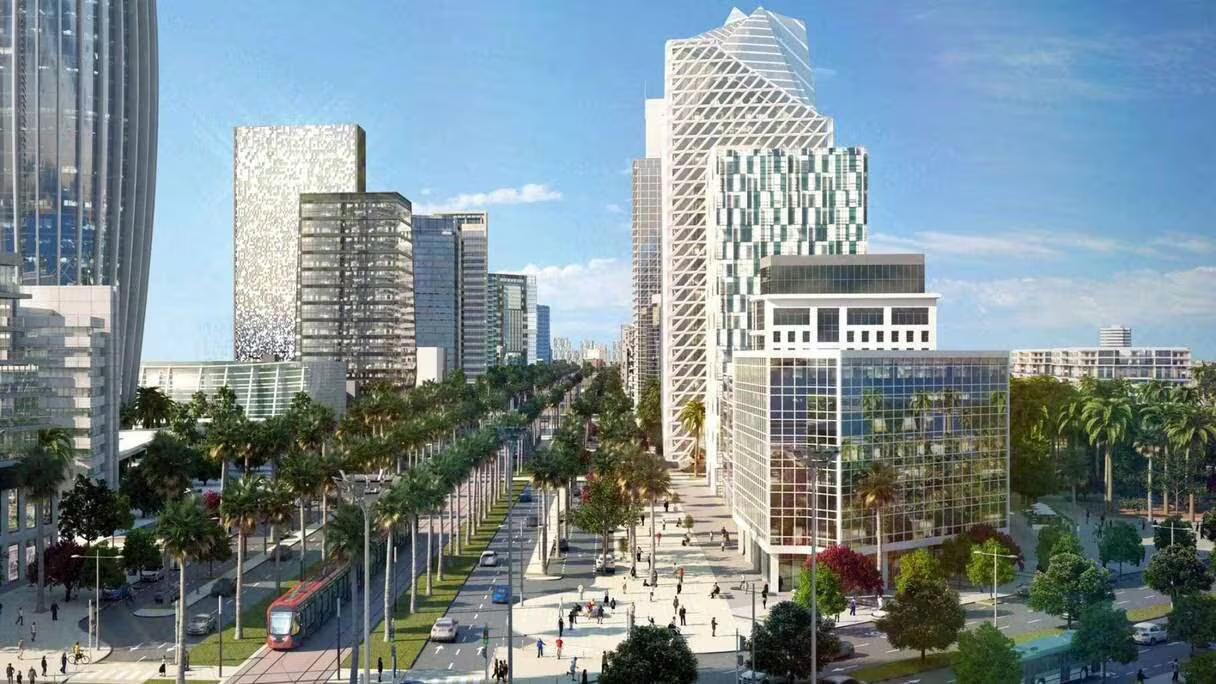
Casablanca is now the top African city in the 39th Global Financial Centres Index (GFCI), released by British think tank Z/Yen, Long Finance, and China Development Institute. The city ranks 49th out of 120 financial centres worldwide, moving up seven spots from last year.
New York remains first, followed by London and Hong Kong. In the Middle East and North Africa, Dubai leads at seventh globally, with Abu Dhabi and Doha next, and Casablanca fourth in the region.
The index looks at 147 factors, including data from the World Bank and OECD. Dubai and Tokyo moved into the top ten, replacing Chicago and Los Angeles, while Amsterdam entered the top twenty, pushing out Dublin. Most cities saw small drops overall, averaging 1.82 percent, with Latin America and the Caribbean losing the most. Still, 56 cities improved, including Cyprus (up 23), Madrid (up 19), and the Cayman Islands (up 18).
Casablanca also jumped 20 places in Fintech, ranking 50th worldwide. Hong Kong and Shenzhen top the Fintech list, while Baku and Bogotá are at the bottom.
Renat Bekturov, head of the Astana International Financial Centre, said the ranking shows how financial hubs adjust to global changes. He added that stability, predictability, and strong institutions are now vital for investors, and cities need to encourage innovation and international collaboration.
Casablanca Finance City (CFC), set up in 2010, is a big reason for the city’s rise. It offers tax breaks and simpler rules for international companies that want to manage their African business from Morocco.
The GFCI combines hard data on business, workforce, and infrastructure with surveys from thousands of finance professionals around the world.
Casablanca’s jump in Fintech comes as part of Morocco’s “Digital Morocco 2030” plan, which invests in digital banking and payments. The city wants to attract startups that can provide mobile banking to unbanked people across West and Central Africa.
The city leads in Africa but competes with Johannesburg and Mauritius. Its location between Europe and Sub-Saharan Africa, along with Morocco’s political stability, makes it an attractive gateway for global investors.


