

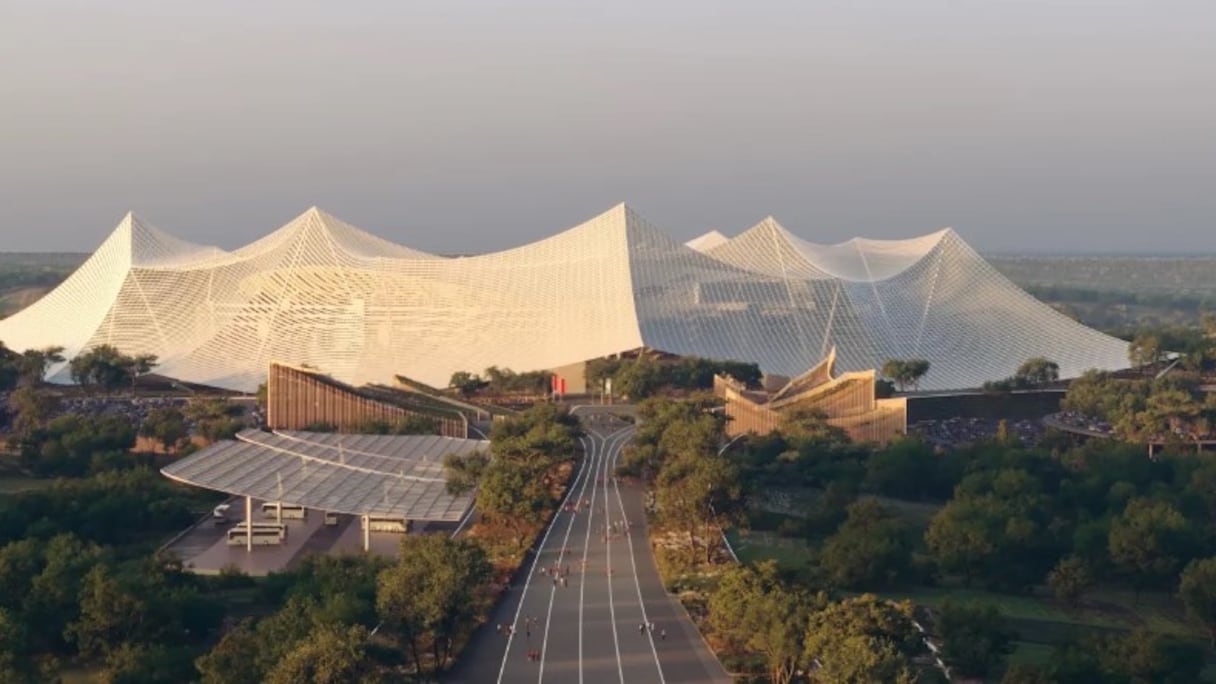
Two new tenders worth nearly MAD 370m ($37.3m) have been launched for the Grand Stade Hassan II in Benslimane. The contracts cover the stadium’s football pitch and seats. Together, they are worth MAD 369.98m, including tax. One tender, worth MAD 92.47m, covers the pitch. The work will use natural grass reinforced with synthetic fibres. The second tender is worth MAD 277.5m and covers the installation of seats for fans, media, VIPs and VVIPs. Both contracts must be completed within 14 months.
The pitch will use a hybrid grass system. Natural grass will be reinforced with synthetic fibres to make the surface more resistant to heavy use.
The pitch will also have underground drainage and ventilation systems. LED lighting will be used in areas that do not get enough sunlight.
A smart irrigation system will control watering. Sensors will monitor temperature, moisture and salinity.
The contractor will have to maintain the pitch for 24 months after the work is provisionally completed.
The provisional guarantee for this contract is MAD 1m.
Stadium seats
The second contract covers the supply and installation of seats across the stadium.
It also includes press tables and camera platforms. The work will include checking the position and numbering of the seats.
The contractor will have 14 months to complete the work.
Late work will result in a daily penalty equal to 0.1% of the original contract value. The penalty cannot exceed 8% of the contract value.
The provisional guarantee is MAD 4m.
Subcontracting will be limited to 50% of the contract value. The main work of supplying and installing the seats cannot be subcontracted.
The contractor will also have to give preference to Moroccan-made materials and products when they meet the required standards.
Up to 20% of jobs created by the project will have to go to workers from the local area.
A major World Cup venue
The Grand Stade Hassan II is being built in Benslimane and is planned to hold about 115,000 people.
The stadium is being designed by Populous and Moroccan architecture firm OUALALOU + CHOI.
The design is inspired by Moroccan moussems, with a large canopy planned to cover the stadium.
The venue is expected to play a major role in the 2030 FIFA World Cup, which will be hosted by Morocco, Spain and Portugal.
The stadium is also being considered as a possible venue for the World Cup final.
Other major stadiums in Rabat, Tangier, Agadir, Fez and Marrakech are also being upgraded ahead of the 2030 tournament and the Africa Cup of Nations.


