

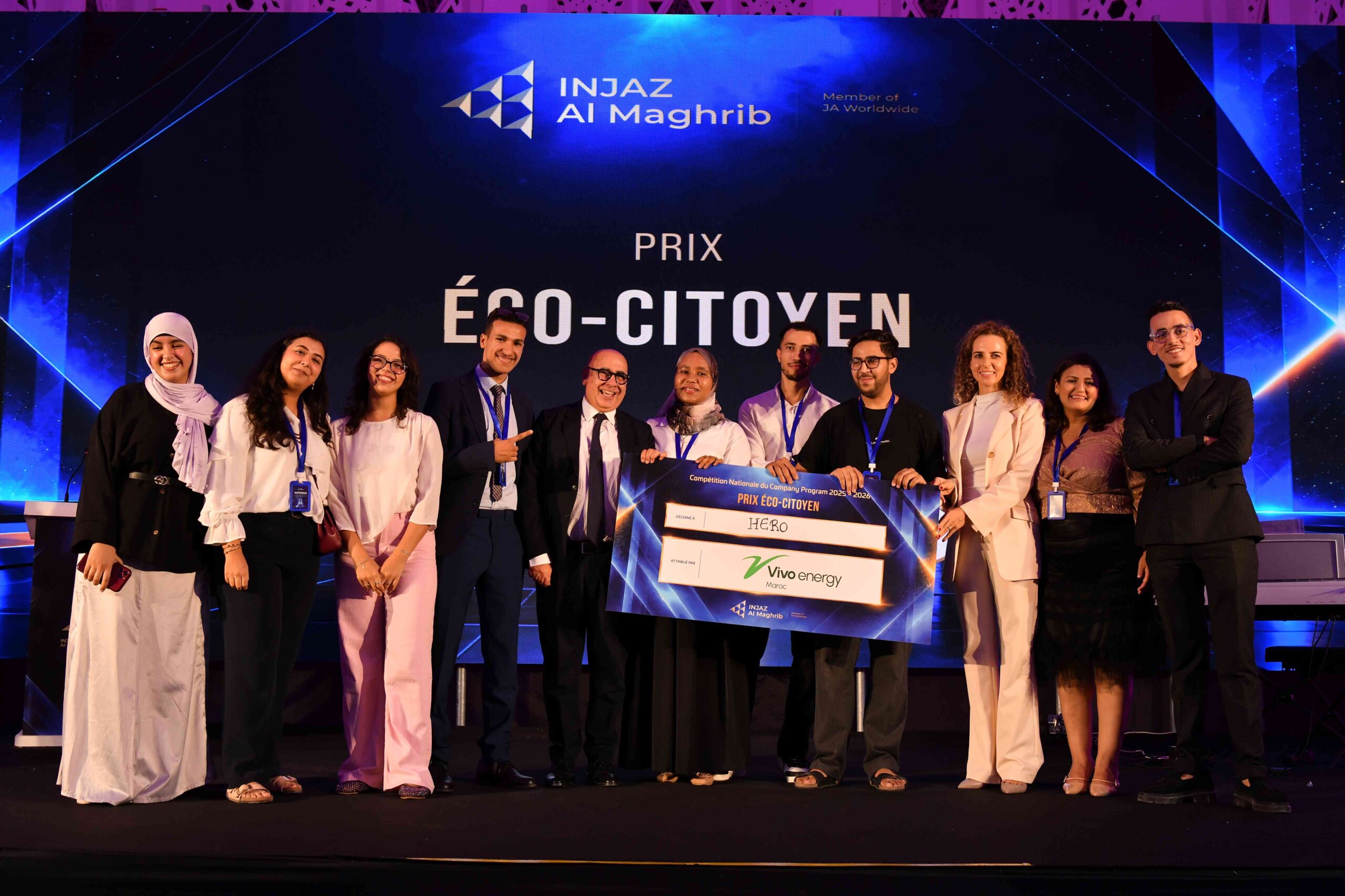
A group of 22 students in Casablanca has built a system that collects excess water from farms and sends it back for irrigation. The system, called HERO, stands for Hydro Environmental Resilience Optimisation. It won the Eco-Citizenship Award at the 2026 INJAZ Al-Maghrib Company Program. Vivo Energy Maroc gave the award.
The students are studying for a Master’s degree in Biotechnology and Quality Approach at the Faculty of Sciences Ben M’Sik, part of Hassan II University of Casablanca.
HERO uses pipes, a water storage tank, a pump and smart sensors. Solar power runs the sensors and pumping system.
The sensors check the condition of the soil. The system starts irrigation when the soil becomes too dry. It starts drainage when the soil has too much water. The excess water then goes into the storage tank and can be used again.
The students designed the system to reduce the amount of water used for farming and avoid losing water through excess irrigation. They also aim to reduce crop losses and irrigation costs.
The project comes as water resources face growing pressure after several years of drought. Agriculture accounts for about 87% of total water consumption in the country, according to figures used by the project.
That makes farming the main area for reducing water use. The sector also employs about 30% of the active workforce and more than 70% of workers in rural areas.
Water shortages have also pushed reservoir levels to very low levels in recent years, with national storage sometimes falling below 25-30% of capacity.
The system focuses on one part of the problem: water that is normally lost after irrigation. HERO collects that water instead of allowing it to leave the farming area.
The system can also help prevent waterlogging, which can damage crops and affect soil quality. Better control of irrigation can also help reduce the risk of soil salinisation.
Solar power gives the system an additional benefit. Farmers could use the system without depending entirely on the electricity grid.
The project fits with national efforts to improve water efficiency in farming. The National Drinking Water Supply and Irrigation Programme, known as PNAEPI, includes work on desalination, irrigation networks and local irrigation systems. The Génération Green 2020-2030 strategy also promotes more efficient water use, new farming technologies and more environmentally friendly agriculture.
Two Vivo Energy Maroc employees volunteered to mentor the students during the project.
The mentors helped the team review some of its decisions, organise its work and improve the way it presented the project. They also helped the students approach HERO as a business idea rather than only as an academic project.
The Eco-Citizenship Award is part of the INJAZ Al-Maghrib Company Program. The award supports student projects that include environmental issues in their business ideas, including challenges linked to water, energy and waste.
The wider programme gives students several months to create and manage a junior company. Students develop an idea, build a prototype, prepare a business plan and present their project in competitions. INJAZ Al-Maghrib is affiliated with Junior Achievement Worldwide and INJAZ Al-Arab.
Vivo Energy Maroc and INJAZ Al-Maghrib have worked together since 2009. The company uses a skills-sponsorship programme to involve employees in mentoring young people on entrepreneurship, project development and business skills.
Hind Mejjati Alami, Communications and CSR Director at Vivo Energy Maroc, said the project shows how young people can develop practical solutions to water conservation.
The next step for HERO is to prove that the system can work outside a student project. That means testing it on real farms, measuring how much water it can recover and checking the installation and maintenance costs.
The system also needs to show that the water savings and lower irrigation costs can justify the investment for farmers.
The project brings together smart sensors, solar power and water recycling in one irrigation system. Its main test will now be whether the idea can move from a university project to a system that farmers can use on a larger scale.


