

Morocco is seeing more Chinese investment turn into factories and industrial projects, with companies completing $2.8bn worth of projects in just 18 months, according to new figures. The amount, recorded between January 2025 and June 2026, is higher than the total value of Chinese projects completed during the previous eight and a half years.
Research group Rhodium Group says Chinese companies have completed projects worth $4.7bn in Morocco over the past decade, out of nearly $8bn announced.
The latest figures show that almost 60% of the completed investment came in the 18 months to June 2026.
Chinese companies completed projects worth $1.6bn in 2025, followed by another $1.2bn in the first six months of 2026.
The figures were shared by Armand Meyer, an analyst at Rhodium Group, with Türkiye Today on 15 November.
But China’s overall share of foreign investment in Morocco remains relatively small. Between 2017 and 2025, Chinese investment accounted for 4% of the total foreign direct investment received by the country, according to calculations by Thierry Pairault, an emeritus research director at France’s National Centre for Scientific Research (CNRS).
Volkswagen joins Chinese battery project
The automotive and battery industries account for many of the largest Chinese investment projects in Morocco.
One of the biggest is a battery factory planned by Chinese manufacturer Gotion High-Tech in Kenitra. The company signed an investment agreement with the Moroccan government in June 2024, committing 12.8bn dirhams (about $1.3bn) to the first phase of the project.
The first phase is designed to produce enough batteries to store 20 gigawatt-hours (GWh) of electricity each year. The wider project could eventually reach 100GWh of annual capacity, with total investment potentially reaching $6.5bn.
The first phase is expected to create about 2,300 direct jobs. The full project could generate up to 10,000 jobs.
Volkswagen announced in September 2026 that one of its subsidiaries would take a 49% stake in a joint venture with Gotion to build a factory producing cathode materials in Kenitra. Gotion will hold the remaining 51%.
Cathode materials are a key component of rechargeable batteries. The factory is expected to supply future battery production plants operated by Volkswagen in Valencia, Spain, and Šurany, Slovakia.
The deal has now entered a regulatory review. Morocco’s Competition Council said on 12 November that it had received formal notification of the transaction and invited interested third parties to submit comments by 23 November.
Volkswagen became Gotion’s largest shareholder after investing about €1.1bn in the Chinese company in 2021. It holds roughly a quarter of its shares.
Why Chinese companies are looking at Morocco
Morocco has several advantages for companies seeking to manufacture battery components and supply European carmakers.
The country has one of Africa’s largest automotive industries, with factories operated by Renault and Stellantis. Its vehicle assembly capacity exceeds 700,000 cars a year, and the government aims to increase that figure to one million.
Morocco also holds about 70% of the world’s known phosphate rock reserves, a key resource for producing lithium iron phosphate (LFP) batteries. The state-owned OCP Group manages the country’s phosphate industry.
Its trade agreement with the European Union gives Moroccan-made industrial products access to the European market without customs duties. The country also has a free trade agreement with the United States.
These advantages have become more important since the EU imposed additional duties on electric vehicles imported directly from China in late 2024. The measures included countervailing duties of up to 35.3%, on top of the standard 10% tariff.
Producing battery materials in Morocco could help Chinese suppliers serve European manufacturers through a different supply chain.
Gotion is not the only Chinese company building a presence in the sector. CNGR Advanced Material has partnered with Moroccan investment group Al Mada on a planned $2bn battery materials complex at Jorf Lasfar. BTR New Material Group is developing a cathode materials factory near Tangier Tech, while Tinci Materials and Hailiang are also involved in projects linked to battery production.
Billions announced, but not all delivered
The latest figures show that a significant part of the Chinese investment pipeline has yet to become operational.
Of the nearly $8bn in projects announced over the past decade, $4.7bn had been completed by mid-2026. That leaves about $3.3bn in projects still pending or under construction.
Gotion’s first-phase investment of about $1.3bn alone represents roughly 39% of that remaining amount.
The gap between announced investment and completed projects has been a feature of Chinese investment in Morocco since the two countries established a strategic partnership in 2016.
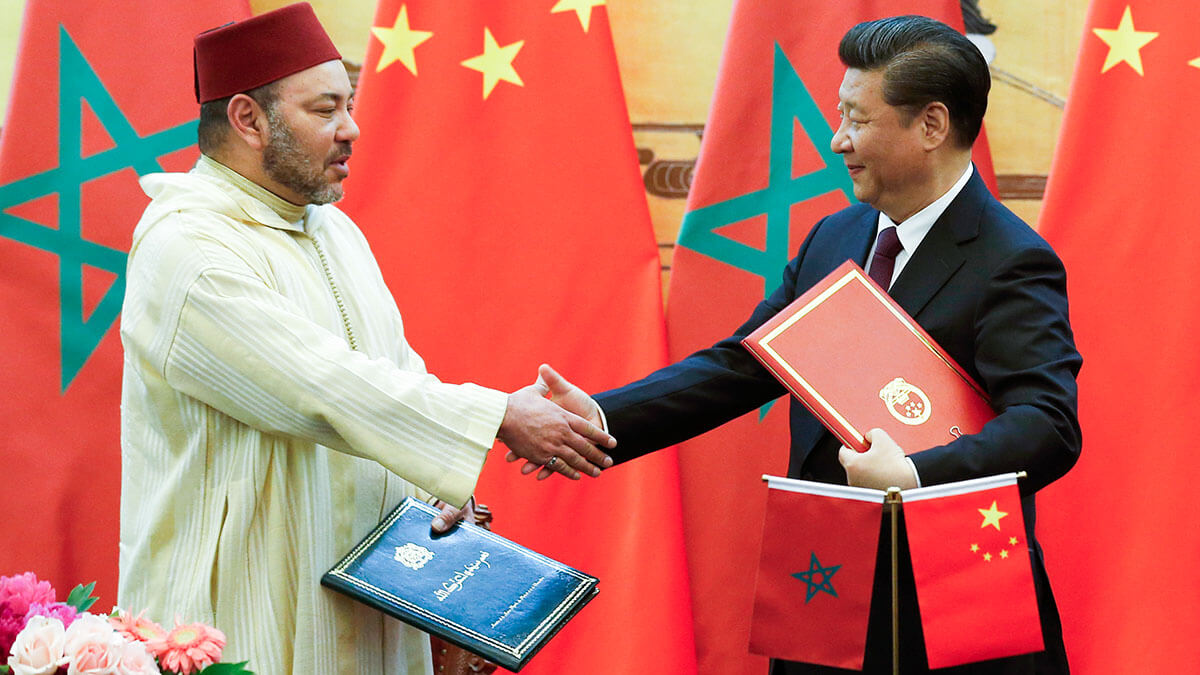
King Mohammed VI’s visit to Beijing in May that year opened the way for closer economic ties. Morocco joined China’s Belt and Road Initiative in 2017 and signed an implementation plan in January 2022.
Some early projects took years to move forward. The Tangier Tech industrial city, announced in 2017, went through several changes in partners and management before gaining momentum.
The recent increase in completed projects suggests that Chinese investment is now moving more quickly from announcements to construction and production.
The scale of that shift is clear in the figures: before 2025, completed projects averaged about $224m a year. The annual average rose to roughly $1.87bn between January 2025 and June 2026.
If the first half of 2026 were repeated throughout the year, completions would reach $2.4bn, 50% more than the total recorded in 2025.
A growing link between Morocco and European factories
The Kenitra project is part of a wider effort to connect Moroccan industrial production with European battery and car factories.
Volkswagen is developing battery production sites in Germany, Spain and Slovakia. Its Valencia factory is designed to reach 40GWh of annual capacity, with the possibility of expanding to 60GWh. The first phase of the Slovak plant is planned to reach 20GWh.
Producing cathode materials in Morocco would place an important stage of battery manufacturing closer to these European facilities.
The strategy also reflects a division of roles between countries. Hungary and Spain are attracting large battery-cell and vehicle assembly plants, while Morocco is seeking to develop the production of battery materials and chemical components.
Other countries are competing for the same investment. Hungary has attracted major projects from China’s CATL and BYD, while Spain is developing battery and vehicle manufacturing projects with Chinese partners. Indonesia, meanwhile, has focused on nickel mining and processing for batteries.
Morocco’s appeal lies in its phosphate resources, industrial base and access to European markets. The challenge will be turning the growing list of investment commitments into factories, jobs and sustained production.


