

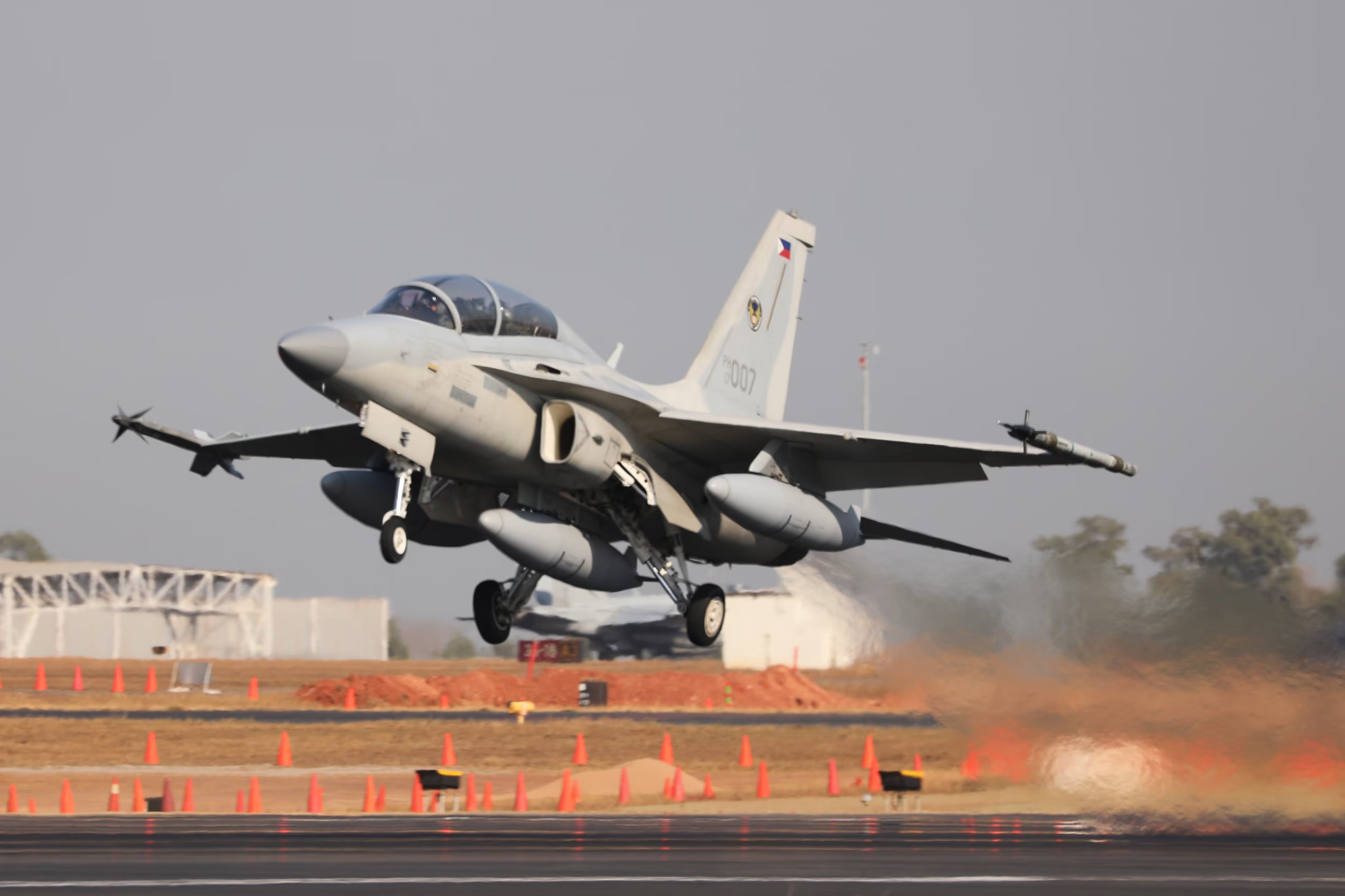
South Korean aircraft maker Korea Aerospace Industries (KAI) is using the Marrakech Air Show to promote its FA-50 fighter jet as a possible replacement for the Royal Moroccan Air Force’s ageing Alpha Jets. KAI has a dedicated space for the FA-50 at the eighth Marrakech Air Show, which opened on Wednesday at the Royal Air Force base in Marrakech and runs until Saturday, 10 October.
KAI is the only South Korean defence company taking part in the show.
The FA-50 is a supersonic, single-engine, two-seat aircraft. KAI developed it from the T-50 Golden Eagle trainer with US company Lockheed Martin. The aircraft can train fighter pilots and carry out light combat missions.
KAI is using its sales in Poland, Malaysia and the Philippines to support its pitch. The company is also showing its KF-21 Boramae fighter jet, Marine Attack Helicopter (MAH) and MIRON armed helicopter.
The company plans to hold talks with government and military officials from Morocco, Qatar, the United Arab Emirates and Saudi Arabia during the show.
Moroccan officials are looking at options to replace the Alpha Jet E aircraft that have served the Royal Moroccan Air Force for more than 40 years.
The air force bought 24 Alpha Jet E aircraft between 1979 and 1981. The jets operate from Meknès and have been used for training and light-attack missions.
The FA-50 has one major advantage in the Moroccan competition: its links to the F-16.
The F-16 is the main combat aircraft in the Royal Moroccan Air Force. The country is upgrading 23 F-16s to the F-16V Block 72 standard and is waiting for 24 new F-16 Block 72 aircraft.
The FA-50 and F-16 share parts of their avionics, flight-control systems and weapons systems. The FA-50 was developed with Lockheed Martin, the US company behind the F-16 programme.
The relationship could make it easier to train pilots moving towards the F-16. The aircraft also offers a lower-cost platform for training and light combat missions.
Interest in the FA-50 became more visible in February at the World Defense Show in Riyadh. A delegation led by Abdellatif Loudiyi, the minister delegate for national defence administration, was shown a scale model of the aircraft.
KAI has now brought the aircraft directly to Morocco as it seeks to move from early discussions to a possible sale.
The FA-50 faces several competitors in the trainer programme.
Italy’s Leonardo offers the M-346 Master, a twin-engine advanced jet trainer with virtual tactical training systems.
The Boeing-Saab T-7A Red Hawk was developed for US Air Force pilot training and is designed to use software and systems suited to modern fighter aircraft.
Turkey’s TAI Hürjet is a single-engine supersonic trainer and light-attack aircraft that is entering production and flight testing.
KAI can point to a growing list of FA-50 customers.
Poland signed a $3bn deal for 48 FA-50 aircraft in September 2022. The value is nearly 28bn dirhams. Poland received 12 aircraft in a transition configuration. The remaining 36 FA-50PL aircraft are being adapted to the Polish Air Force and are due for delivery between 2025 and 2028. These aircraft are planned to include AESA radar.
Malaysia signed a $920m deal, worth about 8.5bn dirhams, for 18 FA-50M Block 20 aircraft in February 2023. The first six aircraft are due to arrive by late 2026.
The Philippines ordered another 12 FA-50 aircraft for about $700m, or around 6.4bn dirhams, in June 2025. The new order brings the Philippine fleet to 24 aircraft. KAI expects to complete deliveries by 2030.
“The FA-50 has proven itself in the Asian market, and this new Philippine order, built on more than a decade of operational trust, represents a very encouraging step forward,” KAI President Kang Goo-young said when the Philippine deal was signed.
Indonesia, Iraq and Thailand also operate aircraft from the T-50 family.
Senegal is KAI’s only customer in Africa. It has bought four KT-1 turboprop basic trainers.
The T-50 and FA-50 use the same basic airframe, developed by KAI and Lockheed Martin. The aircraft is about 80% the size of an F-16.
The T-50 is mainly an advanced jet trainer and lead-in fighter trainer. The FA-50 is the combat version and adds radar, tactical datalinks, self-defence systems, an internal gun and a wider range of weapons.
Both aircraft are 13.14 metres long, have a wingspan of 9.45 metres and stand 4.94 metres high.
The T-50 has an empty weight of about 6,441kg. The FA-50 weighs about 6,470kg when empty.
Both aircraft use one General Electric F404-GE-102 turbofan. The engine produces 11,000lb of dry thrust and 17,700lb with afterburner.
Both aircraft can reach Mach 1.5, or about 1,840km/h. Their service ceiling ranges from 14,630 metres to 16,764 metres, or 48,000ft to 55,000ft.
The T-50 has a maximum take-off weight of 13,472kg. The FA-50 has a maximum take-off weight of between 12,300kg and 13,472kg, depending on the version.
The T-50 can carry about 2,500kg of training weapons and pods. The FA-50 can carry up to 4,500kg across seven hardpoints.
Both aircraft have a triple-redundant digital fly-by-wire flight-control system. Their cockpits have HOTAS controls, a wide-angle head-up display and two 5-by-5-inch multifunction displays.
The baseline FA-50 uses the IAI EL/M-2032 pulse-Doppler fire-control radar. Newer Block 20 versions can use AESA radar, including Raytheon’s PhantomStrike system.
The FA-50 also has radar-warning receivers, chaff and flare countermeasures and Link 16 tactical datalinks.
Its weapons include AIM-9L/M/X Sidewinder air-to-air missiles. Block 20 versions have an integration path for AIM-120 AMRAAM missiles.
Air-to-ground weapons include JDAM guided bombs, AGM-65 Maverick missiles and GBU-12 Paveway II laser-guided bombs.
Modernised versions can also carry stand-off weapons such as the KEPD 350K-2 or light air-launched cruise missiles. The aircraft can use Sniper Advanced Targeting Pods for precision strikes.
KAI is also using the Marrakech show to promote other aircraft.
The KF-21 Boramae is a twin-engine 4.5-generation fighter. KAI has started serial production and is presenting it to defence officials from countries including Saudi Arabia and the UAE as a possible future high-end fighter.
The company is also displaying the Marine Attack Helicopter and MIRON armed helicopter.
The sales effort comes as Morocco develops its aerospace industry. More than 150 aerospace companies operate in the country and supply global manufacturers such as Airbus and Safran.
KAI’s discussions with Moroccan authorities are expected to cover more than aircraft sales. Possible areas include industrial offset agreements, maintenance, repair and overhaul facilities and technical support.
The Marrakech Air Show is held every two years under the High Patronage of King Mohammed VI. The event is organised by the Ministry of Industry and Trade, the National Defense Administration and MEDZ, a subsidiary of the Caisse de Dépôt et de Gestion.
Organisers expect more than 15,000 visitors and about 40 official delegations.
The FA-50 campaign gives KAI a chance to compete for the replacement of the Alpha Jet fleet while also seeking a wider defence and industrial presence in North Africa.


