

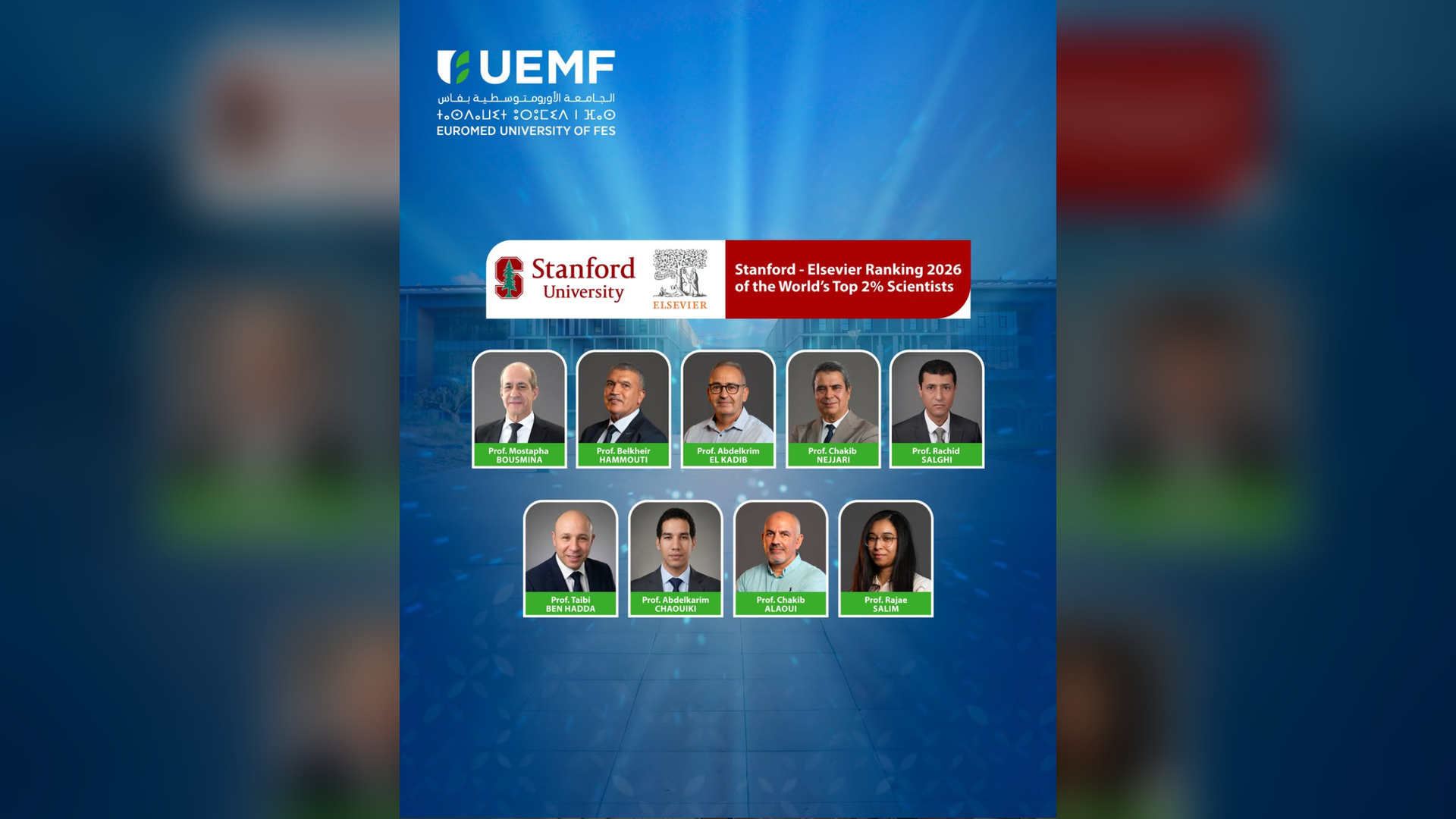
Nine researchers at Euromed University of Fes have been named among the world’s top 2% most influential scientists in the 2026 Stanford-Elsevier ranking, up from four two years ago. The list recognises researchers whose scientific work has had a strong impact, based on data from Elsevier’s Scopus database, which tracks research publications and citations.
The nine researchers are university president Mostapha Bousmina, Belkheir Hammouti, Abdelkrim El Kadib, Chakib Nejjari, Rachid Salghi, Taibi Ben Hadda, Abdelkarim Chaouiki, Chakib Alaoui and Rajae Salim.
The university’s numbers have grown steadily, from four researchers in the ranking in 2024 to eight in 2025 and nine in 2026.
UEMF says the increase reflects its efforts to expand scientific research, encourage innovation and raise its international profile.
The researchers work across several fields, including chemistry, materials science, public health, environmental studies and renewable energy.
Bousmina is a physical chemist who specialises in nanomaterials and polymer physics. Hammouti researches corrosion prevention and green chemistry, while El Kadib focuses on inorganic materials, hybrid networks and green catalysis.
Nejjari specialises in epidemiology and public health. Salghi works on environmental chemistry, including water treatment and wastewater recycling, while Ben Hadda researches bio-organic and medicinal chemistry.
Chaouiki focuses on materials science and anti-corrosion materials. Alaoui works on renewable energy systems and smart grids, while Salim specialises in advanced chemical processes and sustainability.
The Stanford-Elsevier ranking assesses researchers across 22 scientific fields and 174 subfields. Its scoring system considers how often their work is cited, their h-index, which measures both publication output and citations, and their contribution to jointly authored research.
The ranking includes measures of both a researcher’s impact over their career and their performance in a single year.
UEMF says its research strategy centres on projects that bring together different academic disciplines and turn scientific findings into practical solutions for society and the economy.
Its priority areas include health, agriculture, sustainability and artificial intelligence, as well as smart cities, transport, cultural heritage and the preservation of cultures.
The university also works with academics, researchers, businesses, local authorities and civil society groups. It aims to link its research to national priorities and challenges shared by countries in the Euro-Mediterranean and African regions.
The institution says the international recognition highlights the expertise of Moroccan researchers and their contribution to scientific research.


