

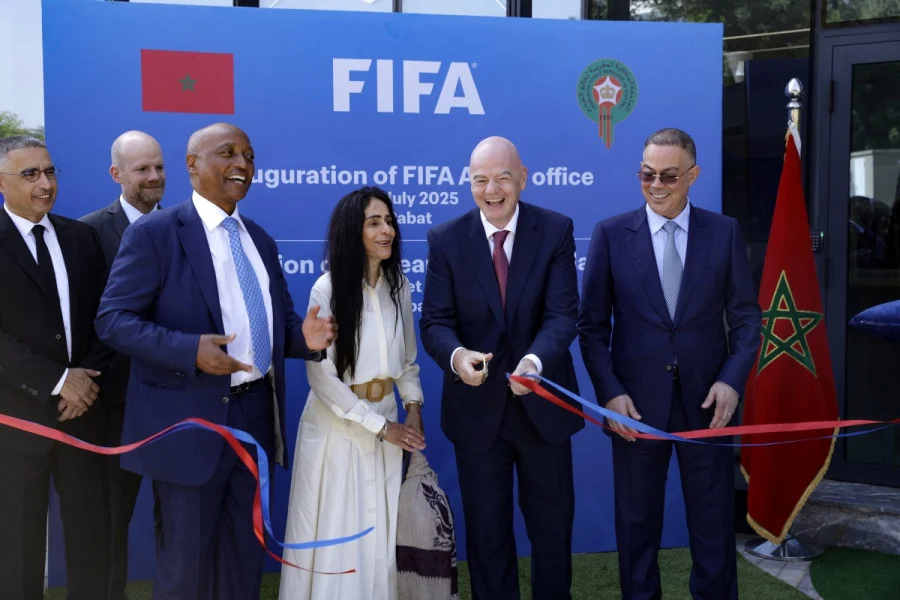
Gianni Infantino heads to Rabat on 18 March for a FIFA Congress that could shape the future of world football. After years of strong support, the FIFA president is now facing growing opposition over his plans for the organisation and questions about who could replace him.
The biggest issue is Infantino’s plan to bring private equity investors into FIFA’s commercial business. The proposal would allow outside investors to help generate money from future FIFA Club World Cups, World Cups, broadcasting rights and other commercial assets.
FIFA is a non-profit organisation based in Switzerland, but it manages billions of dollars in football income. It made a record $7.5 billion during the 2019-2022 financial cycle, mainly because of the Qatar World Cup. It expects to earn $11 billion between 2023 and 2026, helped by the expanded 48-team 2026 World Cup in Canada, Mexico and the United States, and the new 32-team FIFA Club World Cup.
Several football bodies oppose the plan. UEFA, the Asian Football Confederation (AFC) and CONCACAF have all raised concerns about transparency, decision-making and how money would be shared. Football associations in Serbia, Sweden and Wales have also withdrawn their support for Infantino.
Infantino became FIFA president in 2016 after the corruption scandal that ended Sepp Blatter’s time in office. He is seeking another term covering 2027 to 2031.
FIFA rules allow a president to serve three four-year terms. FIFA’s Council decided that Infantino’s first period in office, from 2016 to 2019, completed Blatter’s term and therefore does not count towards the limit. That means he can stay in office until 2031.
No one has officially entered the race, but several senior football figures have been mentioned as possible candidates.
They include Victor Montagliani, president of CONCACAF and a FIFA vice-president; Aleksander Čeferin, president of UEFA; Sheikh Salman bin Ibrahim Al Khalifa, president of the AFC; Nasser Al-Khelaïfi, president of Paris Saint-Germain and chairman of the European Club Association and BeIN Media Group; and Lise Klaveness, president of the Norwegian Football Federation, who has pushed for stronger governance, transparency and human rights within FIFA.
Every one of FIFA’s 211 member associations has one vote, regardless of its size or football history.
Europe has 55 votes, Africa 54, Asia 47, CONCACAF 35, Oceania 11 and South America 10. Together, Africa and Asia control 101 votes, making both regions crucial in the election.
The result also matters for Morocco.
Infantino has built a close relationship with Fouzi Lekjaa, president of the Royal Moroccan Football Federation (FRMF) and Minister Delegate in charge of the Budget. He has often praised the Mohammed VI Football Complex in Salé, which cost more than $63 million to build. Rabat is also home to FIFA’s regional office for Africa.
The election comes as Morocco, Spain and Portugal prepare to host the 2030 FIFA World Cup. Uruguay, Argentina and Paraguay will stage the opening centenary matches.
One of the biggest decisions still to be made is where the final will be played.
The Grand Stade Hassan II near Casablanca is one of the leading candidates. The stadium is being built in El Mansouria and is expected to hold around 115,000 fans, making it the world’s largest football stadium. It is designed by Populous and Oualalou + Choi and is expected to cost around 5 billion dirhams ($500 million).
Its main rivals are Santiago Bernabéu in Madrid, which recently completed a renovation costing more than $1 billion and has a capacity of about 85,000, and Spotify Camp Nou in Barcelona, where a $1.6 billion Espai Barça redevelopment will increase capacity to around 105,000.
The World Cup hosts will not change, regardless of who wins the FIFA election. However, a new president backed by UEFA could influence discussions when FIFA’s Council chooses the stadium for the 2030 World Cup final.


