

The 2025 Africa Cup of Nations final, held on January 18, 2026, in Rabat, took a dramatic and unprecedented turn that may soon lead to major disciplinary consequences from the Confederation of African Football (CAF). While Senegal secured a 1-0 victory over Morocco in extra time, the outcome itself could now be thrown into question following a series of extraordinary events that unfolded late in the match.
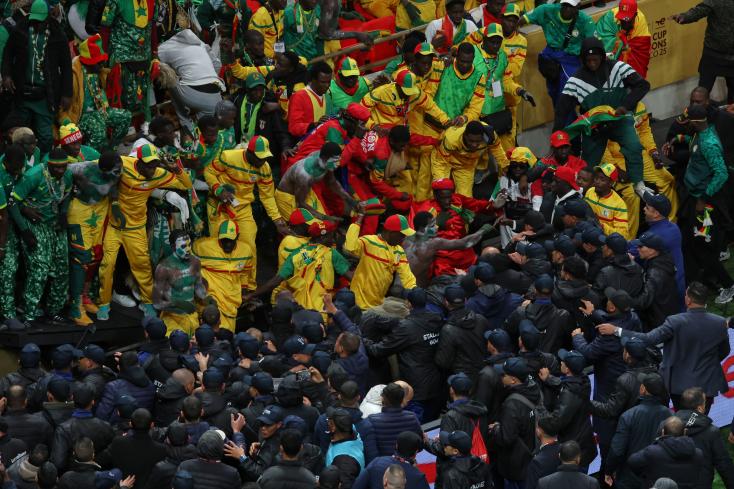
The controversy began during stoppage time in regular play, when Congolese referee Jean-Jacques Ndala Ngambo awarded a penalty to Morocco after consulting the VAR. The decision triggered immediate outrage from the Senegalese side, prompting all their players to walk off the pitch in protest. The game was halted for over fifteen minutes as chaos erupted—supporters attempted to invade the field, several security staff were attacked, and the atmosphere grew increasingly volatile. It wasn’t until Senegal captain Sadio Mané intervened and urged his teammates to return that play eventually resumed.
At the heart of the controversy lies Senegal’s temporary withdrawal, a move that may carry serious consequences. According to CAF’s disciplinary code, specifically Article 148.1, leaving the field without the referee’s permission—regardless of the duration—is treated as a formal abandonment. This automatically triggers a forfeit and a minimum fine of $20,000. Both African and international case law have consistently upheld this rule: once a team steps off the field, the infraction is considered committed, even if the match later resumes.
The regulations governing the tournament go even further. They state that if a team voluntarily disrupts play, it loses the match by default, with a recorded score of 3-0 unless already trailing. If applied to a final, such a ruling could not only invalidate Senegal’s win but also strip the team of its title. Under Article 80, more severe penalties could follow—including a suspension of the Senegalese Football Federation from the next two editions of the tournament, should CAF classify the incident as a particularly serious offense.
At the same time, the violence in the stands adds another layer of accountability. CAF’s Article 83.1 holds national federations fully responsible for the behavior of their supporters, regardless of whether they played a direct role in the disturbances. With injuries reported among security personnel and property damage in the stadium, the consequences could escalate. Under Articles 151.2 and 153, the fine could rise as high as $300,000, and sporting sanctions might also be imposed.
Historical precedents lend weight to potential disciplinary action. In 1989, the infamous Rojas incident helped establish the principle that leaving the field constitutes a definitive abandonment. More recently, the Court of Arbitration for Sport (CAS) reaffirmed this stance after the controversial 2019 Champions League final between Wydad and Espérance, ruling that no team can refuse to continue a match over disputes with officiating. The case emphasized the primacy of maintaining “sporting public order.”
The Senegalese Football Federation has requested a delay in the hearing, now scheduled for January 28, and is expected to argue that the match was never formally stopped by the referee, that play eventually resumed, and that some players never fully left the pitch. However, CAF’s rules make no allowance for such nuances—the infraction is recognized regardless of an official stoppage or the length of the disruption.
Meanwhile, Morocco’s football federation has announced plans to refer the matter to both CAF and FIFA. Still, under standard protocol, only CAF has the authority to issue a ruling on this specific case.
The decision that follows may set a defining precedent. CAF now faces a critical choice: apply its regulations to the letter, potentially rewriting the result of one of Africa’s biggest football matches, or take a more political route by opting for symbolic sanctions and preserving the final scoreline. Whatever the outcome, this final is certain to go down as one of the most controversial and consequential moments in the history of African football.


