The German government has given official support to a plan to bring renewable electricity from Morocco to Germany through a 4,800km undersea cable.
Germany’s Ministry of Economics and Energy said it supports the Sila Atlantik project, which would send solar and wind power from Morocco to Germany using high-voltage cables under the sea. In a letter to Morocco’s investment minister, Karim Zidane, state secretary Frank Wetzel said Germany welcomed the project and highlighted its “ambitions and potential”.
Project leaders say talks with the Moroccan government are already underway. “We are seeing growing interest in Sila Atlantik,” said Roman Dudenhausen, head of Conenergy and one of the project’s founders. He said support from the German government and companies had been “very helpful”.
If built, the project would include up to 15 gigawatts of wind and solar plants in Morocco. It would send up to 26 terawatt hours of electricity to Germany each year, equal to about 5% of the country’s total power use. Developers say this could replace the output of three large fossil fuel power stations.
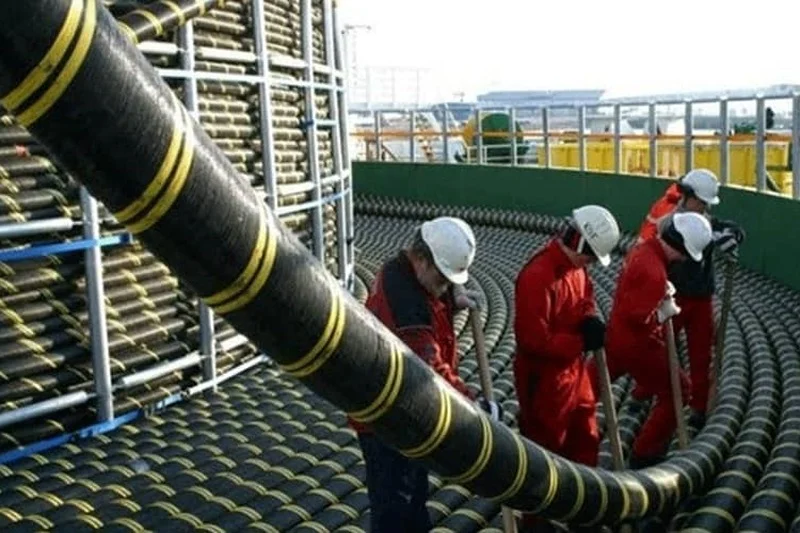
Electricity would be carried by two high-voltage direct current cables laid under the sea. The route would run along the coasts of Portugal, France, Belgium and the Netherlands before reaching Germany. Large battery systems in Morocco would allow power to be supplied for more than 20 hours a day.
The total cost of the project is estimated at between €30bn and €40bn.
Major German energy firms, including E.ON and Uniper, have shown interest. Deutsche Bahn, Germany’s state railway and the country’s largest electricity user, has also said it could be a customer. In a letter to the ministry, the company said solar and wind power from Morocco would be an “attractive supply option”. About 70% of Deutsche Bahn’s electricity already comes from renewables, and it aims to use only green power by 2038.
Sila Atlantik follows the failure of a similar plan to link Morocco to the UK, which was dropped in 2025 after delays by the British government. Supporters say much lower renewable energy costs and better cable technology now make the Germany project more realistic than earlier plans such as Desertec in the 2000s.
The project builds on a long energy partnership between Morocco and Germany that began in 2012. Germany is looking for new power sources as it moves away from coal and Russian gas.
There are still major challenges. The project needs approval from several European countries whose waters the cable would cross. There are also shortages of undersea cables and wind turbines worldwide. To deal with this, developers are considering building cable factories in Morocco and Germany.
Partial operation is planned for the mid-2030s, with full capacity expected close to 2040, in line with Germany’s plan to shut down its last coal power plants.