

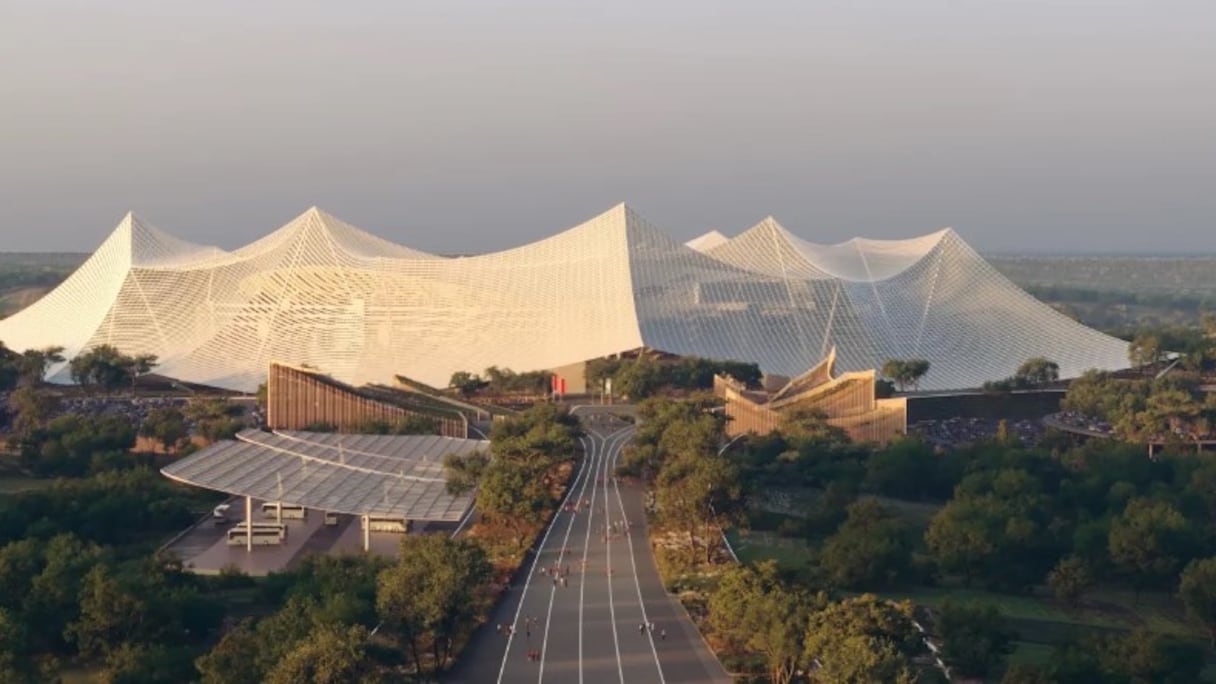
Work on the Grand Stade Hassan II in Benslimane has entered a new phase with a 2.7 billion dirham contract for the roads, utilities and public spaces around the stadium. The contract has been awarded to the CMS-GTR consortium. It will take 18 months to complete and covers a wide range of work needed to make the area around the stadium ready for large crowds, vehicles and services.
The stadium is being built ahead of the 2030 FIFA World Cup, which will be co-hosted by Morocco, Spain and Portugal. It is planned to seat 115,000 people, which would make it the largest football stadium in the world.
The stadium is located on the outskirts of Casablanca and is at the centre of a 100-hectare sports and entertainment complex.
The CMS-GTR contract covers the construction of internal roads, entrances and exits, junctions, service roads, squares, pedestrian areas and open spaces.
It also includes ramps, retaining walls, support structures, stairs, underground channels, technical corridors, inspection chambers and cable boxes. These structures will carry different networks and allow for future maintenance.
A major part of the work will focus on water management. The consortium will build systems to collect, retain, drain and treat rainwater and wastewater. The works will include drains, channels, inspection chambers and other water equipment.
The stadium will also be connected to external drinking water, electricity and telecommunications networks. The contract includes fibre-optic and internet connections, as well as high- and low-voltage electrical networks and related equipment.
The project is designed to handle tens of thousands of people moving around the stadium on match days.
Fences, barriers, gates, crossing points and access-control equipment will be installed. Traffic routes will be separated for spectators, service vehicles and technical teams. Security systems will also be put in place.
The work will cover the treatment and finishing of open areas, including pavements, pedestrian paths, technical routes, squares and other surfaces.
Landscaping is also part of the contract. It includes planting trees, creating green spaces and installing irrigation systems.
The consortium will supply and install seats, barriers, poles, handrails, protective equipment and fixed furniture. It will also carry out architectural cladding, decorative work and finishes around the stadium.
The contract does not end when construction is finished. CMS-GTR will test the equipment and networks, make adjustments and commission the systems before handover. The different systems must work together before the site is accepted.
The 2.7 billion dirham contract covers only the exterior infrastructure and landscaping. The stadium itself is being delivered through several specialised contracts, including major civil engineering works, fluid networks, electrical systems, roofing and facades.
Earlier projections put the stadium construction cost at around 5 billion dirhams. The combined value of the different specialised contracts reflects the wider scale of the project and the infrastructure needed around the venue.
The 18-month programme will run alongside work by other companies and consortia. This will require coordination between the teams working on the structure, roof, facades, electrical equipment and fluid networks.
The wider site is planned as a major sports and entertainment complex. It will include a 25,000-capacity athletics stadium, an Olympic-sized swimming pool, a convention and exhibition centre, shopping areas, hotels and large green spaces.
The stadium was designed by French architecture practice Oualalou+Choi and stadium specialist Populous. Its design takes inspiration from traditional Moroccan moussem gathering tents.
The wider infrastructure programme also includes improvements to access roads, highway interchanges, service lanes and internal parking routes.
The site will require large stormwater retention systems, wastewater treatment facilities and high-voltage power networks. The infrastructure is being designed to handle the large increase in people and services expected on match days.
The final stage will include full testing of the stadium’s external systems and their connections before the venue is handed over for use.


