

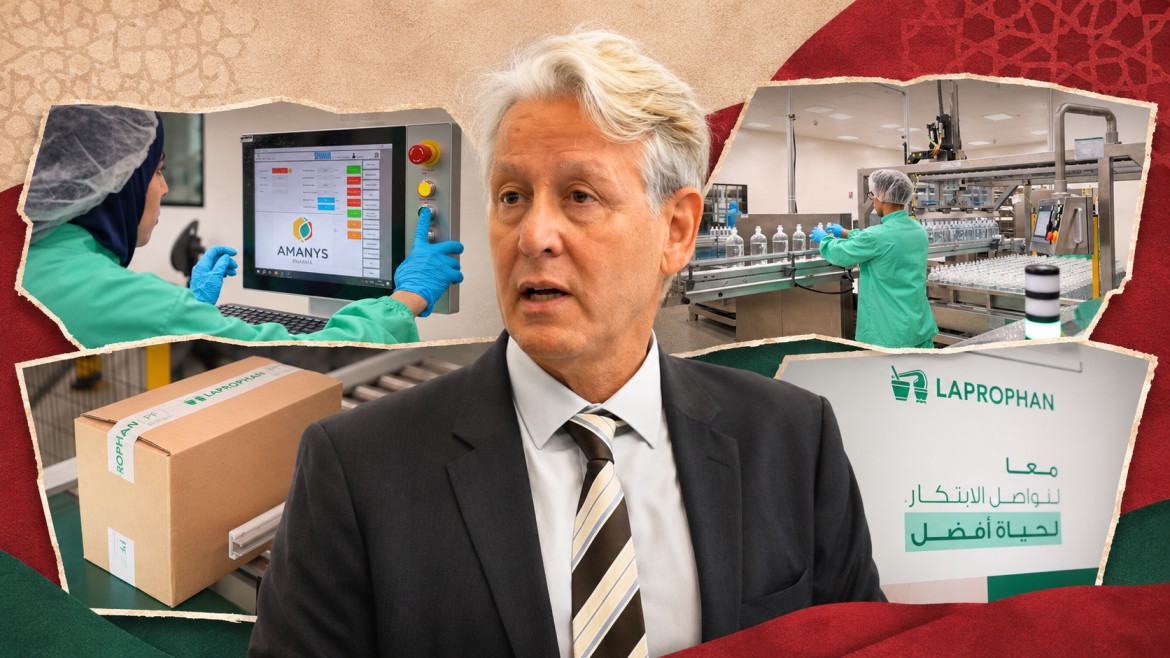
Hospitals and patients could see more medicines produced locally as Moroccan pharmaceutical group Laprophan prepares to build a new factory for injectable drugs near Rabat, in a 374m dirham investment. The plant, which will be built in Aïn El Aouda, is expected to start operating in 2027 and produce up to 30 million units a year. Its products will be supplied in bottles of 100ml, 250ml and 500ml, commonly used in hospital treatment.
The project is part of a wider 431m dirham investment programme covering production facilities, quality control equipment and digital systems. Laprophan announced the details as it prepared to list on the Casablanca Stock Exchange, with the subscription period for its initial public offering due to close on 17 November.
Mohammed Squalli Houssaini, industrial director and responsible pharmacist at Laprophan subsidiary Amanys Pharma, presented the project on 11 November.
The new factory will have 18,000 sq m of built space on a 62,000 sq m site, which it will share with an existing antibiotics plant. Its facilities will include 5,400 sq m for production, 1,100 sq m for quality control laboratories and storage space for about 7,000 pallets.
Automated production lines will prepare containers, fill them with medicines, sterilise the products, inspect them and package them. The factory is being designed to meet European Good Manufacturing Practice standards, which set rules for the safe and consistent production of medicines.
Separate routes will be used for workers, raw materials and finished products to reduce the risk of contamination. Monitoring systems will also track production conditions and technical parameters.
The site will also increase its production of beta-lactam antibiotics, a family of medicines that includes penicillins and cephalosporins. Annual capacity is expected to rise from 15 million to about 25 million units by 2027, an increase of nearly 67%.
Together, the two facilities will be able to produce up to 55 million units a year: 30 million injectable medicines and 25 million antibiotic units.
Moving production from Casablanca
Laprophan also plans to move its existing injectable medicine production from Casablanca to Aïn El Aouda by the first quarter of 2029.
The company has set aside 26m dirhams for the transfer and expansion of the operations involved.
A further 20m dirhams will be spent on increasing production capacity and refurbishing Laprophan and Amanys facilities. The programme includes another 8m dirhams for quality control equipment and 3m dirhams to upgrade IT systems and digitise industrial management.
The 374m dirham factory represents the largest part of the programme, accounting for nearly 87% of the total investment.
Building on the Amanys acquisition
The expansion follows Laprophan’s acquisition of Amanys Pharma in March 2024 through the holding company AIF Pharma.
The deal gave Laprophan more than 350 additional marketing authorisations, allowing it to expand its hospital medicines portfolio in anti-infective treatments, intensive care, haematology and specialised oncology.
Amanys operates in the import, distribution and export of medicines. Its partnerships include GSK, with which it works on beta-lactam production, as well as Amgen and Octapharma, whose specialised treatments it distributes and promotes.
The subsidiary also has an international presence through two companies. Amanys Pharma India Private Limited is involved in procurement and pharmaceutical development, while its Dubai-based entity supports commercial activities and international distribution.
These operations are intended to help the group expand its business abroad, particularly in African markets.
A group with an international footprint
Laprophan operates four production sites in Morocco and Switzerland, covering nearly 76,500 sq m of built area. The group employs about 1,450 people and holds more than 1,300 marketing authorisations across 15 therapeutic areas.
Its medicines are sold, either directly or through distributors, in more than 50 countries.
Founded in Casablanca in 1949 by Abderrahim Bennis, Laprophan is led by Farid Bennis. The company is one of the country’s oldest pharmaceutical manufacturers.
A consortium led by private equity firm Mediterrania Capital Partners acquired a significant minority stake in Laprophan in 2023. The investors also included European development finance institutions Proparco, FMO and DEG. Their investment was intended to support acquisitions, international expansion and the group’s growth plans.
Strengthening local pharmaceutical production
The expansion comes as Morocco seeks to strengthen its domestic pharmaceutical industry and reduce reliance on imported medicines.
The country’s pharmaceutical market is estimated to be worth between 15bn and 16bn dirhams a year, making it Africa’s second-largest after South Africa. Local manufacturers supply an estimated 60% to 70% of medicines consumed in the country by volume.
However, specialised products, including sterile injectables, oncology treatments and blood-derived medicines, remain areas where imports play an important role.
Injectable medicines are widely used in hospitals, particularly in intensive care and surgery. Demand is expected to benefit from the expansion of mandatory health insurance and ongoing investment in public hospitals.
The Covid-19 pandemic also exposed the risks of depending on foreign suppliers for essential medicines, prompting renewed efforts to strengthen local production.
Laprophan’s investment is part of that wider shift. The company plans to use its Moroccan and Swiss production sites for different stages of manufacturing, while drawing on its Indian and Dubai operations for procurement, development and distribution.
The Aïn El Aouda project is expected to be a central part of that strategy when production begins in 2027. The transfer of the remaining injectable medicine operations from Casablanca is scheduled to be completed by early 2029.


