

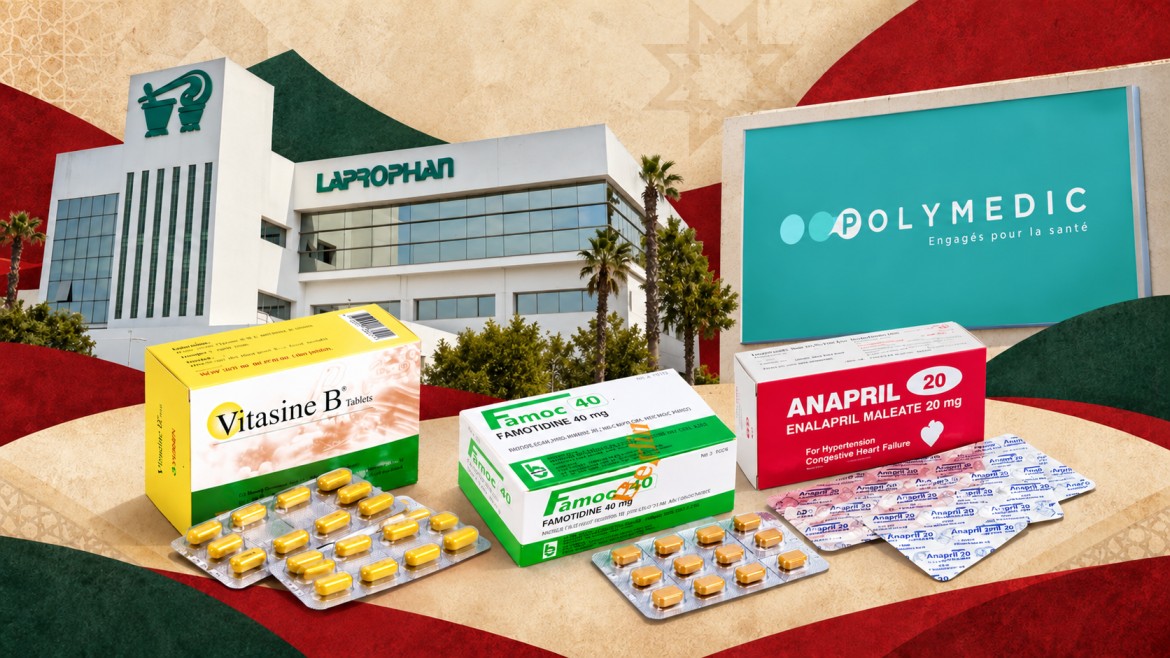
Thousands of medicines sold in pharmacies and hospitals are made by local drug companies. Now, two of the country’s pharmaceutical manufacturers could come under the same ownership as Laprophan moves to buy rival Polymedic. Laprophan has signed an agreement to acquire 100% of Corporate Investment Holding, the parent company of Polymedic, and has submitted the deal for approval by the Competition Council. The financial terms have not been disclosed, and there is no confirmed date for completion.
The proposed takeover would expand Laprophan’s range of medicines, production capacity and sales networks. It would also strengthen its position in treatments for skin conditions, heart disease and disorders of the central nervous system.
The deal comes as the pharmaceutical market in Morocco is expected to grow by 7.8% in 2026, reaching 38.6bn dirhams, up from 35.8bn dirhams in 2025. Local manufacturers already supply about 70% of the country’s pharmaceutical needs.
Founded in 1964, Polymedic runs a 9,600-square-metre factory in Casablanca and employs nearly 280 people. Its portfolio includes 138 marketing authorisations covering more than 200 products across 12 therapeutic areas.
Its medicines include treatments for skin conditions, heart disease and neurological and psychiatric disorders. The company also makes medicines for respiratory conditions, anaesthesia and intensive care, rheumatology, gynaecology, hormonal treatments and mineral deficiencies.
Polymedic produces its own generic medicines and manufactures drugs on behalf of other pharmaceutical companies, including products for international firms such as Aventis.
Laprophan, founded in 1949, is a larger manufacturer. It operates four production sites in Morocco and Switzerland, covering a total of 76,500 square metres, and can produce more than 180 million units a year.
The group employs nearly 1,450 people and sells products in more than 50 countries. It manages more than 1,300 marketing authorisations across 15 therapeutic areas and has operational subsidiaries in eight countries.
Its products include medicines for digestive disorders, neurological and psychiatric conditions, pain and inflammation, heart disease and infections. The group also makes medicines for hospitals, including those used in anaesthesia, resuscitation and intensive care.
Laprophan has also produced and distributed medicines under licence for international companies, including Pfizer, Procter & Gamble and Danone.
The company has expanded through a series of acquisitions in recent years. In 2024, it bought 100% of Amanys Pharma and 75% of Botanic Pharma.
Amanys strengthened its presence in hospital medicines, injectable treatments and beta-lactam antibiotics, a class of antibiotics that includes penicillins and cephalosporins. Botanic expanded the group’s activities in dietary supplements, natural health products and medicinal plants.
In November 2024, Laprophan signed an agreement with the National Agency for Medicinal and Aromatic Plants to develop plant-based dietary supplements, using Botanic Pharma’s infrastructure.
Earlier in 2026, the group acquired a 60% controlling stake in Swiss pharmaceutical company Rivopharm, expanding its manufacturing presence in Europe.
The proposed Polymedic acquisition could also strengthen Laprophan’s position in public hospital contracts. In 2025, 10 companies won 64% of the 1.35bn dirhams allocated to public drug procurement. Polymedic secured 52.4m dirhams in contracts, equivalent to about 4% of the total.
Combining the two businesses could allow Laprophan to coordinate production, research and development, and distribution more efficiently. It could also reduce competition in some medicine categories, particularly where the companies sell similar products.
The Competition Council must approve the transaction before it can be completed. Its review is expected to consider the impact on competition in specific therapeutic areas, including whether the combined group could gain excessive influence over prices.
Neither the purchase price nor the timetable for regulatory approval has been announced.


