

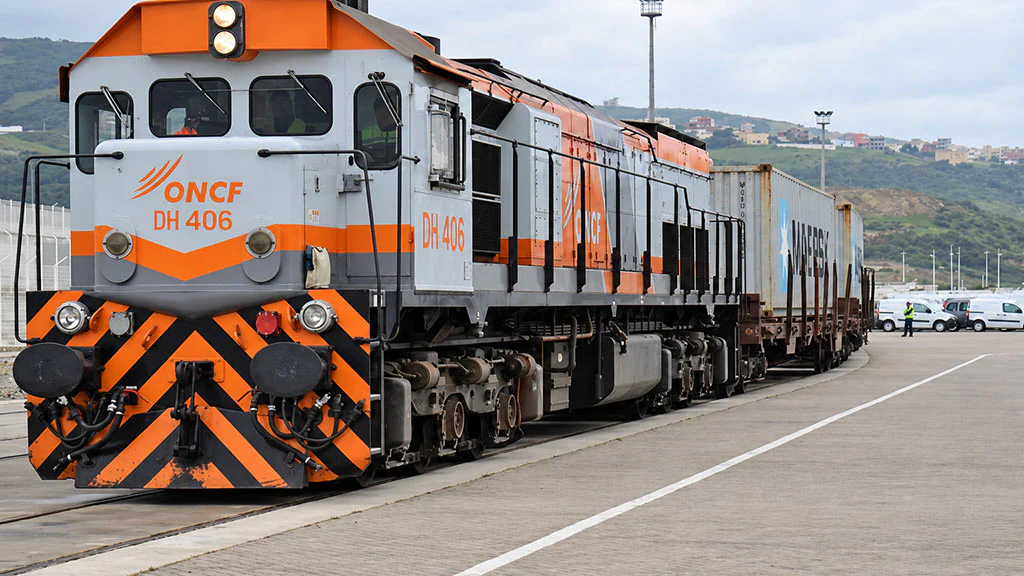
Danish shipping giant Maersk has teamed up with Morocco’s state rail operator to move more containers by train, as booming trade puts pressure on the country’s roads. Maersk and the National Railways Office (ONCF) signed a memorandum of understanding to expand rail freight and integrated logistics services, the Danish group said in a statement issued in Rabat on 24 November.
The exploratory deal aims to combine ONCF’s rail network with Maersk’s global shipping routes and logistics operations, to improve links between Morocco’s main ports, industrial zones and big cities.
ONCF chief executive Mohamed Rabie Khlie said the partners would explore “solutions that can be deployed at scale” to make Moroccan supply chains more competitive.
Guillaume Sauzedde, who heads Maersk’s Europe region, said the aim was to offer customers transport that is “more reliable, more efficient and lower-emission”.
Tangier to Casablanca by train
The deal builds on a rail service Maersk launched in August between Tangier and Casablanca. Containers are unloaded at Tangier, taken by train to Casablanca, cleared through customs and stored, then delivered by lorry.
The set-up makes Tangier Maersk’s main sea gateway into Morocco, with rail carrying goods on to Casablanca, the country’s main commercial hub.
In November Maersk also raised its shipping capacity serving Casablanca by 48%.
The Danish group has traded with Morocco for a century. Its first recorded charter, in 1925, carried Moroccan phosphates to European ports.
Road still dominates
Morocco’s growing car and aerospace industries, and the rise of the Tanger Med port, have tied the country more closely into global trade, Maersk said. Tanger Med handled a record 11.1 million containers in 2025, up 8.4% on the year before.
But most of that cargo still travels by road. Rail’s share of freight “remains limited”, according to a recent study of the sector.
ONCF, founded in 1963, carried 55.6 million passengers and 23 million tonnes of goods on its 2,295km network in 2025. Phosphates made up the bulk of that freight, at 14.2 million tonnes.
Its other freight earned MAD 744m ($75m) last year. The operator is in the middle of a MAD 96bn ($9.6bn) rail programme due to run to 2030.
Maersk, which has more than 100,000 customers and as many staff, operates in around 130 countries. It cited World Bank forecasts of Moroccan economic growth of 4.9% in 2025 and 4.4% in 2026.


