

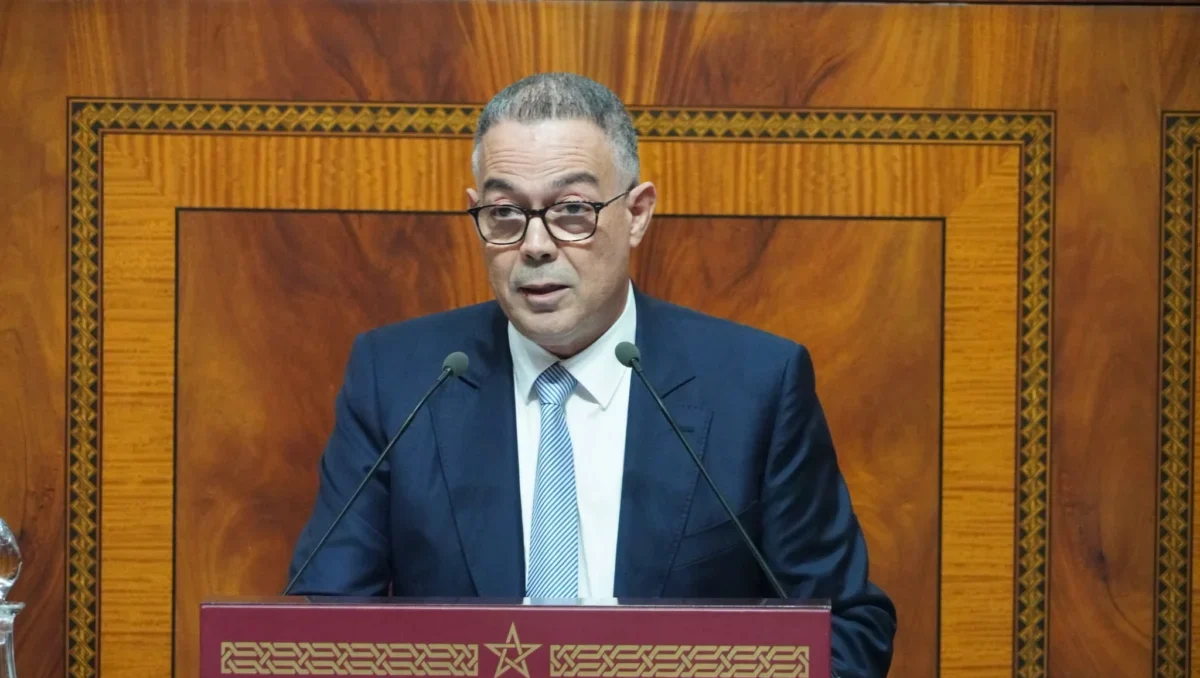
Finance minister has rejected claims that preparations for the 2030 FIFA World Cup will increase the country’s public debt, saying the projects are being financed through separate funding arrangements and will not affect public finances. Fouzi Lekjaa told MPs on Tuesday that investments by state-owned companies should not automatically be counted as government debt because these companies have their own budgets, revenues and business models.
He was speaking during a detailed parliamentary debate on the 2027 Finance Bill.
Lekjaa cited the National Railway Office (ONCF), which plans to invest 104bn dirhams, saying it would be misleading to add the entire amount to public debt.
“Is the National Railway Office going to invest 104bn dirhams, and then someone takes that figure and adds it to public debt?” he said.
He said the railway operator had its own economic model, budget and turnover, while the government’s contribution was limited to 1.2bn dirhams.
The minister said this type of state support was not new, pointing to the railway line between Tangier and Kenitra. He added that railway projects needed time to generate enough revenue to recover their investment costs.
Lekjaa also defended the investment programme covering six airports, saying it should not automatically be included in government debt.
“Some people take 50bn dirhams in airport investments and add it to public debt, then start calculating and saying these projects will increase debt by 300bn, 400bn or 500bn dirhams,” he said.
He said the airport projects were part of the National Airports Office’s business plan. The government had contributed land for Mohammed V Airport, which was added to the office’s assets at a value of 5bn dirhams, without providing direct financial support in return.
The government has adopted a 20-year financing arrangement for sports stadium projects, under which it will pay between 700m and 800m dirhams each year. The Hassan II Stadium in Benslimane is also covered by this arrangement.
Lekjaa said the government had opened a financing facility with the Deposit and Management Fund (CDG) to benefit from any potential profits.
“If there is any profit, it will be ours,” he said.
He added that the final cost of the Hassan II Stadium would not be known until the last contract had been awarded.
“When the final contract for the stadium is awarded, we will do the calculations and say: this is how much the stadium has cost us,” he said.
The minister said all projects planned so far were covered by funding arrangements included in the country’s finance laws.
He also said government revenue collection had exceeded initial forecasts. Detailed figures for the end of October would be presented to MPs, he added, with the improved revenue figures allowing the government to revise its forecasts upwards.
Lekjaa also backed MPs who questioned why sports stadiums could be built within two years while some social infrastructure projects, including hospitals, took much longer.
“Am I not asking the same question? I stand with you,” he said, responding to concerns that a stadium could be built in two years while a hospital could take 12 years.
The minister invited MPs to visit the Hassan II Stadium construction site to see the progress of the work and the companies involved.
He said Moroccan companies and workers were carrying out the project. He also said 106 Moroccan companies had taken part in building the Prince Moulay Abdellah Stadium in Rabat, promising to provide further details about their involvement.


