

Spain and Morocco have signed a new agreement to keep working on plans for a rail tunnel under the Strait of Gibraltar.
The deal brings together Spain’s National Geographic Institute and Morocco’s National Center for Scientific and Technical Research to study earthquakes and ground movement in the area.
Spanish Transport Minister Óscar Puente and Moroccan minister Karim Zidane confirmed the agreement on 4 December 2025 in Madrid. The idea of a fixed link between Europe and Africa has been studied for almost 50 years.
Spanish media say the government approved another €1.73m in March 2026 to continue technical studies. The work is being managed by SECEGSA, a public company created in the 1980s to develop the project.
The tunnel would be about 65km long in total, with around 40km on the Spanish side. The northern entrance is planned near Vejer de la Frontera.
The distance between the two stations would be 42km. The tunnel itself would be 38.5km long, including 27.7km under the sea. The deepest point would reach 475m.
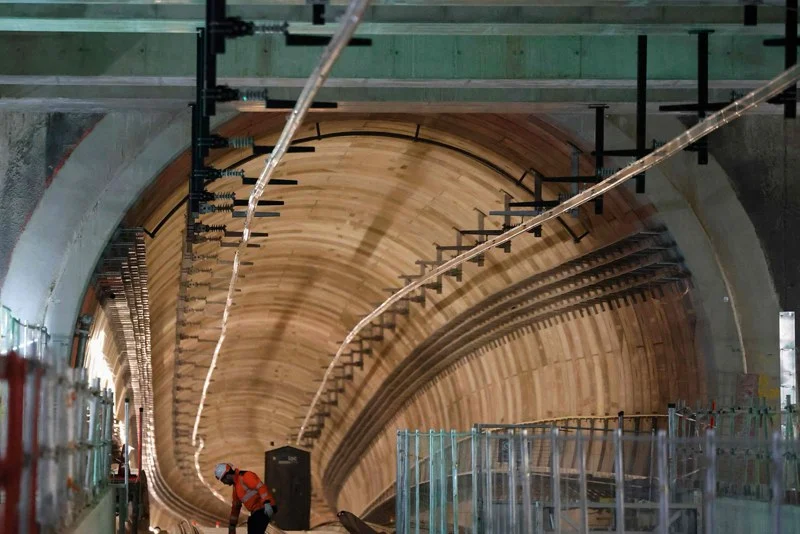
Plans show two separate railway tunnels, each carrying one track. A smaller central tunnel would run between them for safety and maintenance. Emergency cross-passages would connect the tunnels every 340m. A safety stop area would be built at the lowest point.
A study by tunnelling company Herrenknecht Ibérica found the project is technically possible with today’s technology. But it warned the work would be very complex and expensive.
The hardest section is an underwater ridge called the Umbral de Camarinal. The ground there is made of layers of sandstone and clay that change quickly over short distances, making construction difficult.
The Spanish side alone is expected to cost more than €8.5bn. If built, trains could cross between Spain and Morocco in about 30 minutes. Completion is estimated between 2035 and 2040.
The agreement sets out three years of studies on earthquakes, tsunamis and how the ground moves in the strait. The area sits on a major fault zone that caused the 1755 earthquake.
If results are positive, a first test tunnel could be approved, possibly starting with a tender in 2027. Building that test tunnel could take six to nine years.
A 15-day marine research mission is planned before mid-2026, with a budget of about €553,000. Scientists will map the seabed, study underground layers and collect samples.
The project involves several Spanish research institutes, the Navy’s Hydrographic Institute and the US Geological Survey.
More than 100,000 ships pass through the Strait of Gibraltar each year. The area is also protected and includes an orca conservation plan. Over 1,900 marine species live there, so strict environmental permits will be required.
All the data collected will be used to build a 3D geological model of the area before any final construction decision is made.


