

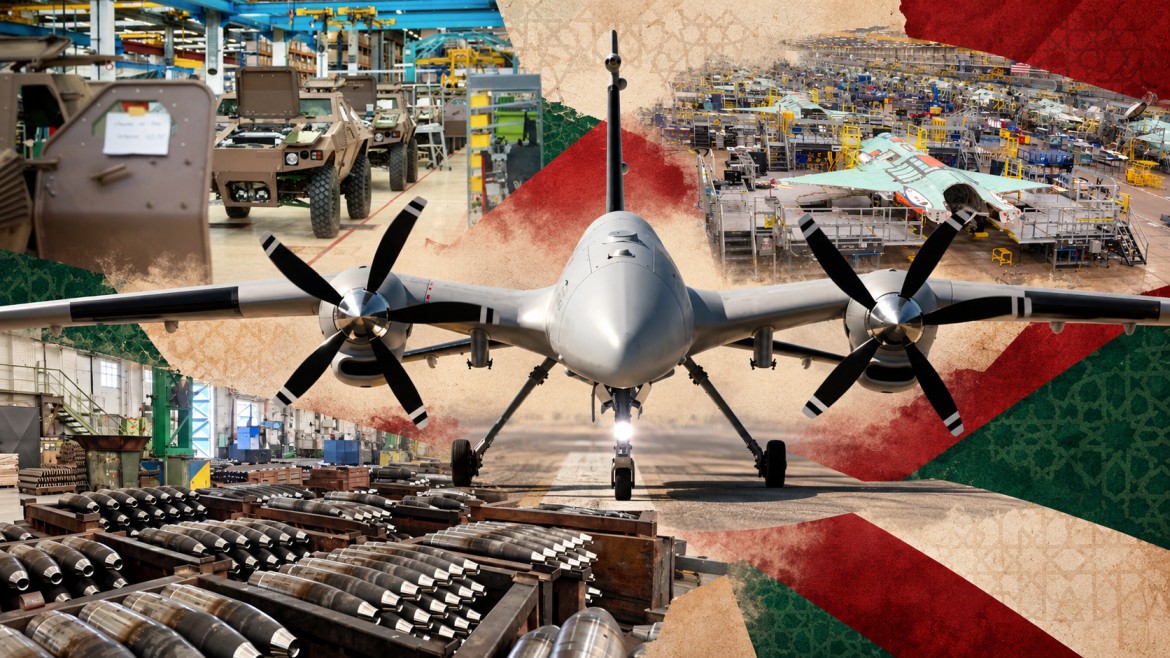
Morocco wants to build more of its own military equipment instead of relying on foreign suppliers, but high production costs and a shortage of skilled engineers could slow its plans, a new report says. The report, The Moroccan Defence Industry, was published jointly by Germany’s Konrad Adenauer Foundation and the Global Governance and Sovereignty Foundation in October 2026. It says the country has laid the foundations for a domestic defence industry since passing a law in 2020 that allowed private companies to manufacture military equipment, weapons and ammunition.
The report identifies aircraft maintenance and small drone production as two of the most promising areas for growth. It also points to two dedicated industrial zones covering a combined 675 hectares, designed to help companies enter the defence sector.
Morocco started developing its military industry later than countries such as Turkey, South Korea and Saudi Arabia. Its strategy is to build on existing expertise in the automotive and aerospace industries rather than start from scratch.
Law No. 10.20, introduced in July 2020, created the legal framework for domestic defence manufacturing. It sets out licensing requirements, security checks and export controls, regulates foreign investment and encourages technology transfers linked to major arms purchases.
The law divides defence production into three broad categories: weapons and major military equipment, including firearms, artillery, armoured vehicles, warships and combat aircraft; electronic systems, including sensors, communications and surveillance equipment; and maintenance, technical support and logistics.
Two industrial zones are being developed under the Defence Industrial Zones Management Company, known by its French acronym SGZID. The initiative brings together the Military Housing and Equipment Agency and MEDZ, an industrial development subsidiary of the state-owned Caisse de Dépôt et de Gestion (CDG).
The first zone covers 75 hectares in Nouaceur, near Casablanca’s aerospace hub. It is intended for aircraft maintenance, avionics and other systems.
The second covers 600 hectares in Sidi Yahya du Gharb, in the Rabat region, and is designed for heavy industry and ammunition production.
Together, the sites cover an area equivalent to about 945 football pitches, using a standard pitch size of 7,140 square metres.
The zones are intended to give licensed companies access to equipped industrial sites, customs arrangements and tax incentives under the Investment Charter. Their location also puts them close to established aerospace and automotive supply chains.
Decree No. 2.24.1030 formally established SGZID in June 2025. The wider legal framework was promulgated in July 2020 through Decree No. 2.20.480.
Maintaining military aircraft and vehicles is one of the clearest opportunities for the emerging industry, the report says. The cost of keeping military equipment operational over its lifetime can exceed the original purchase price.
A 15,000-square-metre facility at Benslimane Air Base is central to this plan. The Maintenance Aero Maroc (MAM) project involves US defence company Lockheed Martin, Sabena Aerospace, part of the Blueberry Group, and MAM.
The facility focuses on the maintenance, repair and modification of F-16 fighter jets and C-130 Hercules transport aircraft used by the Royal Armed Forces. The longer-term ambition is to provide services to other African operators.
“The Benslimane project for the maintenance of F-16 and C-130 aircraft, developed in cooperation with Lockheed Martin, stands out as a first step toward transforming Morocco into a regional hub for military maintenance services,” the report says.
The project could help local engineers and companies gain experience in work that requires specialised skills and strict military standards before moving into more complex manufacturing.
The report also pointed to the production of small unmanned aerial vehicles, commonly known as drones.
Using commercially available electronic components could allow local companies to design, assemble and modify drones for surveillance and tactical use without depending on all the specialised components supplied by foreign defence firms.
Components that fall outside the scope of the United States’ International Traffic in Arms Regulations (ITAR) could reduce the need for US export approvals. However, other applicable export controls would still have to be followed.
The approach could give companies greater freedom to adapt designs and potentially sell them abroad, while building on expertise already available in the country’s technology and manufacturing sectors.
The report says the wider industrial strategy relies on existing civilian capabilities. The aerospace sector alone has more than 140 companies operating in the country, according to the background material accompanying the study. Automotive manufacturing also offers a pool of suppliers and technical expertise that could be adapted for defence work.
The report warns that military manufacturing may not be an attractive option for many civilian companies.
Automotive and textile firms, for example, could face high costs when adapting their production lines to meet military certification, security and quality requirements. Those costs are harder to recover when defence contracts involve smaller orders than civilian manufacturing.
The industry also faces competition for young engineers from established automotive and civil aerospace companies. The emigration of Moroccan engineers adds to the challenge.
The report recommends specialised training programmes and clearer career paths to help retain skilled workers and develop the technical expertise needed for military production.
Without a larger pool of qualified engineers and a reliable flow of orders, companies may struggle to justify the investment required to enter the sector.
The authors also recommend creating a dedicated agency to coordinate the armed forces’ needs with the capabilities of domestic manufacturers.
The proposed body would be modelled on France’s General Directorate for Armaments, known as the DGA. It would act as a permanent link between the military and industry, translate military requirements into clear production goals, and help establish testing and certification centres.
The Royal Armed Forces could support the process by gradually increasing orders from local suppliers. This would give companies an opportunity to learn military production standards before expanding into wider manufacturing and competing in international markets.
The report says the long-term goal is to develop a defence industrial base that can meet domestic needs, support military equipment throughout its service life and eventually compete for business abroad.
The main challenge is turning the initial legal and industrial infrastructure into a sustainable industry, with enough skilled workers, predictable orders and coordination between the armed forces and private companies.


