

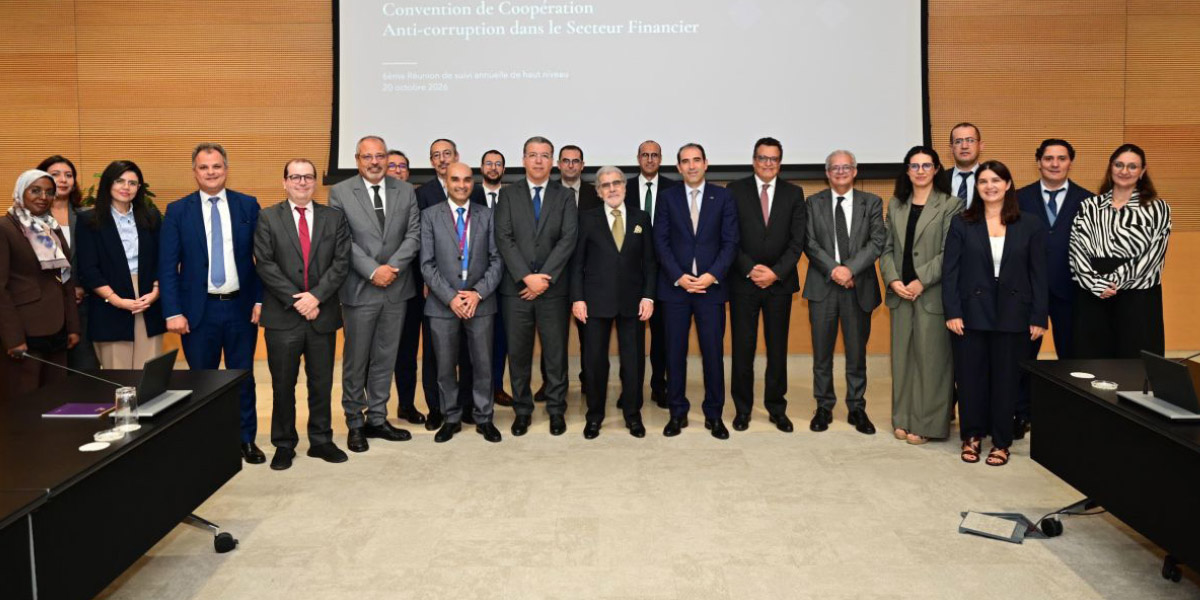
Morocco’s financial regulators are moving from identifying corruption risks to making institutions act on them, under a new plan covering 2027 and 2028. The roadmap was approved on 20 October in Rabat at the sixth annual meeting of four bodies: Bank Al-Maghrib (BAM), the Moroccan Capital Market Authority (AMMC), the Supervisory Authority of Insurance and Social Welfare (ACAPS), and the National Authority for Probity, Prevention and Fighting Corruption (INPPLC).
The plan requires the institutions to put measures in place to address corruption risks identified in previous assessments of the banking, stock market and insurance sectors.
The four bodies signed their cooperation agreement in November 2019. Their work since then has focused mainly on identifying weaknesses. The new roadmap marks a shift towards enforcing plans to fix them.
The measures cover a financial system that includes banks with more than 1.7 trillion dirhams ($165bn) in assets, a stock market whose value has historically ranged from 600bn to 700bn dirhams, and an insurance sector described as the second largest in Africa.
The regulators want to close gaps between the different parts of the financial system that could allow corruption or other financial crimes to go undetected.
The move follows the country’s removal from the Financial Action Task Force (FATF) grey list in February 2023. The international watchdog had raised concerns about safeguards against money laundering and the financing of terrorism. The country was removed after strengthening its system to tackle those risks.
Authorities are now applying a similar approach to bribery and corruption. The effort is also intended to protect foreign investment and maintain relationships with European correspondent banks, which help financial institutions process international payments.
A key target is for the INPPLC to obtain ISO 37001 certification by 2027. The international standard requires independent audits of an organisation’s systems for preventing bribery, including its internal controls and the accountability of its leaders.
The anti-corruption authority aims to show that it follows the same standards it expects other organisations to meet.
More than 900 staff members from the four institutions received targeted training on integrity and corruption prevention during 2025 and 2026. The regulators also plan to work more closely with the Moroccan Foundation for Financial Education (FMEF) to include anti-corruption lessons in financial literacy programmes.
The aim is to make compliance part of everyday professional practice, rather than relying only on penalties after wrongdoing occurs.
The effort is also reaching beyond the financial industry. A recent forum for organisations certified under ISO 37001 brought together more than 70 executives from 40 entities across different sectors.
The initiative could provide a model for extending anti-corruption measures to other parts of the economy.


