

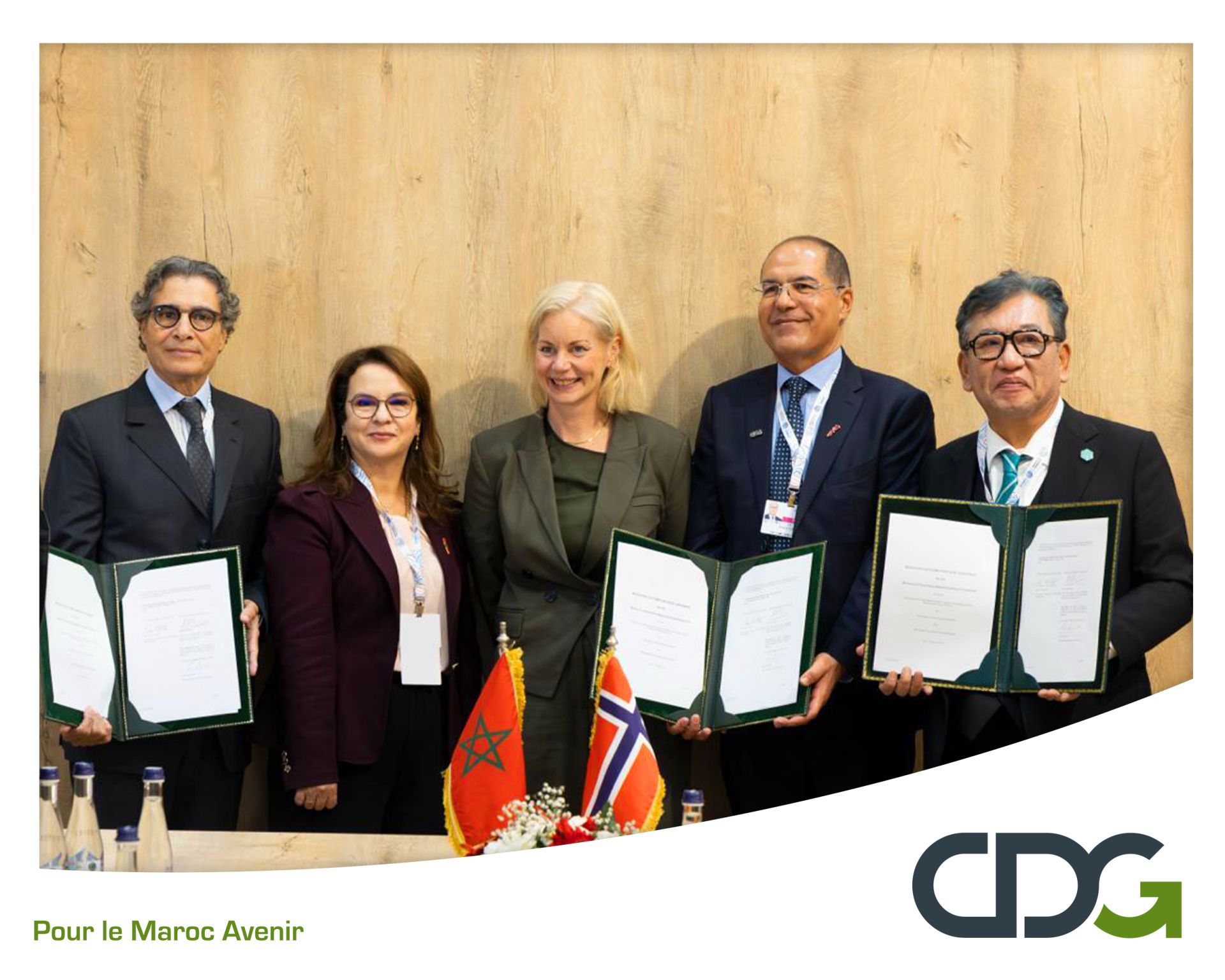
Morocco is hoping to attract more investment in solar and wind energy through a new agreement with Norway that will allow the two countries to trade carbon credits. The 10-year deal, signed on the sidelines of the COP31 climate summit in Antalya, Turkey, aims to support renewable energy projects capable of generating up to 2 gigawatts (GW) of electricity and cutting emissions by as much as eight million tonnes of carbon dioxide equivalent (CO2e).
The agreement brings together Africa Carbon Link (ACL), a joint initiative of the state-owned Caisse de Dépôt et de Gestion (CDG) and the Casablanca Finance City Authority (CFCA), and Norway’s Article 6 fund, represented by the Global Green Growth Institute (GGGI).
ACL will manage the programme, bringing together eligible solar and wind projects, helping structure their financing and overseeing the process of measuring and verifying emissions reductions.
The partnership operates under Article 6.2 of the Paris Agreement, which allows countries to buy and sell verified emissions reductions through bilateral agreements.
This means Norway can pay for emissions cuts generated by renewable energy projects in Morocco and count them towards its own climate targets.
However, the same reductions cannot be counted twice. Morocco will have to deduct every tonne sold to Norway from the emissions reductions it reports towards its own national climate commitments. This is known as a corresponding adjustment.
How much money could the deal generate?
The two sides have not disclosed how much Norway will pay for each tonne of emissions avoided. They have also not announced which projects will benefit, how much money will be invested upfront or whether any projects have already secured financing.
Indicative prices in comparable international carbon deals range from $15 to $30 per tonne of CO2e.
If the programme reaches its target of eight million tonnes, that could translate into between $120m and $240m over ten years. This is an estimate based on market benchmarks, not a confirmed value or guaranteed payment under the agreement.
The money would provide renewable energy developers with an additional source of income alongside revenue from selling electricity. Long-term carbon credit purchases could also make projects less risky for investors and banks by giving developers greater certainty about future earnings.
Building the planned 2GW of solar and wind capacity could require between $1.5bn and $2.2bn, based on typical construction costs for renewable energy projects in North Africa.
The carbon payments would therefore be one part of the financing package, alongside loans and private investment.
What does 2GW mean for Morocco?
The planned capacity is equivalent to between 37% and 43% of the country’s existing renewable energy capacity.
Morocco currently has around 11.5GW to 12GW of total installed electricity capacity. Renewable sources account for an estimated 4.6GW to 5.4GW of that total.
The country wants renewables to make up 52% of its installed electricity capacity by 2030, compared with an estimated 40% to 45% in 2025-2026.
Coal still accounts for around 60% to 65% of electricity generation, with major coal-fired power stations operating at Jorf Lasfar and Safi.
New solar and wind farms could reduce the amount of electricity generated by these plants, cutting emissions from the power sector.
A 2GW portfolio of solar and wind projects could generate between 4.38 and 5.26 terawatt-hours of electricity a year, assuming an average operating capacity of 25% to 30%.
Based on an estimated electricity grid emissions factor of 0.60 to 0.65 tonnes of CO2 per megawatt-hour, this could avoid between 2.63 million and 3.42 million tonnes of emissions annually.
Over ten years, the theoretical reduction could reach between 26.3 million and 34.2 million tonnes.
However, the agreement sets a much lower ceiling of eight million tonnes over the same period. That represents roughly 23% to 30% of the potential physical emissions reductions.
The difference could be explained by the gradual construction and commissioning of the projects, as well as arrangements under which only part of the emissions reductions is transferred to Norway. Morocco could retain the remaining reductions for its own climate accounting.
The programme’s target works out at an average of 800,000 tonnes of emissions reductions a year, or 400 tonnes per megawatt annually.
A link to Morocco’s 2030 climate target
The agreement also supports the country’s wider climate commitments.
Morocco has pledged to cut greenhouse gas emissions by 45.5% by 2030 compared with a business-as-usual scenario.
Of that target, 18.3 percentage points are unconditional, meaning they do not depend on international funding. The remaining 27.2 percentage points depend on receiving international climate finance.
The agreement with Norway could help mobilise some of that funding, although emissions reductions sold to Norway must be removed from the reductions counted towards Morocco’s own target.
The partnership also builds on earlier efforts to develop international carbon trading arrangements.
Morocco has already established an Article 6 cooperation framework with Switzerland and the KliK Foundation. Norway and GGGI have pursued similar carbon finance programmes in Senegal, Indonesia, Zambia and Cambodia.
The institutional structure of the new agreement is different from many existing programmes. Rather than relying solely on government ministries or external consultants to identify projects, it uses ACL as a central platform backed by CDG and CFCA.
CDG, established in 1959, is a state-owned institutional investor that manages long-term savings, pension funds and strategic investments. CFCA manages Casablanca Finance City, an international financial centre that connects businesses and investors with opportunities across Africa.
ACL is designed to bring several renewable energy projects under one programme. This could reduce the technical and legal costs that individual developers face when applying for carbon credits, including the costs of measuring, reporting and verifying emissions reductions.
What happens next?
The signing establishes the framework, but the programme still needs to move through several technical and regulatory stages before Norway can receive carbon credits and payments can be made.
ACL must identify eligible solar photovoltaic and onshore wind projects, prepare technical documents describing their expected emissions reductions and establish systems to monitor their performance.
The Moroccan government must then issue formal authorisation letters confirming that the emissions reductions can be transferred internationally and that corresponding adjustments will be made to national carbon accounts.
Independent verification will also be required. Only after the projects generate electricity and their emissions reductions are confirmed can the corresponding Internationally Transferred Mitigation Outcomes (ITMOs) be issued and transferred to Norway.
The agreement builds on international rules developed over several years.
Countries agreed on the main principles of Article 6.2 at COP26 in Glasgow in November 2021, including safeguards against double counting. Further rules on reporting, authorisation and carbon registries were finalised at COP29 in Baku in November 2024.
The programme will also need to comply with national regulations governing private renewable energy production and access to the electricity grid, including Law 13-09 and amendments introduced through Law 40-19.
The main challenges will be securing government approvals and ensuring that the electricity network can accommodate the additional 2GW of intermittent solar and wind power.
The new agreement could help attract private investment and provide renewable energy developers with another source of revenue. Its success will ultimately depend on how quickly projects are approved, financed, built and connected to the grid.


