

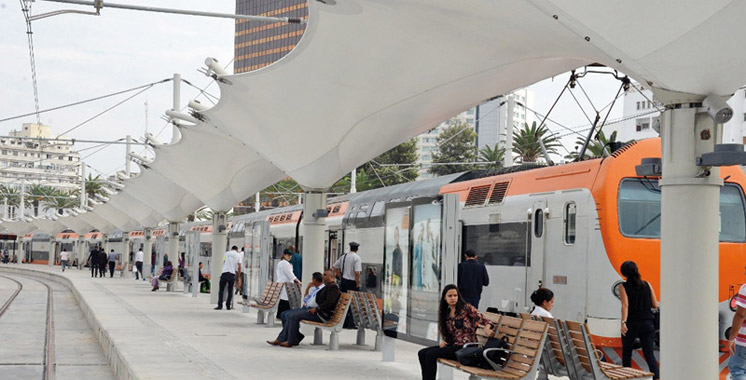
Millions more people are expected to travel by train in Morocco over the next four years, as the national rail operator invests 96bn dirhams in new trains, high-speed rail and network upgrades. The National Railway Office (ONCF) expects annual passenger numbers to reach nearly 100 million by 2030. It also forecasts annual turnover of 10bn dirhams and an operating margin of more than 5bn dirhams.
The figures are included in a report on public institutions and state-owned companies accompanying the draft 2027 Finance Bill, published on the website of the Ministry of Economy and Finance and Public Administration Reform.
The investment programme aims to increase the number of passengers the network can carry, particularly in major cities and along the country’s main economic routes.
The 96bn-dirham programme is divided into three main areas.
The largest share, 53bn dirhams, will fund the extension of the high-speed rail line between Kenitra and Marrakech, including infrastructure and related equipment.
Another 29bn dirhams will pay for 168 new-generation trains.
The remaining 14bn dirhams will go towards maintaining and improving the network. This includes 8bn dirhams for work supporting the high-speed line extension and the development of regional express rail infrastructure, and 6bn dirhams to maintain the existing network and keep it operational.
Construction of the high-speed line between Kenitra and Marrakech began in April 2025. The route will stretch for about 430km.
A separate rail programme for the Casablanca region was launched in September 2025. It includes a multimodal station called Casablanca-South, new stations at Mohammed V Airport and the new Hassan II Grand Stadium, and more train services between Mohammedia and Nouaceur.
The new trains will include 18 high-speed trains, 40 intercity trains and 110 trains for regional express and shuttle services.
The purchase contracts also include industrial compensation commitments aimed at developing Morocco’s ability to manufacture regional express trains locally and strengthening the wider railway industry.
ONCF expects the gradual introduction of the new infrastructure and trains to increase capacity and help the network cope with growing demand.
The rail operator recorded turnover of about 2.479bn dirhams in the first six months of 2026, an increase of 2% compared with the same period a year earlier.
However, it reported a net loss of 716m dirhams, while investment spending reached about 4.83bn dirhams.
ONCF expects turnover to exceed 5.27bn dirhams for the full year 2026, with an operating profit of 216m dirhams. It forecasts a net loss of 652m dirhams.
Investment spending is expected to reach 18.2bn dirhams in 2026, about 4% less than in 2025.
The operator forecasts turnover of more than 6.05bn dirhams in 2027, rising to 6.56bn dirhams in 2028 and 7.04bn dirhams in 2029.
Investment is expected to exceed 29bn dirhams in 2027 as work continues on major rail projects, the train fleet is renewed and the network is expanded to meet rising demand by 2030.


