

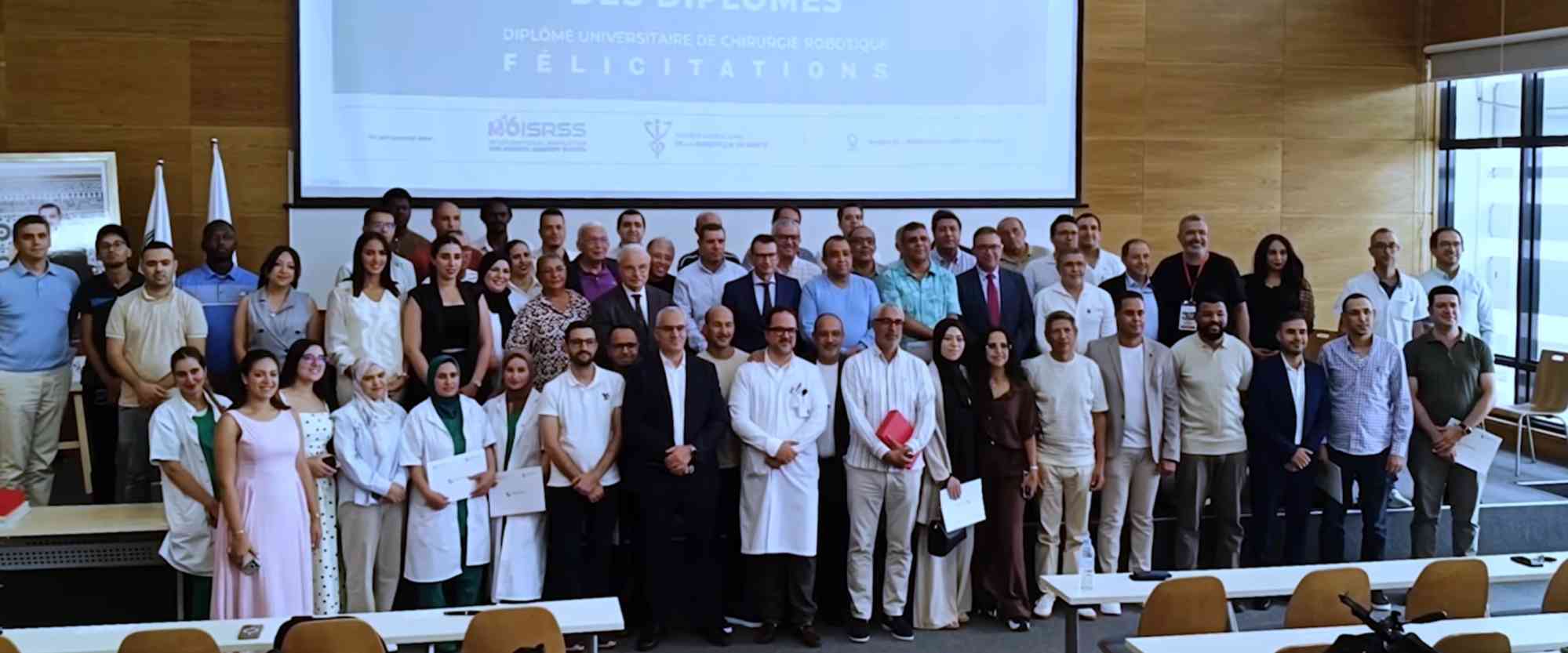
A total of 76 surgeons and operating-room nurses have completed Morocco’s first university programme focused on robotic surgery. The graduates completed their training at the Mohammed VI Interventional Simulation and Robotic Surgery School (M6-ISRSS) in Casablanca. The school held a ceremony on Saturday, 12 September, to mark the end of its first year.
The programme started in January at Mohammed VI University of Health Sciences (UM6SS). It combines classroom lessons with simulation and hands-on training to teach medical staff how to use surgical robots.
More than 58 surgeons and 18 operating-room nurses completed the programme. They include specialists in general surgery and urology from different parts of Morocco.
The programme has also attracted doctors and medical staff from Tunisia, Djibouti and Cameroon.
“They are not only Moroccan, but also Tunisian and Cameroonian… This University Diploma is a success that has exceeded initial expectations,” said Prof Jacques Hubert, a urologist and professor emeritus at the University of Lorraine in France.
The programme was developed with the University of Lorraine’s School of Surgery in Nancy. Hubert helped set up the training after working on robotic surgery programmes in France.
Robotic surgery requires specific training. Surgeons cannot simply start using a robot after receiving access to the technology.
The programme teaches anatomy, robotic systems, safety and ethics. Trainees then practise on virtual simulators, synthetic models and human tissue before observing real surgical procedures.
The school has two surgical robots used only for training, along with virtual reality and augmented-reality equipment.
The training also includes lessons from Royal Moroccan Air Force fighter pilots. They help trainees improve communication, coordination, spatial awareness and their response to emergencies.
“This is the first academic project of its kind in Morocco and Africa, aimed at improving care for all Moroccan citizens… The input of fighter pilots revealed itself to be important, interesting, and effective,” said Prof Mohammed Chahbouni, director of the Mohammed VI International Center for Simulation in Sciences and Health.
The school plans to train more Moroccan surgeons and gradually open the programme to more professionals from Africa.
The aim is to make Casablanca a training centre for robotic surgery in the region as more hospitals adopt robot-assisted procedures.
Prof Soufiane Essamoud, an assistant professor of paediatric surgery and a graduate of the programme, said the technology can help surgeons reach areas that are difficult to access.
“Robotic surgery expands precision to reach areas that were previously hard to access, which yields superior outcomes across several pediatric pathologies.”


