

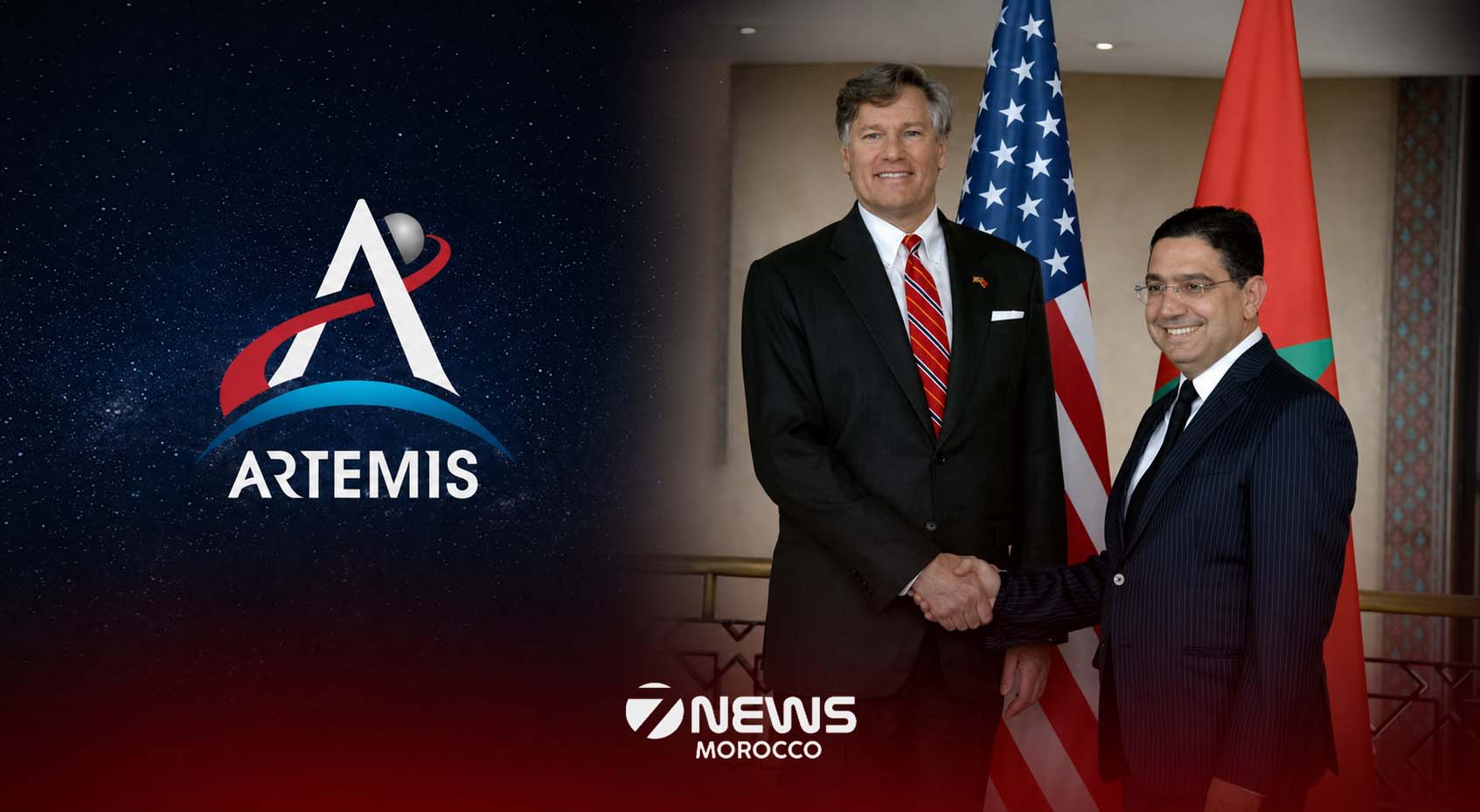
Morocco has signed the Artemis Accords, formally joining the United States-led framework for civil space cooperation. The US State Department said Morocco’s signature reflects the strength of the strategic relationship between the two countries and opens new opportunities for cooperation in space exploration and scientific research.
In an official statement, the department said: “This step confirms the Kingdom’s commitment to responsible and peaceful space exploration based on transparency, international cooperation, and the exchange of scientific data.”
The Artemis Accords set principles for cooperation in civil space exploration. These include coordination between countries, mutual support, peaceful use of space and the protection of space resources. Morocco’s accession brings the number of signatory countries to 64.
The agreement was signed in Rabat by Foreign Minister Nasser Bourita in the presence of senior US officials. The accords were launched in 2020 by the United States and seven founding partners to create a shared framework for responsible behaviour in space.
Morocco’s move forms part of a wider strategy to expand its role in advanced industries and strengthen global partnerships.
From satellites to the Moon
Morocco already operates two high-resolution Earth observation satellites, Mohammed VI-A and Mohammed VI-B, used for border surveillance, agricultural mapping and disaster management.
By joining the Artemis framework, Moroccan research institutions could eventually take part in scientific experiments linked to the “Gateway” lunar space station, which will orbit the Moon and serve as a communications and habitation hub for deep-space missions.
The Artemis programme aims to land the first woman and the next man on the Moon. The accords provide the diplomatic and legal foundation for international participation in these missions.
The signing also reflects Morocco’s status as a Major Non-NATO Ally of the United States and comes amid global debate over future rules governing lunar resources such as water ice at the Moon’s south pole.
A bet on the trillion-dollar space economy
Morocco is positioning itself for the commercial side of space. The global space economy is projected to exceed $1 trillion by 2040.
Joining the Artemis framework is expected to help attract aerospace investment, support university programmes in astrophysics and aerospace engineering, and expand the use of satellite data for climate monitoring and water management.
Morocco has also announced plans to host a training workshop in space oceanography to help Atlantic African countries manage marine resources using satellite data. Student programmes, including CanSat mini-satellite initiatives developed with the US Embassy, aim to build a future workforce for the sector.
Aerospace industry expands rapidly
Morocco’s aerospace sector is shifting from basic assembly to high-value manufacturing. The industry is centred in the Midparc zone in Nouaceur near Casablanca.
In early 2026, King Mohammed VI inaugurated a €280m Safran Landing Systems plant producing and maintaining aircraft landing gear for the Airbus A320 family. In April 2026, Pratt & Whitney opened a 130,000-square-foot facility to manufacture precision parts for the PT6 engine family.
Boeing’s industrial ecosystem in Morocco now sources more than $1bn in parts each year from local suppliers, creating a growing cluster of specialised firms.
The sector now includes more than 150 companies and around 26,000 skilled workers. Annual exports are estimated at roughly MAD 29bn, about $2.9bn, with local integration exceeding 40%.
Engine manufacturing milestone
Morocco has entered aircraft engine manufacturing, a significant shift in the value chain.
Pratt & Whitney Canada opened a $76m facility in April 2026 producing precision components for turboprop engines. Safran is developing two major sites and aims for Morocco to become the second country after France able to assemble LEAP engines used in Boeing 737 MAX and Airbus A320neo aircraft by 2027.
The long-term goal set by the Ministry of Industry is to produce a fully Moroccan-made aircraft by 2030.
Climate and satellite diplomacy
Morocco’s space programme is closely linked to climate challenges. The Royal Centre for Remote Sensing has partnered with the European Space Agency under the EO AFRICA programme to use satellite data to address water scarcity.
A space oceanography workshop planned for 2026 will train African partners to manage fisheries and marine resources using satellite technology.
World Cup and aviation growth
Civil aviation remains the main economic driver. Aviation and related tourism account for about 7.9% of Morocco’s GDP.
Royal Air Maroc is expanding its fleet, leasing 13 Boeing 737-8 aircraft from 2027 and targeting 200 aircraft by 2037. The expansion is tied to Morocco’s role as co-host of the 2030 FIFA World Cup and expected passenger traffic of 80 million annually by 2030.
The fleet growth is accelerating investment in maintenance, repair and overhaul facilities, positioning Morocco as a regional aviation hub.
Present profits, future prestige
By 2030, aviation is expected to deliver the largest economic impact through infrastructure, tourism and job creation. Space activities are seen as a long-term investment in technology, research and strategic autonomy.
Morocco’s signature on the Artemis Accords places the country within the largest international framework for lunar exploration and signals its ambition to link African talent with the global aerospace and space economy.


