

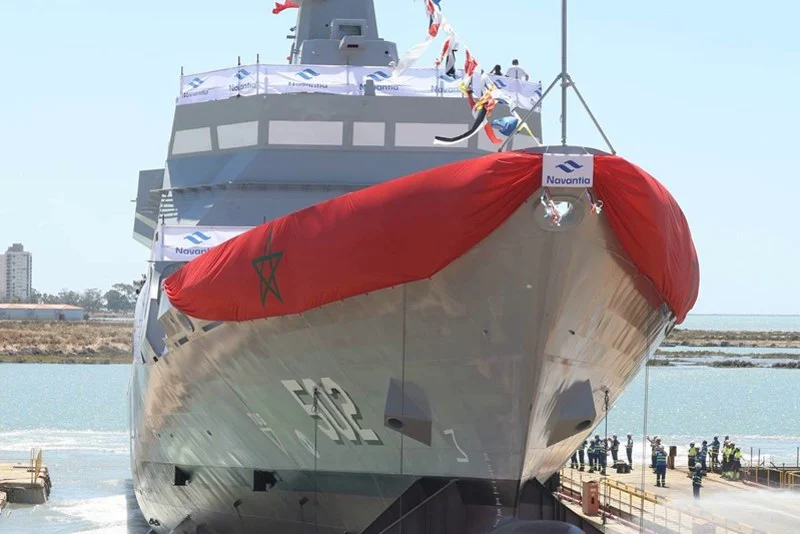
Morocco’s Royal Navy is preparing to receive the RMNS Moulay Hassan, a new patrol vessel built by Spanish state-owned shipbuilder Navantia. The ship has completed sea trials in the Bay of Cadiz and is due to be handed over this summer. Named after Crown Prince Moulay Hassan, it is the first warship Spain has built for Morocco in four decades.
The vessel is based on the Avante 1800 design. The programme created more than 1,100 jobs in the Cadiz region. The contract, estimated at between €130m and €150m, includes training for Moroccan crews and long-term logistical support.
Technical profile
The Moulay Hassan is designed to sit between Morocco’s coastal patrol boats and its FREMM-class frigates.
The ship is 87 metres long with a displacement of 2,020 tonnes. It can reach a top speed of 24 knots and has a range of 4,000 nautical miles. It is fitted with an Oto Melara 76mm main gun, secondary cannons and missile launchers. The vessel also includes stealth features to reduce radar detection and a flight deck capable of operating helicopters weighing up to 10 tonnes.
Strategic timing
The delivery gives Morocco a stronger naval presence near Cadiz, the Canary Islands and the Strait of Gibraltar.
The handover coincides with the 22nd African Lion military exercise taking place in Morocco. This year’s exercise focuses on artificial intelligence in warfare. More than 40 US technology companies are taking part, testing AI-driven analysis and robotic battlefield awareness. Moroccan and US forces have also validated Link-16 tactical communications, allowing real-time encrypted data exchange with Western allies.
The drills mark the start of a new US-Morocco defence roadmap covering 2026 to 2036.
Rising tensions with Washington
The delivery comes as relations between Spain and the United States face growing strain. The Trump administration has criticised Madrid after Spain refused to allow US aircraft to use its military bases during recent campaigns in Iran.
Washington has raised the possibility of suspending Spain from NATO over defence spending and cooperation concerns. Without NATO’s collective security guarantees, Spain’s position in its North African enclaves of Ceuta and Melilla would be weakened.
Several US lawmakers have publicly described Ceuta and Melilla as “occupied Moroccan territory”.


