

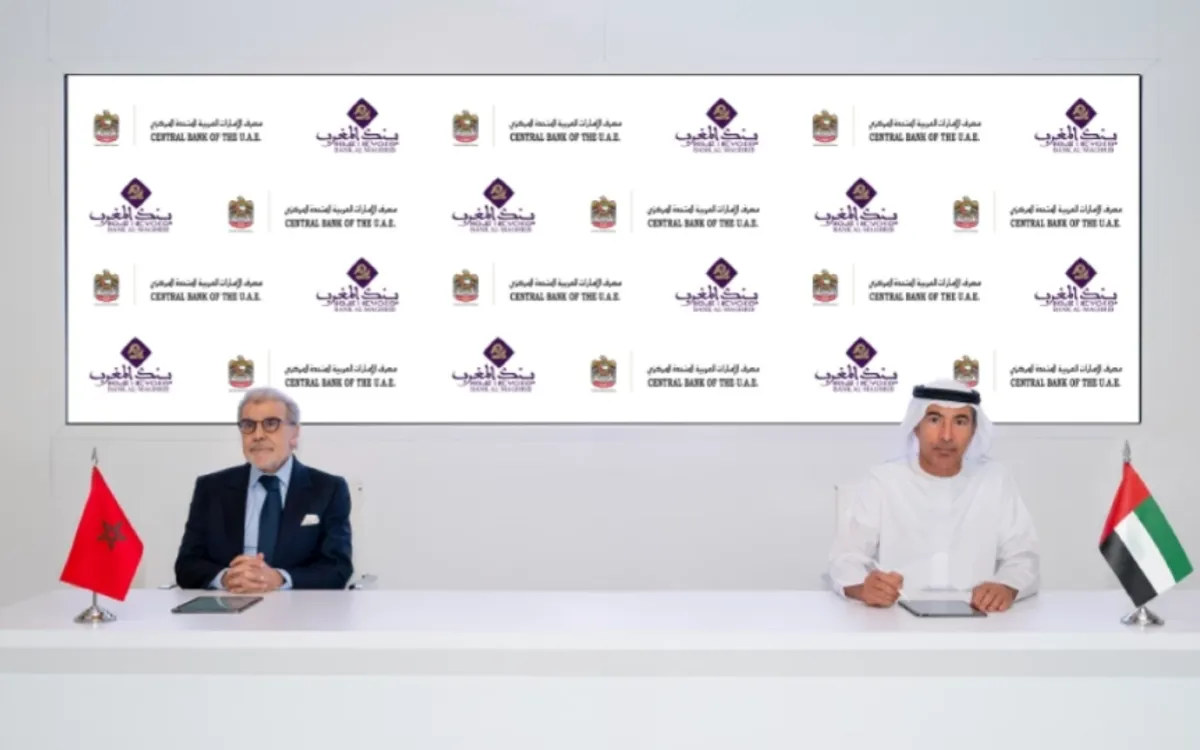
Morocco and the United Arab Emirates have agreed to study ways to connect their payment systems, which could make it easier and faster to send money and use bank cards between the two countries. The Central Bank of the UAE (CBUAE) and Bank Al-Maghrib signed two memorandums of understanding in Abu Dhabi on 3 October. The agreements cover payment systems, digital currencies, banking supervision, Islamic finance and cross-border financing.
The first agreement focuses on payment infrastructure. The two central banks will study whether their instant payment platforms, national card switches and financial messaging systems can be linked directly.
The plan could eventually allow a bank card issued in Morocco to be used at shops and ATMs in the UAE, and Emirati cards to be used in Morocco. It could also allow faster bank-to-bank transfers between individuals and businesses.
At present, payments between the two countries generally rely on international card networks such as Visa and Mastercard, or on correspondent banks. These systems can involve several intermediaries, foreign exchange costs and longer processing times.
The proposed system would look at three areas: national card networks, instant payment platforms and financial messaging systems.
The work could include linking the UAE’s Aani instant payment platform with instant transfer systems in Morocco. The central banks will also study direct and secure messaging between financial institutions in the two countries.
The agreement does not mean that a new system will start operating soon. No launch date, investment amount or transaction fee has been announced. Any connection would require further technical work, cybersecurity measures and regulatory approval.
The two central banks will also study central bank digital currencies, known as CBDCs. The work will cover both retail payments for consumers and wholesale payments between financial institutions.
The aim is to examine whether digital currencies could make cross-border settlements faster and easier. The study does not mean that Bank Al-Maghrib has decided to launch a digital dirham for the public.
The agreement also covers financial technology, cryptoassets and stablecoins. The two regulators plan to exchange expertise and study ways to protect consumers using connected digital payment systems, including safeguards against fraud, technical failures and disputes.
The second memorandum focuses on banking supervision and Islamic finance.
The two central banks will exchange information about banks and financial institutions and work on closer coordination between their regulatory practices. This could make it easier for banks operating in one country to expand into the other.
The agreement also provides for cooperation between bodies responsible for Sharia compliance in Islamic finance.
This is particularly relevant to Morocco, where participatory banking is still a relatively young sector. The UAE has a more established Islamic finance market, including experience in developing Sharia-compliant financial products.
The two sides will also study cross-border Islamic financing for trade and infrastructure projects.
The framework could eventually support financing for commercial activity and large infrastructure projects using Sharia-compliant financial instruments. No credit line, fund or specific project was announced when the memorandum was signed.
The agreements were signed at the CBUAE headquarters by CBUAE Governor Khaled Mohamed Balama and Bank Al-Maghrib Governor Abdellatif Jouahri.
For now, the agreements mainly create a framework for further work. Payments will continue to use existing international card networks and correspondent banking arrangements until any direct links are developed and approved.
The next stage will involve technical studies, regulatory coordination and cybersecurity work before any new payment infrastructure can become operational.


