

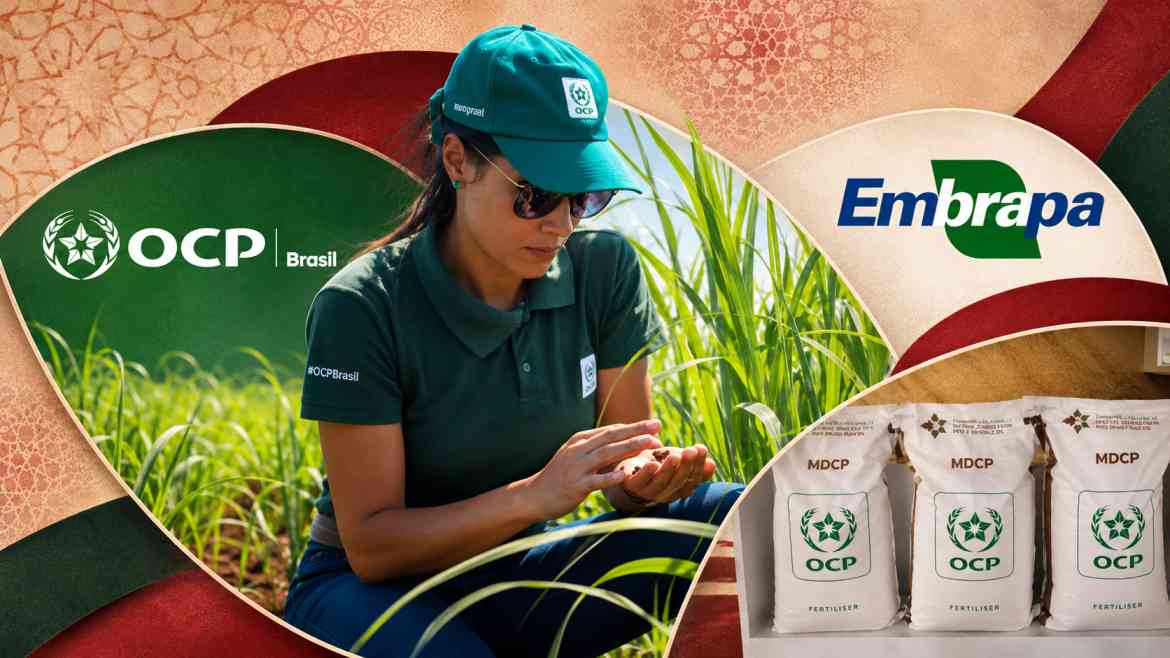
Morocco’s state phosphate giant OCP is teaming up with Brazil’s top farm research body to develop fertilisers laced with helpful microbes, aimed at getting more out of tropical soils. OCP’s Brazilian arm, OCP Brasil, and the Brazilian Agricultural Research Corporation (Embrapa) announced the four-year deal, according to Brazilian farm news site CompreRural.
The research will focus on soya beans and maize, the backbone of Brazil’s farming and exports.
The aim is to find out whether microbes added to fertiliser pellets can help crops absorb more phosphorus, so farmers can use less fertiliser for the same harvest, or grow more with the same amount.
In tropical soils like Brazil’s, much of the phosphorus spread as fertiliser gets locked onto soil minerals before plant roots can reach it. Crops end up using only a fraction of what farmers apply.
The partners will look for microbes that free up nutrients, help roots grow and make plants more resistant to stresses such as drought.
The hard part is keeping the microbes alive. They must survive manufacturing, storage, transport and spreading, which expose them to heat, moisture, changes in acidity and being crushed.
Tests will start in the laboratory, move to greenhouses and then to working farms.
Researchers will measure how well crops absorb nutrients, root strength, plant growth and yields, and check whether results hold across different soils, climates and farming systems.
Six Embrapa research centres will take part, covering soils, soya, maize and sorghum, the environment, farm biology and instrumentation.
The project is part of FertBrasil, an Embrapa-led network that brings together scientists, companies and farmers to turn lab research into products.
For OCP, the aim is to design fertilisers for specific crops and soils, rather than selling standard products. Embrapa wants to make better use of nutrients and build Brazil’s own expertise in farm inputs.
The stakes are high for Brazil, one of the world’s biggest food exporters. It imports more than 85% of the fertiliser it uses, according to industry body ANDA, making it the world’s largest importer.
In 2025, 43.3 million tonnes of the 49.1 million tonnes of fertiliser delivered to Brazilian farms came from abroad.
Brazil’s National Fertiliser Plan, launched in 2022, aims to cut that dependence to about 50% by 2050.
Microbe-based products are already part of the answer. A recent Embrapa study found that using bacteria to release phosphorus locked in the soil could save soya farmers billions in fertiliser costs each season.
Brazil is one of OCP’s most important markets. OCP has been described as Brazil’s biggest supplier of phosphorus, accounting for about 40% of imports.
This year, Brazil’s agriculture ministry signed a memorandum with OCP Nutricrops setting a reference supply of 3.8 million tonnes of phosphate fertilisers for Brazilian buyers.
The new project builds on a strategic agreement signed in 2025 between Embrapa, OCP and Morocco’s Mohammed VI Polytechnic University.


