

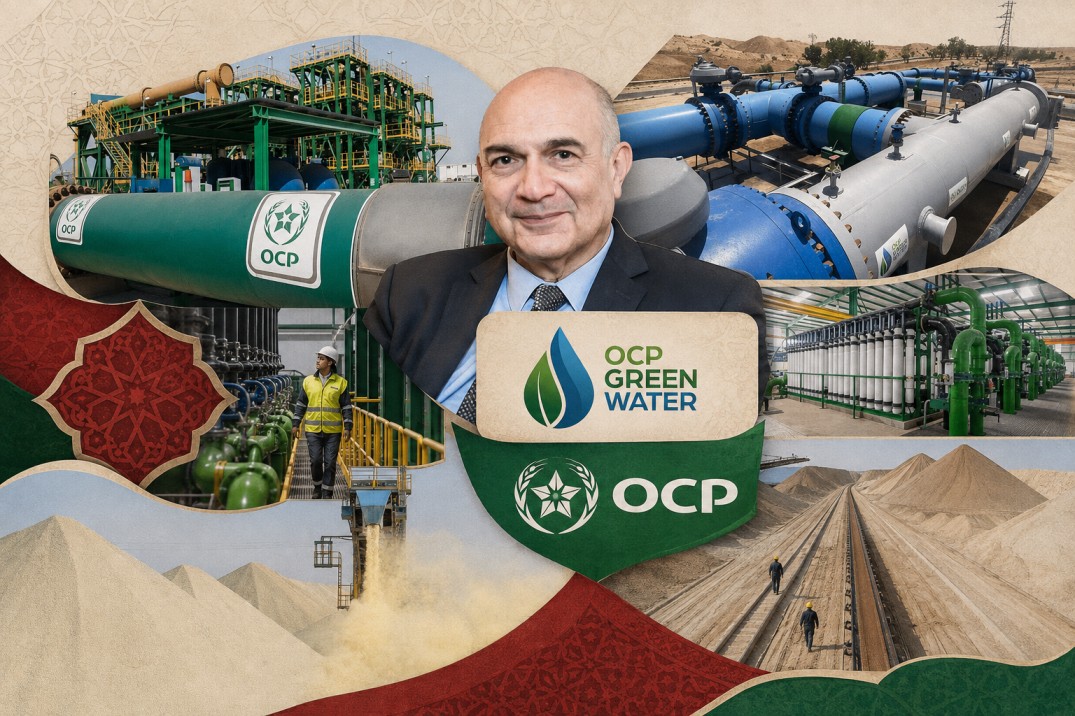
OCP Group is using more desalinated water and clean electricity as it changes how its mining and fertiliser business operates. The phosphate producer covered 81% of its water needs with non-conventional sources in 2025. It also used clean sources for 73% of the electricity needed by its industrial operations.
OCP’s current infrastructure can now cover 100% of its industrial water needs with non-conventional sources.
The group has 288m cubic metres a year of desalination capacity and can treat 53m cubic metres of wastewater. Its water network covers 214km.
A new pipeline between Jorf Lasfar and Khouribga started operating in July 2025. It can carry 80m cubic metres of desalinated water a year inland. The project marks a “transition from site-scale autonomy to a regional water system”.
The company plans to increase desalination capacity to 560m cubic metres a year by 2027. Wastewater treatment capacity is also expected to reach 60m cubic metres a year.
OCP Green Water supplies drinking water to El Jadida, Moulay Abdallah, Haouzia, Azemmour, Safi, Casablanca and Khouribga. The company plans to extend the network to other areas facing water shortages and to some agricultural users.
Safi already reuses about 12m cubic metres of treated urban wastewater each year for industrial operations. The total infrastructure there is close to 23m cubic metres.
OCP has a green investment programme worth up to $13bn. It covers renewable energy, water projects, industrial expansion and green hydrogen and ammonia.
Nearly $2.6bn is planned for renewable energy between 2025 and 2030.
OCP Green Energy is developing solar and wind projects with combined capacity expected to reach 1.2GW in 2027. The International Finance Corporation is supporting the programme with a €200m green loan.
The wider plan targets 5GW of solar and wind capacity by 2027 and 13GW by 2032.
OCP aims to reach carbon neutrality across its operations by 2040.
Clean electricity accounted for 73% of industrial electricity use in 2025. The figure falls to 68% when electricity used to desalinate drinking water for local communities is included.
Green ammonia plans
Green ammonia is a major part of the group’s plans.
OCP calls it “one of the central pillars” of its transition and is targeting production capacity of 1m tonnes.
At Tarfaya, feasibility and pre-engineering studies were completed in 2025. The project also went through pre-certification under renewable fuels of non-biological origin standards.
The planned project is expected to cost $7bn. It would use 3.8GW of wind and solar power to produce green hydrogen for ammonia production.
Output is planned to reach 200,000 tonnes a year by 2026, 1m tonnes by 2027 and 3m tonnes by 2032.
The project is designed to reduce dependence on imported fossil-based ammonia. Import costs exceeded $2bn a year during periods of high prices.
Worley, an Australian engineering company, has started front-end engineering design work for the Tarfaya project and a green hydrogen demonstration unit at Jorf Lasfar.
OCP has also created a joint venture with Fortescue Energy to develop green hydrogen, green ammonia and technology manufacturing facilities.
Other partnerships with Engie and French development agencies are focused on sustainable agricultural supply chains.
Emissions still rising
OCP introduced a “shadow price” of $50 for every tonne of CO2 equivalent in 2025.
The figure is used when the group prepares budgets, plans capital spending, assesses mergers and acquisitions and reviews profit and loss.
The system currently applies to OCP Nutricrops, mines, industrial operations and INNOVX.
OCP says the next step could be an “internal carbon fee”.
Total emissions increased to 21.5m tonnes of CO2 equivalent in 2025, from 20.4m tonnes in 2024.
Scope 1 emissions stood at 3.5m tonnes. Scope 2 emissions were 1.1m tonnes under the market-based method, while Scope 3 emissions reached 16.9m tonnes.
Scope 1 and Scope 2 carbon intensity increased by about 10% between 2022 and 2025.
Total emissions intensity across all three scopes fell by about 20%.
OCP linked the fall to higher production of triple superphosphate. Its share of production increased from about 10% in 2022 to 27% in 2025.
Production and profits
OCP produced 42.9m tonnes of phosphate rock in 2025, compared with production capacity of 47.5m tonnes.
It produced 7.6m tonnes of phosphoric acid from an 8m-tonne capacity.
Fertiliser production reached 13.6m tonnes, against capacity of 15.6m tonnes.
The group estimates its market share at 19% for phosphate rock, 36% for phosphoric acid and 34% for fertilisers.
OCP has 160 fertiliser formulas designed for different soils, crops and climates.
Revenue reached $12.3bn in 2025. EBITDA stood at $4.6bn, giving the group a 38% margin.
Capital spending reached $3.6bn.
The group holds more than 70% of the world’s known phosphate reserves. Its fertiliser production capacity is expected to increase from 15.6m tonnes to 20m tonnes.
OCP chairman and chief executive Mostafa Terrab said sustainability “is not a separate pillar” of the strategy and “underpins competitiveness, performance, and long-term resilience.”
The group also describes sustainability as a “fundamental growth driver”.
Contractor safety remains a problem
OCP recorded no work-related deaths among its employees in 2025, matching the 2024 figure.
Employee fatalities stood at three in 2021, two in 2022 and one in 2023.
Four contractors died in work-related incidents in 2025, compared with one in 2024.
Severe non-fatal injuries among employees increased from five to 11. Contractor cases rose from six to 32.
Recordable accidents involving contractors increased from 113 to 136.
OCP described the overall safety results as a “mixed evolution” and kept its target of “zero harm”.
The group has 27,176 employees worldwide, including 17,275 core employees in Morocco.
Some 99.7% of employees have permanent contracts and 80% are covered by collective bargaining agreements.
Training spending reached $41.25m, or $2,388 per employee.
Women make up 45% of the board and 50% of the highest executive body when the CEO is excluded.
Terrab said the approach was part of a “just transition” designed to “place people at the center”.
Community spending
OCP spent $330m on community programmes in 2025.
The money supported 469 projects that directly benefited 311,045 people.
Employees contributed 100,656 hours to community activities.
The OCP Foundation’s education programmes reached 95,731 people, with women accounting for 60% of beneficiaries.
Al Moutmir helped more than 40,000 farmers adopt good agricultural practices.
The Phosboucraa excellence programme reached 5,566 high-school students through guidance and orientation programmes.
OCP works with about 7,000 suppliers.
Some 93% of industrial spending goes to Moroccan suppliers. The figure is 82% for mining operations.
The Damane Tamayouz fund provided $7.5m in financing to 59 suppliers.
The wider commercial network includes about 350 wholesale clients and millions of end users across five continents.
Risk and expansion
OCP added climate and nature risks to its main risk matrix in 2025. A central team monitors them.
The World Benchmarking Alliance assessed 1,600 companies and ranked OCP “first in the chemical sector” for its approach to the just transition.
The internal audit team completed all 21 planned missions and issued 244 recommendations. Some 85% were implemented on time.
Two audits focused on ESG issues linked to renewable energy and non-conventional water.
OCP is also expanding its fertiliser business in sub-Saharan Africa. Planned blending and manufacturing facilities in Nigeria and Ethiopia are aimed at producing fertilisers suited to local farming needs.
The group is now trying to expand its water, energy and fertiliser operations while keeping costs, emissions and safety risks under control.


