

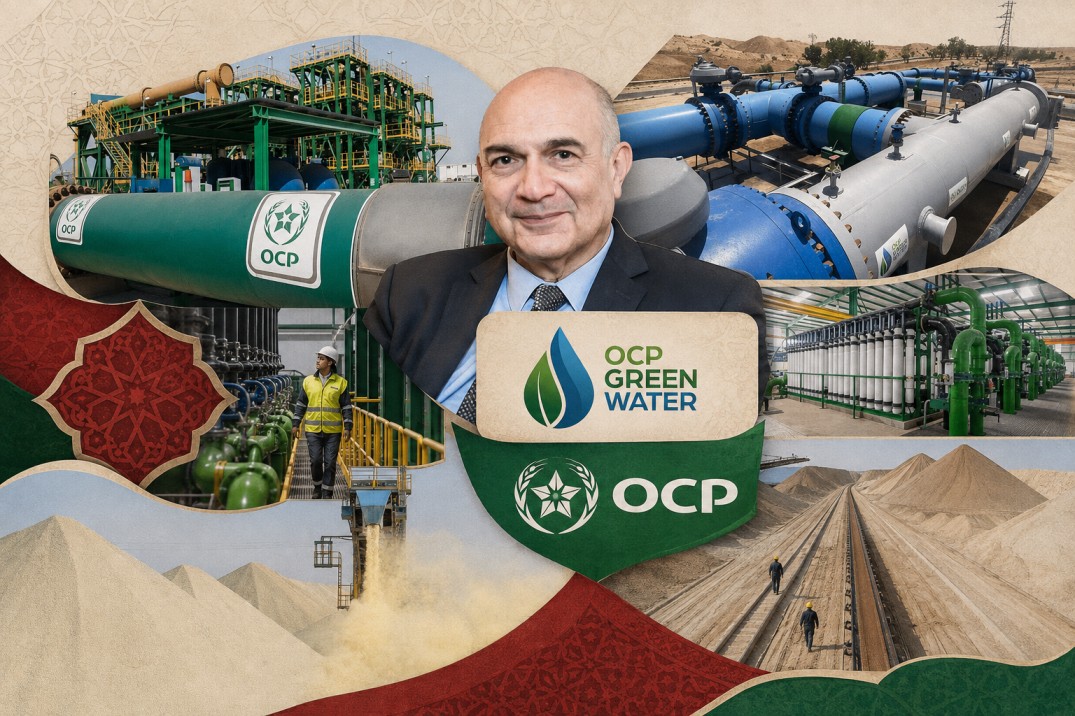
OCP is opening some of its water infrastructure to outside investors as it looks to share the cost of financing its growing desalination and water transport business. A decree signed on 23 July by Head of Government Aziz Akhannouch allows OCP Green Water to create two companies focused on desalination and water transport. The companies can bring in other shareholders. Public entities will keep a majority stake, but OCP will not have to hold that majority by itself.
The move changes how OCP treats water infrastructure that was originally built to support its phosphate business. These facilities are now becoming part of a wider water network that serves cities and regions beyond OCP’s own industrial sites.
The first company will cover the central zone, including Safi, Benguerir, Youssoufia and Marrakech. It will target annual capacity of 195 million cubic metres.
The second will cover the northern zone, including Jorf Lasfar, El Jadida, Casablanca and Khouribga. It will target 215 million cubic metres a year.
OCP’s board approved the plan in March 2025. OCP Green Water’s board approved it in February 2026.
The new structure will also allow each company to raise its own debt. This means the companies can finance their projects through separate balance sheets rather than relying only on OCP’s main balance sheet.
The structure also makes it possible for outside investors to buy minority stakes. These could include institutional investors, sovereign wealth funds and international infrastructure funds.
The plan comes as OCP Green Water has become a major water operator.
The group turned to water supply after drought put pressure on drinking-water supplies in the Oum Er-Rbia basin in 2022.
OCP was already desalinating seawater at Jorf Lasfar at the time. The facility operated under an authorisation that allowed OCP to produce water for its own industrial plants.
The government gave OCP a wider role in July 2023. A concession allowed OCP to produce drinking water for the water utilities serving Safi and El Jadida.
The contract set annual production at 85 million cubic metres until 2025 and 110 million cubic metres from 2026.
A new unit serving southern Casablanca started operating at Jorf Lasfar in October 2024. It initially produced 20 million cubic metres a year. Its capacity rose to 60 million cubic metres in December.
That capacity covers more than a quarter of the drinking-water needs of Casablanca-South.
OCP Green Water had a total desalination capacity of 340 million cubic metres a year by 30 June 2026.
The company also had eight wastewater treatment plants and a 219km pipeline carrying desalinated water from Jorf Lasfar to Khouribga.
The water network grew out of infrastructure built around OCP’s phosphate operations in Jorf Lasfar, Khouribga, Benguerir, Youssoufia and Safi.
OCP is now separating its assets into two broad categories: assets it needs to control and assets it can share with other investors.
Phosphate mining, chemical production and core fertiliser operations remain strategic assets where OCP keeps control.
Water and other utility infrastructure can be financed and owned with other partners.
The new companies are therefore designed to bring in both debt and equity. Their separate balance sheets can support borrowing linked to individual water projects and their future revenues.
The model can also reduce the amount OCP has to finance itself. It allows the group to share the cost of expanding water infrastructure while keeping more of its own capital focused on phosphate mining, chemicals and fertiliser production.
What started as a way to supply water to OCP’s industrial operations has become a much larger network serving drinking-water needs in central and northern parts of the country.


