

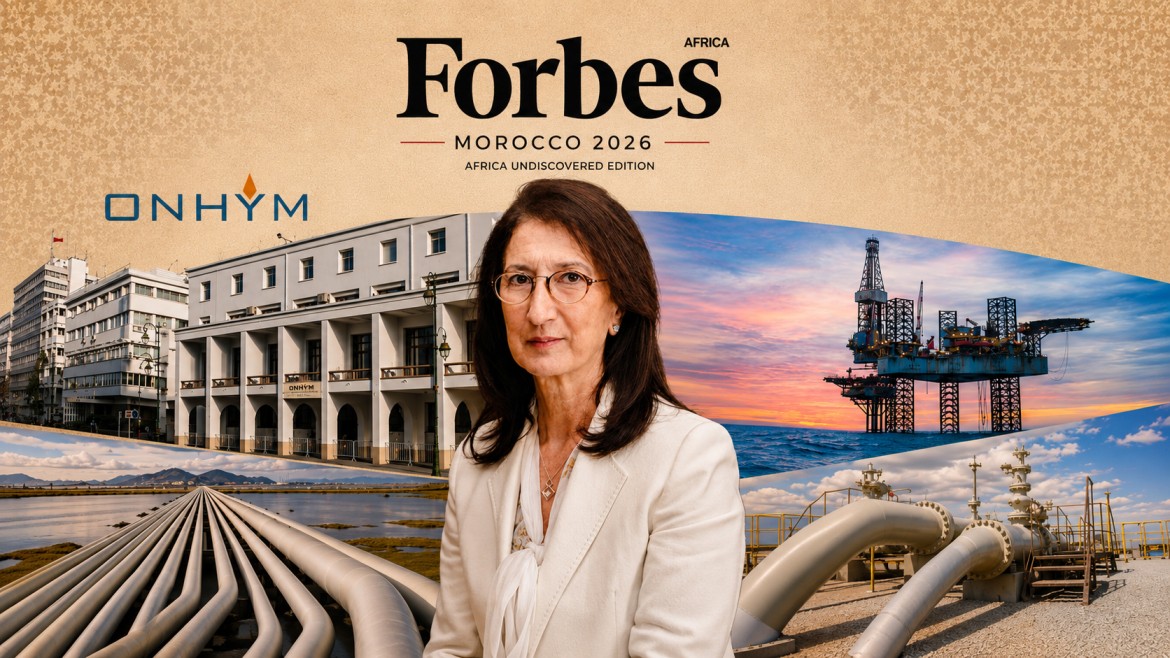
Morocco is stepping up efforts to find new mineral and gas resources and attract foreign companies to its mining and energy sectors. A recent Forbes Africa feature, Unlocking Morocco’s Subsurface Advantage, looked at the work of the National Office of Hydrocarbons and Mines (ONHYM) and its General Director, Amina Benkhadra. The article appeared in the August/September 2026 special issue, Morocco 2026: Africa Undiscovered Edition.
ONHYM is investing in geological surveys and data to give companies a clearer picture of what lies beneath the country’s land and offshore areas. “We undertake strategic investments in new data acquisition and analysis at the front end of the exploration cycle to enhance knowledge of the prospects of offshore and onshore Moroccan sedimentary basins, and conduct strategic and tactic exploration in the mining sector, enhancing the critical minerals.”
The data can help companies decide where to invest in exploration before spending large amounts of money on drilling.
ONHYM had 13 international oil and gas companies working on exploration projects at the end of 2024. The projects covered more than 233,000 sq km.
Hydrocarbon investment reached MAD 1.05bn ($105m) in 2024, with partners providing 96% of the funding. “Thirteen internationally renowned oil and gas companies are operating on 73 exploration permits for onshore and offshore operations. Our portfolio is still growing with new companies signing new agreements.”
ONHYM’s official figures for 2024 list 53 exploration permits: 19 onshore and 34 offshore. The organisation also held reconnaissance authorisations and exploitation concessions.
Searching for critical minerals
ONHYM is also looking for minerals used in batteries, renewable energy and electricity networks.
Its projects include copper, cobalt, lithium, manganese, nickel, uranium and rare earth elements.
ONHYM had 44 mining projects in 2024. Half were its own projects and half were carried out with partners.
Phosphates remain the country’s biggest mining business. The US Geological Survey estimates that Morocco has about 50bn tonnes of phosphate-rock reserves, around 68% of the world’s total.
Phosphates and their derivatives generated about MAD 87bn in exports in 2024.
Benkhadra said: “We have discovered almost all the mines in Morocco.”
ONHYM continues to explore for new deposits, particularly minerals that could be needed for the energy transition.
A 6,900km gas pipeline
ONHYM is also involved in the planned Nigeria-Morocco Gas Pipeline.
The project would stretch for about 6,900km and pass through 13 countries before reaching Morocco. It could carry up to 30bn cubic metres of gas a year.
“The strategic Nigeria-Morocco Gas Pipeline project will run along the West African coast from Nigeria, through Benin, Togo, Ghana, Côte d’Ivoire, Liberia, Sierra Leone, Guinea, Guinea-Bissau, Gambia, Senegal, and Mauritania, to Morocco. This gas pipeline will be a catalyst for economic development in the region. Indeed, it will help accelerate the electrification of the countries crossed. It will support local development through the industrialization of different sectors and improve the living conditions of the population. Moreover, it will contribute strongly to the regional integration. The project will give Africa a new economic, political, and strategic influence.”
The pipeline is expected to cost about $25bn. A final investment decision is targeted for late 2026, while first gas is expected in 2031.
The project is still being developed, so the expected economic benefits have yet to materialise.
More gas infrastructure
ONHYM is also involved in existing gas infrastructure.
The Maghreb-Europe Gas Pipeline has allowed gas to flow from Spain into Morocco since Algerian supplies through the route stopped in 2021.
Domestic gas production continues in areas including Gharb and Essaouira. The Tendrara project is another key development. It has certified gross recoverable resources of about 377bn cubic feet, according to Sound Energy.
Forbes Africa said: “In its onshore and offshore explorations, the institution has made gas discoveries in Gharb, Essaouira, and Tendrara, as well as the Moroccan Atlantic margin off the coast of Larache.”
The publication also highlighted ONHYM’s role in gas infrastructure: “The Nigeria-Morocco Gas Pipeline, the Maghreb Europe Gas Pipeline, and the implementation of a two-way gas flow with Spain are some of the institution’s noteworthy engagements in the field of natural gas transport and storage infrastructure.”
ONHYM is also working with Moroccan and international companies on mining projects involving critical minerals, precious metals, base metals, uranium, rare earth elements and industrial minerals.
Forbes Africa said: “ONHYM conducts mining exploration, contributing to the development of economically exploitable mining businesses… ONHYM develops different types of prospects, including precious metals, base metals, uranium, rare earth elements, industrial minerals, and critical minerals, in partnership with domestic and international operators focusing on meeting the demand for essential minerals in Morocco’s energy transition plan.”


