

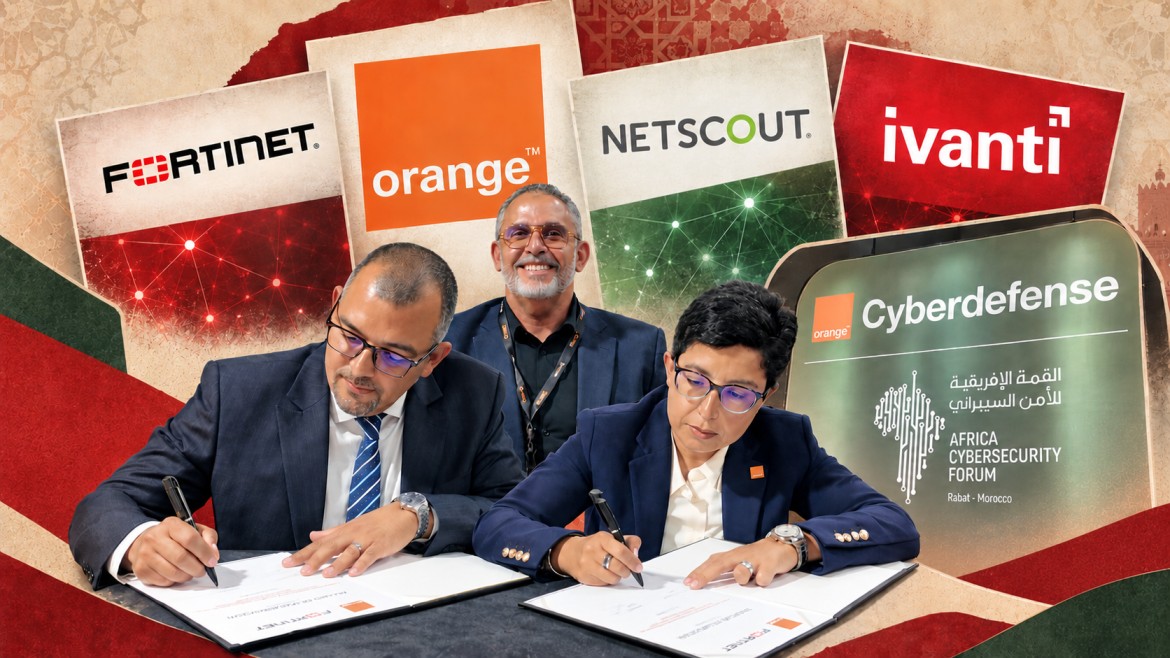
Businesses, government offices and industrial sites are facing growing risks as they move more of their work online. Orange Maroc has announced three partnerships with global cybersecurity firms to help protect their systems, networks and connected devices. The telecom operator signed agreements with Fortinet, NETSCOUT and Ivanti during Morocco CyberSecurity Week 2026, which runs from 12 to 14 October in Rabat. Orange Maroc is a silver sponsor of the event and its cloud and security partner.
The deals will help the company protect industrial control systems, detect threats to networks and identify and fix security weaknesses in computers and other connected devices.
Orange Maroc has obtained an Operational Technology (OT) specialisation through its partnership with Fortinet. The technology is used to protect the systems that control industrial operations, including those found in energy networks, water facilities, transport hubs and factories.
The agreement with NETSCOUT will expand protection beyond conventional defences against distributed denial-of-service (DDoS) attacks, which try to overwhelm a website or network with traffic. The new approach will provide wider network visibility and help detect changing threats.
The partnership with Ivanti will focus on managing security risks across devices. Its technology can help organisations identify equipment, detect vulnerabilities and automate fixes, including software updates that close security gaps.
“At a time when AI accelerates digital transformation and evolves threats, cybersecurity has become an essential pillar of any successful transformation,” said Nouhade Mechkour, ICT director at Orange Maroc.
“Our ambition is to support Moroccan companies and administrations in securing their activities by combining deep knowledge of their challenges with a global technological and partnership ecosystem,” she said.
“Through our commitment, we contribute to building a safer, more resilient digital environment conducive to economic development,” she added.
ortinet, founded in 2000 and based in Sunnyvale, California, specialises in network security, secure access service edge (SASE) technology and industrial cybersecurity. It is listed on the Nasdaq stock exchange under the ticker FTNT.
Its products include FortiGate firewalls and the Fortinet Security Fabric, a platform designed to bring different security systems together.
In the Orange Maroc partnership, Fortinet’s expertise will focus on operational technology. This includes supervisory control and data acquisition (SCADA) systems, programmable logic controllers (PLCs) and industrial control systems (ICS), which help operate machinery and manage industrial processes.
These systems are used in sectors such as manufacturing, energy and transport, where a cyberattack can disrupt physical operations as well as digital services.
NETSCOUT was founded in 1984 and is based in Westford, Massachusetts. Listed on the Nasdaq under NTCT, it provides tools for monitoring network performance, examining data traffic and detecting cyber threats.
Its security portfolio includes technology from Arbor Networks, which NETSCOUT acquired to strengthen its DDoS detection and protection business.
The partnership with Orange Maroc will use network monitoring, traffic analysis and threat intelligence to help identify suspicious activity and protect large networks against changing attacks.
Ivanti was formed in 2017 through the merger of HEAT Software and LANDESK, although the businesses behind it date back to 1985. The privately held company is based in South Jordan, Utah, and specialises in unified endpoint management, IT service management and security.
Its tools allow organisations to discover, manage and secure devices from a central system. They can also help automate vulnerability detection, software patching and other corrective actions.
The technology is relevant to businesses with staff working remotely or across several offices, as well as organisations using connected devices and equipment.
Orange Maroc’s cybersecurity plans are part of a wider push into digital infrastructure and enterprise services.
During Morocco CyberSecurity Week, which runs under the theme “Cybersecurity at the Service of Transformation and Digital Development”, company executives are taking part in discussions on secure cloud transformation and market growth.
The event is bringing together government and cybersecurity stakeholders to discuss digital security and regional cooperation.
In early October 2026, Orange Maroc signed separate enterprise agreements during the AUSIM convention to deploy sovereign cloud platforms backed by graphics processing unit (GPU) infrastructure. The systems are intended to support artificial intelligence processing within local enterprise environments.
Orange Cyberdefense, the group’s cybersecurity business, also operates a hub in Casablanca’s Technopolis. It serves organisations in Morocco and across North and West Africa.
The three new partnerships add industrial protection, network monitoring and device security to Orange Maroc’s business services as companies and public institutions face growing pressure to protect their digital systems.
Orange Maroc serves 18.8 million customers in the country. The company says its investments are intended to support the wider digital economy as businesses and public institutions rely more heavily on connected services.
The agreements come as Morocco pursues its Maroc Digital 2030 strategy and prepares infrastructure for major international events, including the 2030 FIFA World Cup.
Industry estimates value the country’s cybersecurity market at $157.11m in 2026. It is forecast to grow by an average of 8.67% a year, reaching $238.12m by 2031.
Demand is growing particularly quickly for companies that manage cybersecurity on behalf of other organisations. Managed security services, threat detection and response, and security operations centres are expanding at an estimated annual rate of more than 13.5%.
One industry estimate puts the combined market for managed detection and response (MDR) and security operations centres (SOCs) at $168m in 2026.
Financial services account for an estimated 25.10% of business spending on cybersecurity, making banking, financial services and insurance a major source of demand.
Healthcare is expected to see the fastest growth in cybersecurity spending, at an estimated 16.74% a year, as hospitals and other providers digitise medical records and face tighter regulatory requirements.
Public institutions and state-owned companies must also follow information security and infrastructure protection guidance issued by the General Directorate for Information Systems Security (DGSSI).
The market is creating opportunities for telecom operators to sell more than phone and internet services. By offering cybersecurity tools and managed protection, they can help businesses defend their systems while developing new sources of revenue.


