

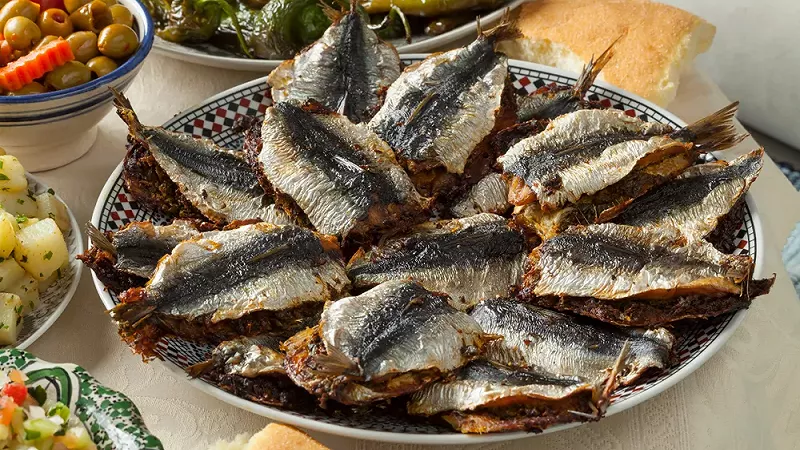
Sardine prices in Morocco have fallen after the end of a seasonal fishing ban, but they remain too high for many families as Ramadan approaches.
The ban was lifted on 15 February in central and southern Atlantic waters. A day later, prices in Casablanca dropped from 50 dirhams a kilo to about 30 dirhams.
Even at 30 dirhams, many shoppers say they cannot afford it.
In markets in Rabat and Salé, sardines were almost impossible to find at the weekend. Some sellers replaced them with anchovies, which were selling at similar prices.
“For nearly a month there were no sardines,” one fish seller said. He blamed bad weather and the fishing stop. “Before, when prices were high, they reached 15 or 20 dirhams. Now they are 50, if you can find them.”
As Ramadan draws near, people on social media have called for price limits. Many are asking for sardines at 10 dirhams a kilo and eggs at one dirham each.
Sardines have long been seen as the “fish of the poor” in Morocco. When meat becomes expensive, many families turn to sardines. Seeing the price reach 50 dirhams has caused anger and worry.
Official figures show a big gap between the price at the port and the price in the market.
On 13 February, sardines at the Casablanca wholesale market were sold for about 22 dirhams a kilo. In El Jadida, they were sold for around 26 dirhams for small amounts, but earlier large supplies were sold for less than 9 dirhams.
In Mohammedia, recent sales were recorded at 5 dirhams a kilo. In Safi, large amounts were sold for about 7 dirhams.
Yet in cities such as Casablanca and Rabat, retail prices were much higher.
People in the sector say several middlemen stand between the fishing boat and the market stall. Some buy large amounts at the dock and control how much reaches the main markets. Transport costs and the risk of spoilage are also used to explain the higher prices.
In the south, especially below Agadir, boats sell at fixed prices that do not go above 3 dirhams a kilo. But once the fish reaches big cities, the price can double or triple.
It can take one to two days for fish from the far south to reach Casablanca and then be sent to other cities. Traders say markets are still waiting for larger supplies after the ban ended.
The government has also launched a “fish at a reasonable price” scheme. At its opening in Tamesna on 12 February, frozen sardines were sold for 13 dirhams a kilo. Officials hope cheaper frozen fish will push down the price of fresh fish.
In Agadir, local reports on 16 February said sardines were selling for between 8 and 10 dirhams a kilo.
Experts say a national price of 10 dirhams is possible, but only if there is strong supply for several days and better control of the supply chain.


