

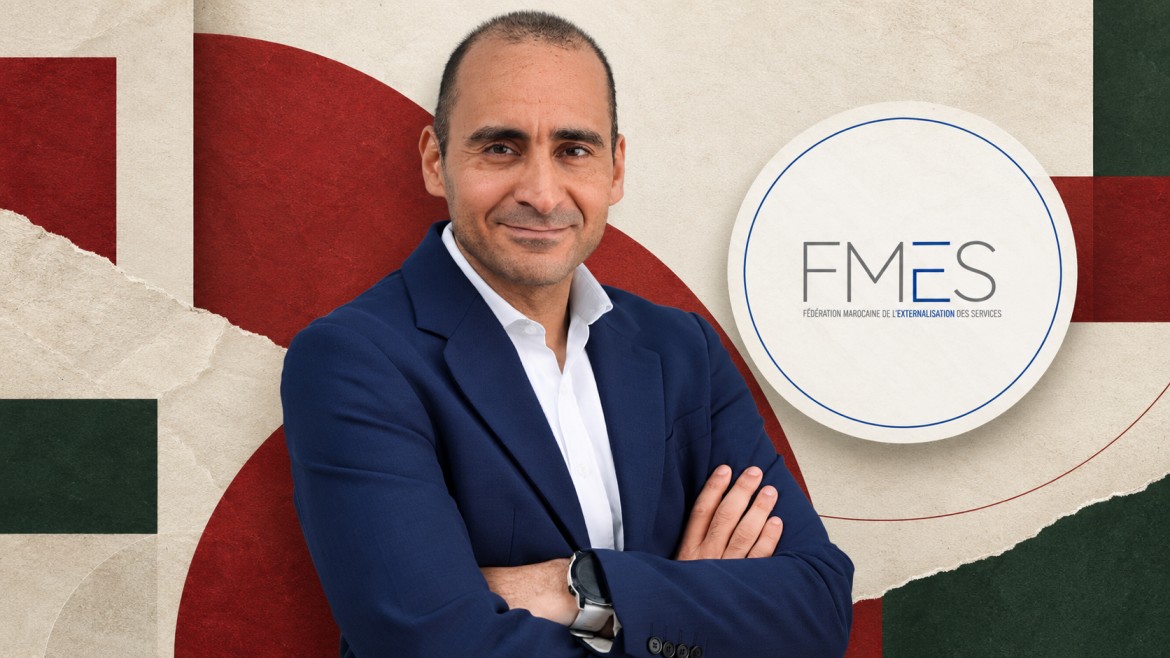
Redouane Mabchour is the new president of the Moroccan Federation of Service Outsourcing (FMES). The federation elected him for a three-year term at its general assembly on 10 September 2026. He replaces Youssef Chraibi, who led the federation for two consecutive terms and was its founding president.
Mabchour is general manager for Africa at Concentrix. He previously served as FMES vice-president.
His plan for the next three years has four main priorities: bringing companies in the sector closer together, preparing workers for new skills, adapting jobs to artificial intelligence and automation, and working with public authorities.
“These next three years must be ones of acceleration and implementing new actions. Our roadmap revolves around four clear priorities: unifying the entire outsourcing ecosystem, anticipating tomorrow’s skills, reinventing our professions in the face of automation, and supporting public authorities,” Mabchour said.
The changes come as artificial intelligence starts to affect how outsourcing companies recruit people and run their operations.
The FMES says the sector has more than 1,000 active companies and employs about 150,000 people. It generated around 18bn dirhams ($2bn) in export revenue.
The industry is also the country’s second-largest employer and third-largest source of export revenue, according to FMES figures.
Chraibi said the leadership change marks a new stage for the federation.
“At the end of my two consecutive statutory terms, I measure the path traveled together since the creation of the FMES. By carrying its foundation and its recognition as a statutory federation within the CGEM, we helped give structure and voice to a strategic sector for Morocco… The election of Redouane Mabchour opens a new stage, which I welcome with confidence,” he said.
The FMES is a statutory federation within the General Confederation of Moroccan Enterprises (CGEM).
Mabchour also wants to strengthen the country’s position as a regional outsourcing hub. The federation plans to promote higher-value services, including engineering and advanced business-process outsourcing.
It also plans to increase the industry’s presence in African markets and help workers develop the digital skills needed as AI and automation change traditional outsourcing jobs.


