

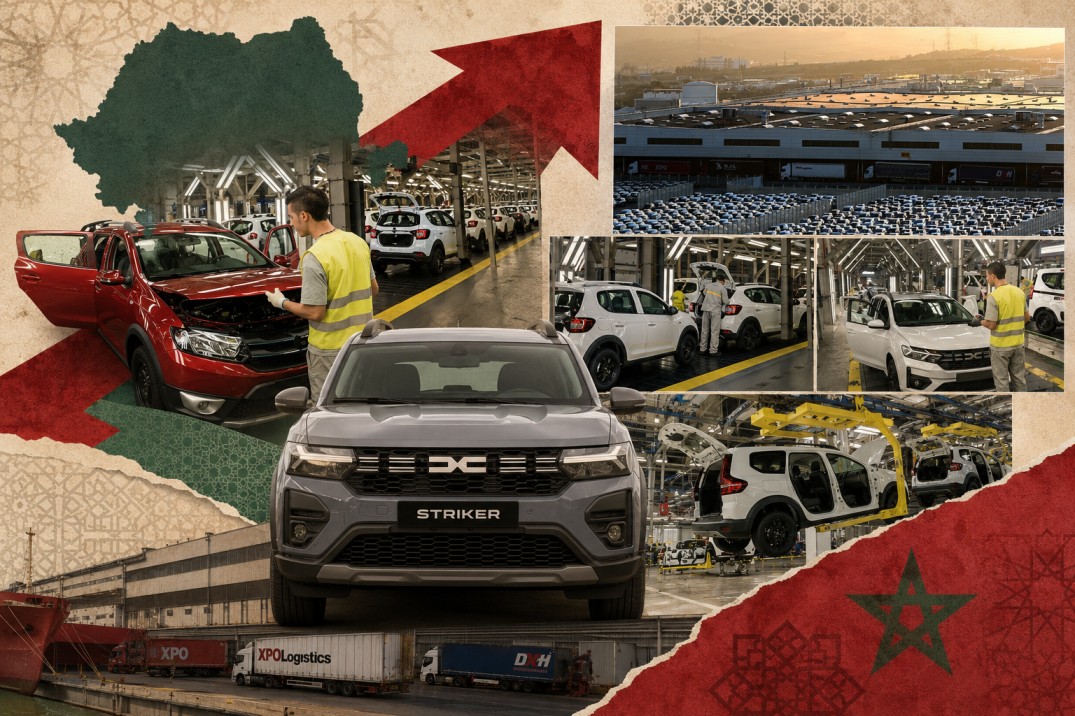
Renault is moving production of new Dacia models from Romania to Morocco after higher energy prices, rising labour costs and higher taxes made its Romanian operations less competitive.
The Mioveni factory in southern Romania, Dacia’s main production site, has been hit hardest. Renault has moved production of new models, including the Dacia Striker, to Morocco and other factories. The decision has raised concerns in Romania about the future of its car industry.
Lower costs are one of the biggest reasons behind the shift. Building a vehicle in Morocco costs just over €100 in labour, compared with €500 to €700 in Romania. Factory workers in Morocco earn around €300 to €400 a month, while similar jobs in Romania pay €800 to €1,100.
Energy costs have also widened the gap. Industrial electricity costs about €0.06 per kilowatt-hour in Morocco, compared with €0.18 to €0.24 in Romania after prices surged across Europe following the energy crisis.
Romania has also increased corporate taxes to reduce its budget deficit. By contrast, companies operating in Morocco’s Industrial Acceleration Zones receive a 100% corporate tax exemption for the first five years, before paying a reduced rate of 15% to 17.5%. Raw materials, machinery and components imported into the zones are also exempt from customs duties and VAT.
François Provost, Renault Group’s Chief Procurement Officer and Chief Partnership Officer, said: “The group faces one of the biggest challenges in its history at the national level, caused by both external and internal factors.”
He added: “The sharp increase in electricity and gas prices in Romania has severely impacted and continues to impact the competitiveness of Renault’s operations in the country, including the Mioveni plant, which must regain its competitiveness so that we can assign the production of other models here in the future.”
Dacia sales in Romania have also fallen. For the first time, the Mioveni factory built fewer cars than Renault’s two factories in Morocco.
The two Moroccan plants in Tangier and Casablanca produced about 394,000 vehicles in 2025, compared with an annual capacity of 300,000 to 350,000 vehicles at Mioveni.
Dacia Romania Managing Director Mihai Bordeanu said: “With the exception of the Duster and Bigster models, there are no new projects planned for execution inside the plant.”
The Romanian factory now focuses mainly on the Dacia Duster and the new Dacia Bigster. The Moroccan plants build high-volume models such as the Sandero, Logan, Express, and new models including the Dacia Striker. Around 82% of the vehicles built in Morocco are exported to more than 60 countries.
The company also builds some models at plants in Bursa, Turkey, and Novo Mesto, Slovenia.
Bordeanu said: “Things are not yet clear regarding the future investments of the Renault Group in this country, especially since policies regarding taxation and energy costs are evolving in a direction that does not serve the group’s interests.”
Logistics also favour Morocco. The Tangier and Casablanca factories are linked to Tanger Med Port, allowing finished vehicles to reach ports in Spain, France and Italy in 36 to 48 hours. Vehicles leaving Romania travel mainly by road and rail across Europe, taking three to five days and facing higher transport costs.
Tanger Med handled more than 11.1 million containers and 161 million tonnes of cargo in 2025. Its vehicle terminal can process up to one million cars a year.
The Moroccan factories also use Renault’s CMF-B platform, which allows the same assembly lines to produce petrol, LPG, mild hybrid and fully electric vehicles. The Tangier plant also runs on renewable wind and solar power and operates as a carbon-neutral, zero-liquid-discharge facility.
The changes come as Europe’s car industry faces growing pressure. In May, the European Automobile Manufacturers’ Association (ACEA) warned that Europe risks losing factories and jobs unless it improves its competitiveness.
The association said: “Without urgent and coordinated action, Europe risks losing its production capacity, innovation potential, and industrial jobs.”
It added: “The growing nature of competitive intensity coming from regions operating under different cost structures, regulatory frameworks, and coordinated industrial strategies puts unprecedented pressure on European manufacturers, suppliers, and workers.”


