

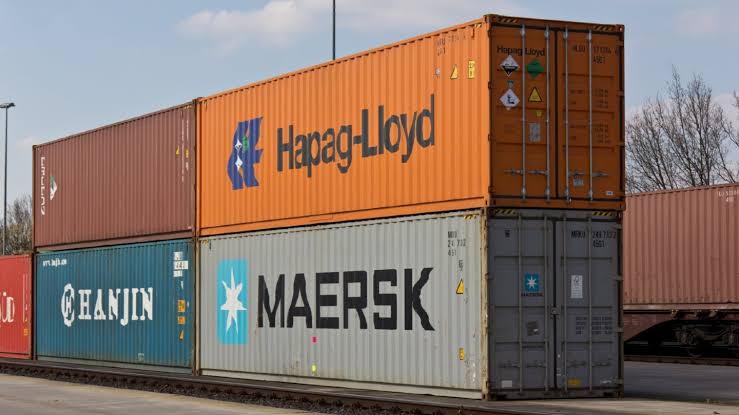
Businesses moving goods between China and Morocco will have a new direct shipping service from November, but Tanger Med will also lose calls on two existing routes as Hapag-Lloyd and Maersk reshape their Asia-Europe networks. The German and Danish shipping groups announced the changes on 19 October. The overhaul affects six services and reflects their wider return to the Suez Canal after security threats in the Red Sea forced ships to take longer routes around southern Africa.
The new service, called SE5 by Hapag-Lloyd and AE18 by Maersk, will link Shanghai and Xiamen in China with Tanger Med. Ships will call at Tanjung Pelepas in Malaysia, pass through the Suez Canal and stop at the Spanish port of Algeciras.
The first vessel listed for the service, the Maersk Edirne, is scheduled to arrive in Shanghai on 22 November 2026. This marks the start of its Asian rotation, not its first arrival at Tanger Med. The date of its first Moroccan call has not been announced.
Hapag-Lloyd says the service will provide “fast and direct connections between central and southern China and key markets in the western Mediterranean.”
The route will allow goods to travel between the Chinese ports served and Tanger Med without being transferred to another ship. It will also give businesses access to onward connections to West African markets.
The companies have not disclosed the ships’ capacity, expected annual cargo volumes for Morocco or exact transit times. Container journeys from Shanghai or Ningbo to Tanger Med typically take 20 to 25 days.
Tanger Med loses two existing services
The new China link comes with a significant change: Tanger Med will be removed from the North Europe Express 1 (NE1) and Asia South Europe 2 (SE2) services.
The NE1 service connects Asia with northern European ports. Under the revised schedule, ships will call at Ningbo, Shanghai, Tanjung Pelepas, Rotterdam, Wilhelmshaven and Bremerhaven, before returning to Rotterdam and continuing via Salalah in Oman and Singapore.
Rotterdam will become the first European port of call on the service, bypassing the western Mediterranean. The first vessel under the new arrangement, the Moscow Maersk, is scheduled to arrive in Ningbo on 13 November.
The change shifts the service’s European entry point northwards. However, the companies have not disclosed how many containers previously passed through Tanger Med on this route or how much cargo may be redirected to Rotterdam or other ports.
The SE2 service will also drop Tanger Med from its Asia-Europe leg, replacing it with Port Said in Egypt. The revised route will add Salalah before the Suez Canal while retaining calls at Valencia and Barcelona in Spain, and La Spezia, Genoa and Vado Ligure in Italy.
The first vessel affected, the Estelle Maersk, is due to arrive in Shanghai on 15 November.
The changes will redistribute scheduled port calls, but they do not establish how much cargo Tanger Med will gain or lose.
Tanger Med retains two calls on SE4
Tanger Med will remain on the Asia South Europe 4 (SE4) service, although its route will also change in November.
The revised rotation will link Tianjin, Qingdao, Busan, Ningbo, Nansha, Tanjung Pelepas, Jeddah, Port Said, Damietta and Tanger Med, before returning via Port Said, Jeddah and Singapore.
The schedule lists two successive calls at Tanger Med, at terminals TC1 and TM2. These are two terminal calls during a single shipping rotation, not two separate services.
The route will replace Shanghai with Nansha in southern China and add Damietta in Egypt. The first vessel under the revised schedule, the Ane Maersk, is scheduled to arrive in Tianjin on 17 November.
The service will maintain connections between Tanger Med and several Chinese industrial centres, as well as Busan in South Korea. The companies have not announced any increase in the handling capacity of the Moroccan terminals.
The changes also affect the SE1 and SE3 services, which serve the eastern Mediterranean.
The SE1 service will replace its calls at Algeciras with calls at Port Said in both directions. It will also add Colombo in Sri Lanka to its eastbound journey to Asia. The first vessel, the Alva Maersk, is scheduled to arrive in Ningbo on 17 November.
The SE3 service will retain its Asian ports and calls at Port Said and Damietta, but will drop Colombo on its return voyage. Its first listed vessel, the Maersk McKinney Moller, is due to arrive in Qingdao on 13 November.
The six services covered by the changes are NE1, SE1, SE2, SE3, SE4 and the new SE5.
A major port facing a changing shipping network
Tanger Med handled 11,106,164 twenty-foot equivalent units (TEUs) in 2025, an increase of 8.4% from the previous year. A TEU is a standard measure of container capacity based on a container about 20 feet long.
The port also processed 161 million tonnes of cargo in 2025. Transshipment cargo — goods transferred between ships on their way to another destination — accounted for 128.7 million tonnes of the reported volume.
In September 2026, Tanger Med handled 423,989 TEUs in exports and 500,521 TEUs in imports across 285 vessel calls.
The port’s growth was supported by the extension of the TC4 terminal by APM Terminals in late 2024. Tanger Med is Africa’s largest port and a major hub in the Mediterranean.
The revised shipping network will concentrate more calls at ports including Port Said and Damietta in Egypt, Salalah in Oman and Rotterdam in the Netherlands. These changes reflect the carriers’ efforts to organise routes around key transfer points closer to the Suez Canal and northern European markets.
The two removed calls do not automatically translate into a specific loss of containers for Tanger Med. The published schedules contain no figures for the cargo previously handled on the affected services or forecasts of the overall impact on the port.
The two terminal calls on SE4 may reflect operational requirements, such as different cargo flows or equipment movements. However, the companies have not explained why both TC1 and TM2 appear in the schedule.
Why shipping companies are returning to the Suez Canal
The Gemini Cooperation, the operational partnership between Maersk and Hapag-Lloyd, began on 1 February 2025. It combines major intercontinental routes with regional services designed to connect cargo through selected hub ports.
The alliance uses a hub-and-spoke model, in which large ships call at major ports and cargo is transferred to smaller vessels for onward journeys. Its stated goal is to achieve schedule reliability above 90%.
Attacks by Yemen’s Houthi movement on commercial ships in the Red Sea forced carriers to divert many services around the Cape of Good Hope in southern Africa. The longer route increased journey times and fuel consumption.
Maersk and Hapag-Lloyd began restoring some services through the Red Sea and Suez Canal during 2026. Four services returned to the corridor in September, according to the information provided. The November changes extend that reorganisation.
Using the Suez Canal can cut Asia-Europe journeys by up to two weeks compared with sailing around southern Africa. Shorter journeys can reduce fuel use, emissions and operating costs.
Moving transfer points closer to the Mediterranean entrance of the Suez Canal can also reduce the need for feeder ships to travel back towards the Strait of Gibraltar to serve eastern Mediterranean markets.
For Tanger Med, the new SE5 service provides a direct link with the Chinese ports covered by the route and onward access to West African markets. But the port is also losing calls on NE1 and SE2, and the net effect on its cargo volumes remains unknown.
China-Morocco trade grows
The route changes come as trade between China and Morocco continues to expand.
Bilateral trade reached $10.96bn in 2025, up from $9.04bn in 2024, according to the figures provided. China is the third-largest trading partner of Morocco globally.
Separate figures from the UN Comtrade database put Moroccan imports from China at $14.23bn in 2025. The main categories were electrical and electronic equipment, worth $2.78bn; machinery and boilers, worth $2.22bn; and vehicles, worth $1.53bn.
These figures are reported as supplied and may use different statistical definitions or measures. They should not be treated as directly interchangeable.
The amount of Chinese cargo moving through Tanger Med will depend on demand, shipping capacity and how businesses use the revised network. Hapag-Lloyd and Maersk have not published forecasts showing whether the new direct service will offset the two removed calls.
The November schedules therefore show a change in how the carriers connect Asia, Europe and Africa, rather than a confirmed increase or decrease in the amount of cargo handled by Tanger Med.


