

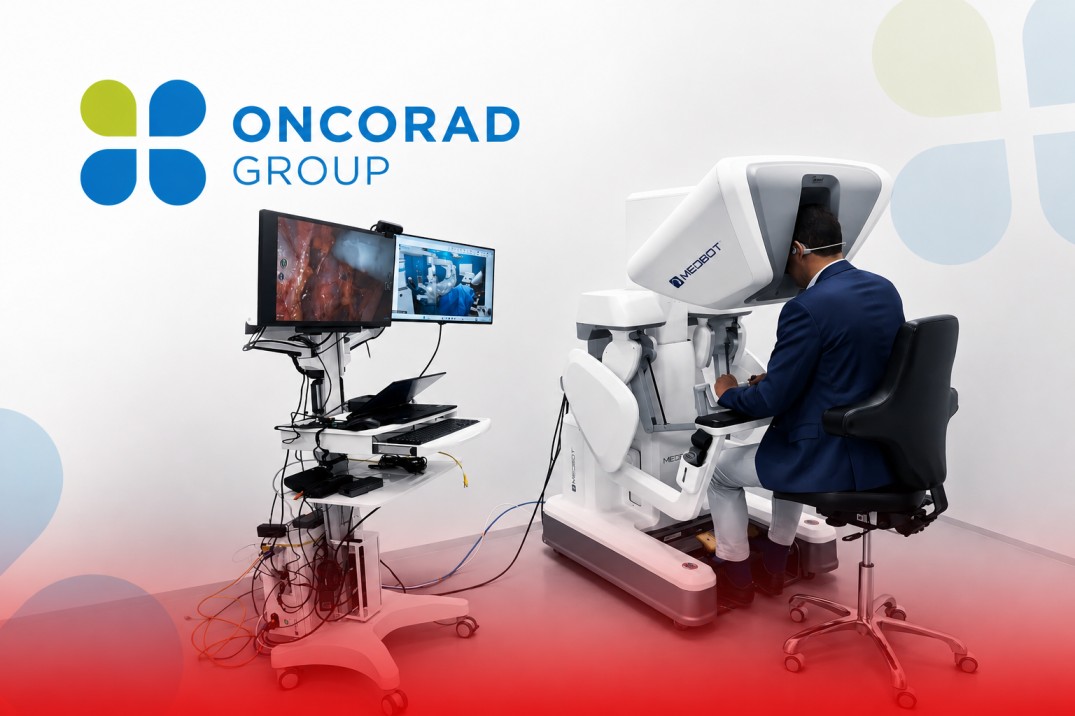
A cancer clinic in northern Morocco has carried out 100 robot-assisted operations in less than a year, as the country’s private hospital groups race to take high-tech surgery beyond Casablanca. Oncorad Group said on 23 November that 91 of the procedures at its Clinique d’Oncologie de Tanger were radical prostatectomies – the complete removal of the prostate to treat cancer.
The company says the clinic is the only hospital in the north of the country with a surgical robot. Morocco carried out its first robot-assisted prostate removal only in May 2024.
Oncorad says the aim is to spare patients in a region of four million people the journey to the big cities for treatment.
Access to specialist cancer care remains uneven. Dr Youness Ahallal, who runs Oncorad’s robotic surgery programme, said this month that access to scans, targeted biopsies and new treatments “remains variable from region to region”.
Race to expand
Founded in 2000 as a cancer specialist, Oncorad is seen as the main challenger to Akdital, Morocco’s largest private hospital operator.
Its robotics programme began at its Littoral Clinic in Casablanca and had carried out more than 450 operations across the group by June, mostly in urology. The Tangier robot, its second, has a dual console that lets a remote expert join an operation in real time.
Oncorad plans to take the technology to other regions. The group, which has raised $45m from private equity firms Stoa and CDG Invest, aims to run around 30 clinics by 2030.
Rivals are moving too. In September Akdital signed a deal with T2S Group to install interconnected surgical robots across several of its hospitals.
The expansion of compulsory health insurance, known as AMO, has boosted demand for private care. It covered 88% of the population in 2025.
Morocco records more than 50,000 new cancer cases a year, and prostate cancer is the second most common among men.
Surgery at a distance
Oncorad is also betting on telesurgery, in which a surgeon controls the robot remotely while a local team stays with the patient.
In November 2024 Dr Ahallal operated from Shanghai on a patient in Casablanca, about 12,000km away. Oncorad called it a world record, although longer links have since been reported, including one between Kuwait and Brazil recognised by Guinness World Records.
The group has also linked Casablanca with Tangier. This year it carried out what it called the first two-way telesurgery between continents, with ORSI Academy in Belgium.
In September Dr Ahallal operated on a Casablanca patient from Padua in Italy, in a session broadcast live to a European surgical congress.
ORSI, a robotic surgery training centre near Ghent, is also training Oncorad’s surgeons. Skills are a bottleneck in a country where many doctors emigrate, and Oncorad has hired foreign medics to fill gaps.
How Morocco compares
Morocco is now ahead of its North African neighbours. Tunisia’s public Charles Nicolle Hospital began robotic operations in November 2025, and Algeria’s first took place in August at a private clinic near Algiers.
Egypt has had a robot at its National Cancer Institute since 2011, but it had carried out fewer than 200 procedures by 2021. Its surgeons noted that insurers in Egypt did not cover robotic surgery.
But Morocco lags well behind South Africa and the Gulf. One Pretoria hospital alone had performed 3,500 robotic procedures by 2023, while Abu Dhabi’s Sheikh Shakhbout Medical City carries out more than 500 a year.
Tangier’s tally is closer to that of Kuwait’s New Jahra Hospital, which logged 155 robotic operations in its first 16 months.
Who pays?
Cost is a major hurdle. Robotic operations cost about 80,000 dirhams (£6,100), and patients often pay in full because insurance coverage is limited, the APA news agency reported last year.
Moroccan households already pay about 45% of their health costs themselves, according to the magazine TelQuel.
There are also unresolved questions over who is liable if something goes wrong when the surgeon is in another country.
Dr Ahallal said wider financial access to new treatments was essential. “Medical excellence must not be reserved for a minority,” he said.


