

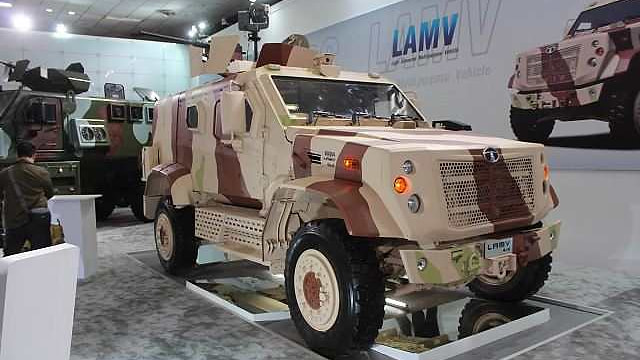
Morocco could soon produce another type of Indian military vehicle as Tata Advanced Systems Limited considers expanding its factory near Casablanca, less than a year after it opened. The Indian company is assessing plans to add the Light Armoured Multipurpose Vehicle (LAMV), a four-wheel-drive armoured vehicle, to its production line in Berrechid. The factory currently makes WhAP 8×8 armoured vehicles for the Royal Moroccan Armed Forces.
The expansion is still under evaluation. Tata has not yet made a final investment decision.
The 20,000-square-metre factory opened in September 2025 and is the first defence manufacturing facility that Tata Advanced Systems has established outside India. The project is part of growing military and industrial ties between Morocco and India.
The plant was initially set up to produce 150 WhAP 8×8 vehicles for the Moroccan armed forces. It reportedly became operational three months ahead of schedule.
If approved, the new production line would allow the factory to make two types of military vehicle instead of one.
What the vehicles can do
The LAMV is a lighter, more mobile vehicle designed to carry personnel and operate in difficult terrain.
It can reach speeds of up to 105km/h, has a 210-horsepower engine and can carry a payload of 1.5 tonnes. It can accommodate up to six people.
The vehicle has a composite crew pod and a V-shaped hull designed to help protect occupants against landmines and improvised explosive devices. It also has independent suspension, run-flat tyres and a central tyre inflation system, which allows tyre pressure to be adjusted for different terrain.
The LAMV can be fitted with remote-controlled weapon systems, turrets and surveillance cameras.
The WhAP 8×8 is a larger, eight-wheeled platform developed by Tata in partnership with India’s Defence Research and Development Organisation (DRDO).
It can be adapted for several roles, including infantry combat, troop transport, reconnaissance, command operations, mortar deployment and ambulance services.
Local production and jobs
The Berrechid project aims to build local manufacturing capacity rather than rely entirely on imported parts.
At the factory’s inauguration, India’s Ministry of Defence said about one-third of the components and subsystems would be sourced and assembled locally from the start. The target is to raise the local value-added share to 50% over the coming years.
That would mean half of the value added to the vehicles through production would come from local activities, including manufacturing and assembly.
The project is also intended to create jobs for Moroccan engineers and technicians and help local suppliers enter the defence industry. India’s Defence Ministry said the factory had already contributed to direct and indirect employment and the development of a supplier network.
Morocco’s existing automotive industry could help support that effort. The country already has experience in vehicle assembly, spare parts manufacturing and logistics. Defence production, however, requires additional technical expertise and compliance with specific security standards.
The factory was inaugurated in September 2025 in the presence of India’s Defence Minister, Rajnath Singh, and Morocco’s minister delegate in charge of the National Defence Administration, Abdellatif Loudiyi.
Although the initial production programme is intended to supply the Moroccan armed forces, the facility could eventually serve other customers. The project has also been presented as a potential base for exports to African and European markets.
Wider defence partnership
The proposed expansion comes as Morocco and India seek to increase cooperation in military manufacturing and technology.
On 8 September 2026, officials from both countries met in New Delhi to discuss producing more defence equipment jointly and establishing new technology partnerships.
Their relationship also includes major trade links in other sectors, particularly phosphates and fertilisers. Trade between the two countries reached $2.55bn in 2025, supported in part by agreements involving Morocco’s state-owned phosphate and fertiliser group, OCP.
Other Indian defence companies are also exploring opportunities in Morocco. MKU, an Indian defence equipment manufacturer, is studying the possibility of opening a facility focused on night-vision technology.
For Tata, adding the LAMV would expand the range of vehicles it can manufacture in Morocco. For the country, it would be another step towards developing a domestic defence industry that draws on existing manufacturing skills while building new technical expertise.
The scale of that expansion will depend on Tata’s assessment and its final investment decision.


