

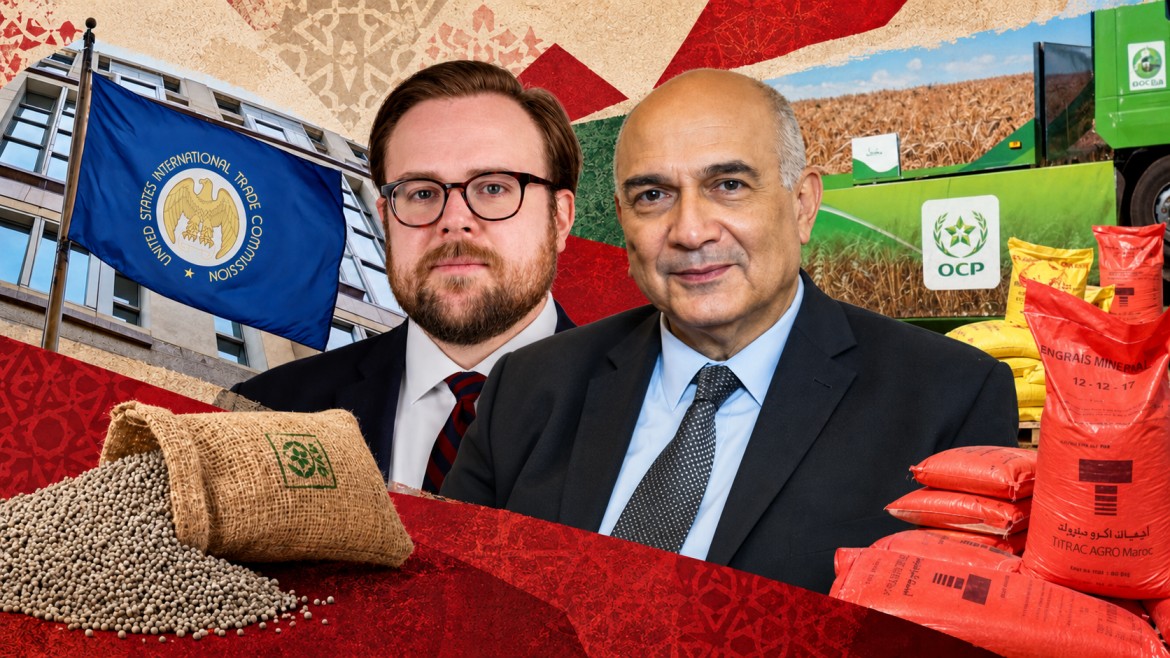
American farmers who need affordable fertiliser could be affected by a US review of trade duties on phosphate products from Morocco and Russia, with a hearing scheduled for 1 April 2027. The US International Trade Commission (USITC) will examine whether removing the duties, introduced in 2021, would harm American fertiliser producers. The hearing will begin at 09:30 local time in Washington, according to a notice published on 9 October.
The review comes as President Donald Trump’s administration has temporarily suspended certain duties on eligible fertiliser shipments from Morocco to help ensure supplies for American farmers.
The US Department of Commerce said in preliminary findings published on 24 July that subsidies for OCP Group, a state-owned Moroccan phosphate and fertiliser producer, were likely to continue or return if the duties were removed. It put the relevant subsidy rate at 20.04%.
That figure is part of the review process, not a new duty currently being charged. The original measures, introduced in April 2021, included a 19.97% countervailing duty on products from OCP.
The review follows a complaint by Mosaic, a major American fertiliser producer, which argued that imports from Morocco and Russia benefited from unfair subsidies and harmed domestic businesses.
Mosaic and another US producer, J.R. Simplot, are taking part in the proceedings. Both confirmed their participation on 17 March 2026 and submitted arguments on 1 April.
The Moroccan government and OCP also filed their submissions on time and responded to the US producers’ arguments on 6 April. The Department of Commerce subsequently opted for a full review, considering arguments from all parties rather than relying only on information already available.
The five-year review began on 2 March 2026. The USITC must determine whether ending the duties would probably cause renewed harm to American producers. The Department of Commerce, meanwhile, is examining whether the subsidies are likely to continue or return.
The two questions are legally separate. Keeping the duties requires the authorities to establish both the likelihood of continued or renewed subsidisation and the risk of material harm to the US industry.
The USITC has set out a timetable for the next stage. A prehearing report is due from 15 March 2027, and parties must submit their initial briefs by 24 March. The hearing will take place on 1 April, followed by posthearing submissions due by 8 April and final comments expected by 29 April.
The commission can extend the review by up to 90 days if the complexity of the proceedings makes more time necessary.
The dispute took a separate turn on 29 June 2026, when President Trump issued an emergency proclamation temporarily suspending certain duties on phosphate fertilisers from Morocco.
The White House said the move was intended to ensure American farmers had an “adequate and timely supply of fertilizer during planting and growing seasons”. It cited supply constraints and the needs of domestic agriculture.
The exemption can cover eligible shipments for up to eight months from the date of the proclamation, unless the emergency ends sooner. It does not automatically remove the duties on every shipment.
Rules issued by the Department of Commerce on 8 July require exporters or importers to submit written requests for approval covering specific consignments. Once approved, shipments can enter the US without payment of the duties covered by the authorisation.
Importers generally have 60 days from notification of approval to bring the goods into the country. If they miss that deadline, the applicable duties may be charged.
The temporary exemption and the five-year review serve different purposes. The exemption is intended to address immediate agricultural supply needs, while the review will determine whether the trade measures introduced in 2021 should remain in place.
The original dispute began in June 2020, when Mosaic petitioned the Department of Commerce and the USITC to investigate imports from Morocco and Russia. The company alleged that foreign producers benefited from government support, including discounted mining rights, tax exemptions and government-backed equity.
In 2021, the US imposed countervailing duties of 19.97% on OCP products. Rates on Russian producers ranged from 9.19% to 47.05%, depending on the company, including producers such as PhosAgro and EuroChem.
The duties changed trade flows. Figures provided in the background material indicate that Moroccan phosphate fertiliser imports into the US fell by more than 80% between 2021 and 2025. OCP expanded exports to markets including Brazil, India and countries across Africa, while US importers faced higher costs for monoammonium phosphate (MAP) and diammonium phosphate (DAP), two widely used phosphate fertilisers. Prices for the products reached record highs during the 2021-2022 farming seasons, according to the supplied background information.
American agricultural groups, including the American Soybean Association, the National Corn Growers Association and the National Fertilizer Solutions Association, have pressed the White House and Congress for relief, arguing that fertiliser costs have squeezed farmers’ profit margins.
The dispute highlights a conflict between two parts of the US economy: fertiliser manufacturers seeking protection from foreign competition and farmers seeking affordable supplies.
OCP is one of the world’s largest producers and exporters of phosphate rock, phosphoric acid and phosphate-based fertilisers, including MAP and DAP. Morocco holds about 70% of the world’s known phosphate rock reserves. OCP operates processing complexes in Jorf Lasfar and Khouribga and has annual fertiliser production capacity of more than 12 million metric tonnes.
The group exports to North America, South America, Asia and sub-Saharan Africa. Before the 2021 duties, it accounted for more than half of US phosphate fertiliser imports, according to the supplied background material.
Mosaic, headquartered in Tampa, Florida, is a major US producer of phosphate and potash fertilisers, with operations in Florida and Louisiana. J.R. Simplot is a privately held agribusiness that produces phosphate fertilisers at facilities in Idaho and Wyoming.
The USITC’s decision will help determine whether the duties remain in place after the five-year review. Producers, exporters, industrial users and other interested parties can submit evidence and arguments before the commission reaches its final decision.


