

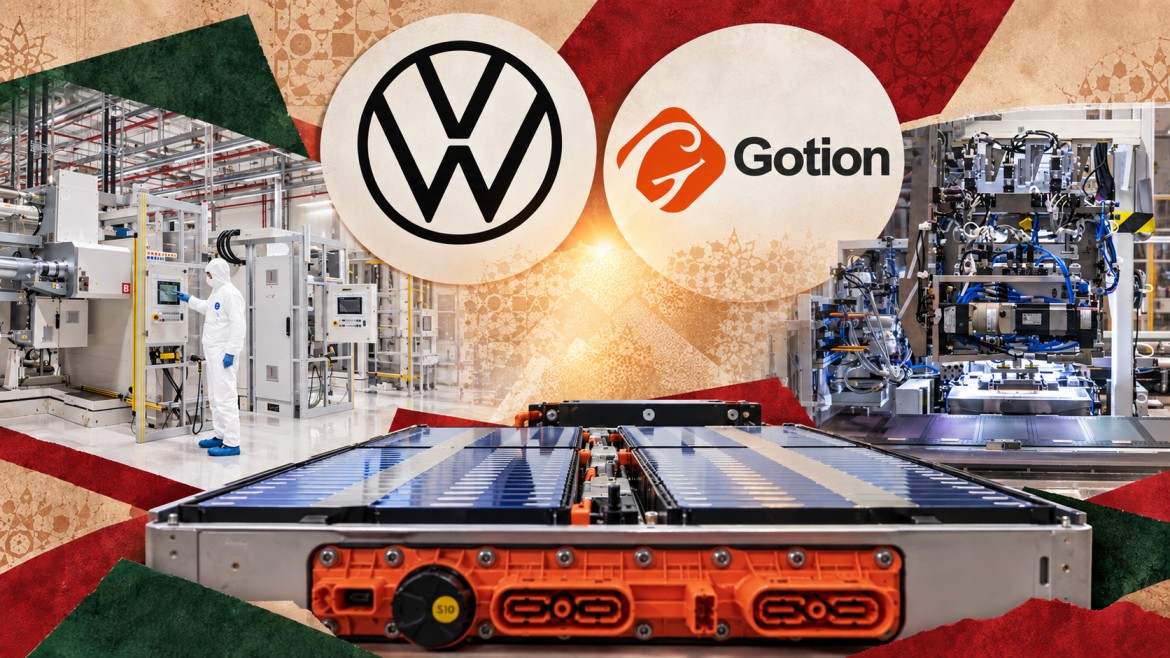
Volkswagen’s battery company PowerCo will take a 49% stake in a Gotion High-Tech plant in Kénitra that will make materials for electric vehicle batteries. Gotion will own the remaining 51% of the joint venture. The project will cost about €480m and is planned to produce 100,000 tonnes of lithium-iron-phosphate (LFP) cathode materials a year.
The plant will supply materials to the partners’ battery production in Europe. It is part of a wider agreement between Gotion and PowerCo covering three industrial sites in Kénitra, Valencia in Spain and Surany in Slovakia.
The ownership structure will be different across the three sites. PowerCo will own 51% of the Valencia plant, while Gotion will hold 49%. In Kénitra and Surany, Gotion will own 51% and PowerCo 49%.
The Kénitra project is linked to Gotion’s wider battery investment announced in 2024. The latest agreement does not mean Gotion is building a second new gigafactory. It sets out PowerCo’s role in part of the existing project and connects the site to the companies’ European battery supply chain.
The Kénitra plant will make LFP cathode active materials. These are a key part of LFP battery cells. The materials will be used to support battery-cell production in Europe, including PowerCo’s plans for LFP batteries.
LFP batteries are becoming more common in electric vehicles, especially lower-cost and mid-range models. They are generally cheaper than some other battery chemistries, have good thermal stability and do not use cobalt.
The project also gives the two companies a production base close to the European market and outside China. Kénitra is connected to Europe by short sea routes and Morocco has free-trade agreements with both the European Union and the United States.
The country also has large phosphate resources, an important raw material for LFP battery production. That gives the project a potential link between phosphate processing, battery materials and electric vehicle manufacturing.
Gotion already has a wider industrial footprint in Kénitra. The battery project is also close to major automotive operations run by companies such as Stellantis and Renault.
The Kénitra, Valencia and Surany projects form three parts of the same industrial plan. The aim is to connect battery-material production in Morocco with battery manufacturing capacity in Europe.
Volkswagen became a strategic shareholder in Gotion in 2020. The carmaker later created PowerCo in 2022 to manage its global battery activities.
The latest agreement therefore brings PowerCo directly into part of Gotion’s Kénitra project and links the Moroccan site to the partners’ planned European LFP battery network.


