

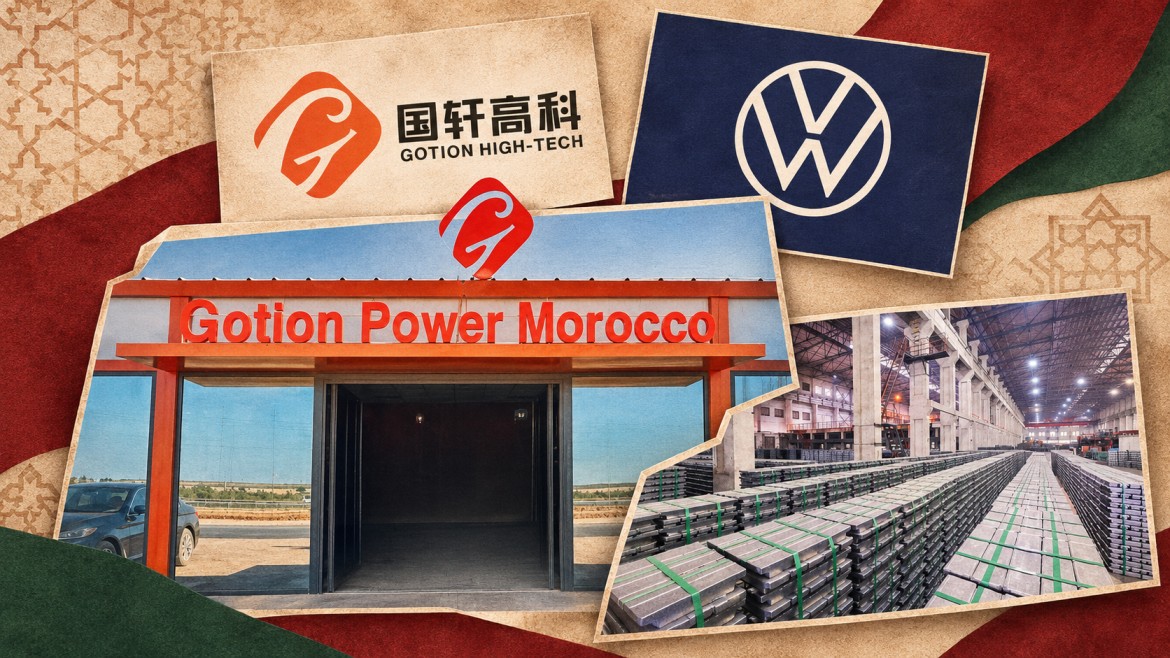
A factory in Kenitra could soon help power millions of electric cars on European roads as Chinese battery maker Gotion High-Tech and German carmaker Volkswagen move to link three major battery projects in Morocco, Spain and Slovakia. The companies have notified Morocco’s Competition Council of plans to establish three connected joint ventures, creating a supply chain that will process battery materials in Morocco before sending them to European factories for battery production.
The projects represent more than $5.8bn in announced initial investment and are expected to provide at least 60 gigawatt-hours (GWh) of annual battery cell production capacity in Europe.
Under the proposed agreement, Gotion will hold a 51% stake in the Moroccan venture through its subsidiary, Gotion Power Africa S.A.S. Volkswagen, through its Luxembourg-based subsidiary Power Holdco Lux S.A., will own the remaining 49%.
The Moroccan Competition Council has opened a 10-day consultation period, giving interested parties until 23 November 2026 to submit comments or objections.
The three ventures are interdependent, meaning none can proceed unless all three receive regulatory approval.
Three countries, one supply chain
The agreement connects industrial projects in Kenitra, near Valencia in Spain, and Šurany in Slovakia. Each factory will have a different role in the production of electric vehicle batteries.
The Moroccan facility will manufacture cathode active materials (CAM), a key chemical component used in batteries. These materials will be sent to two European factories, where they will be used to manufacture lithium-iron-phosphate (LFP) battery cells.
The Spanish factory belongs to Volkswagen’s battery subsidiary, PowerCo Battery Spain S.A.U. The Slovak facility will be developed by Gotion GmbH.
The arrangement brings together three projects that were previously developed separately. Its biggest change is Volkswagen’s decision to take a direct 49% stake in the Moroccan operation, turning what was initially a Chinese investment project into a joint Chinese-German venture.
Volkswagen’s investment will be made through newly issued shares in Gotion Power Africa. This means the money will go directly into the Moroccan company to finance factory construction and equipment.
The proposed ownership structure also gives Volkswagen a larger economic interest than its direct 49% stake suggests. The German carmaker already owns approximately 24.47% of Gotion High-Tech, which controls the remaining 51% of the Moroccan venture.
Based on these figures, Volkswagen’s combined direct and indirect economic exposure would amount to about 61.5%. Gotion would nevertheless retain the majority of voting rights in the Moroccan company.
$1.3bn factory in Kenitra
The Moroccan project is located in the Atlantic Free Zone in Kenitra.
Gotion signed an investment agreement with the Moroccan government on 6 June 2024, committing $1.3bn, equivalent to about 12.8bn dirhams, for the first phase.
The initial investment is expected to provide annual production capacity of 20GWh. The company’s longer-term plan is to increase the investment to $6.5bn and expand production capacity to 100GWh.
The new regulatory filing specifies that the Moroccan joint venture will focus on producing cathode active materials, one of the most expensive components of an electric vehicle battery. These materials account for an estimated 40% to 50% of the total cost of a battery cell.
The investment is significant compared with the size of the national economy. Against an estimated nominal GDP of $155bn, the initial $1.3bn investment represents about 0.84% of annual economic output. The full $6.5bn investment target would be equivalent to about 4.19% of GDP.
These figures compare the planned investment with one year’s economic output and do not mean the entire amount will be spent in a single year.
Spain and Slovakia will make the battery cells
Volkswagen’s factory near Valencia will receive some of the materials produced in Kenitra and turn them into battery cells.
The facility is located at Parc Sagunt II in Spain. Volkswagen has committed more than €3bn to the project as part of its wider €10bn Future: Fast Forward electrification programme in the country.
Construction began in March 2023. The factory is expected to start with an annual production capacity of 40GWh, with the possibility of expanding to 60GWh.
It will manufacture Volkswagen’s standardised Unified Cell, using both LFP and nickel-rich battery chemistries.
The second European factory is being developed in Šurany, in the Nitra region of southern Slovakia.
The project was initially structured as a joint venture between Gotion and Slovak battery company InoBat, with Gotion holding 80% and InoBat 20%.
The factory carries an estimated investment of €1.2bn. Its initial annual production capacity is expected to reach 20GWh, with plans to increase it to 40GWh.
Together, the Spanish and Slovak factories will initially produce 60GWh of battery cells each year. Their combined capacity could eventually reach 100GWh.
To put that figure into perspective, a typical battery pack for a smaller electric car holds about 60 kilowatt-hours (kWh). At that size, the initial production capacity of the two European factories could supply around one million cars a year. Full expansion could raise that number to approximately 1.67 million vehicles.
The calculation assumes that all production is used for 60kWh battery packs.
Why European carmakers want Moroccan battery materials
Morocco’s phosphate reserves are a major reason why the country has attracted investment in battery production.
The country holds approximately 70% of the world’s known phosphate rock reserves, according to the figures cited in the research report. The reserves are largely managed by the state-owned OCP Group.
Phosphate is a key raw material used in LFP batteries. Producing battery materials close to the source could reduce transport costs and strengthen the supply chain.
The Kenitra industrial zone also offers access to Atlantic port infrastructure, including Tanger Med and the port facilities serving the Kenitra area.
LFP batteries are becoming increasingly popular with carmakers because they do not require expensive cobalt and nickel. Their production costs are estimated to be 20% to 30% lower than those of nickel-manganese-cobalt batteries, known as NMC.
The technology is particularly attractive to manufacturers seeking to produce more affordable electric cars, including models priced below €25,000.
The partnership also comes as European carmakers look to reduce their dependence on Chinese battery supply chains.
The European Union introduced anti-subsidy tariffs on Chinese-built electric vehicles in late 2024. At the same time, manufacturers face rules requiring them to meet specific local-content and rules-of-origin requirements to benefit from preferential trade arrangements.
Morocco has free trade agreements with both the European Union and the United States. Battery materials processed in the country can benefit from preferential tariff treatment when incorporated into products manufactured in Europe, provided they meet the relevant rules of origin.
The proposed arrangement allows Gotion and Volkswagen to process battery materials in Morocco while keeping the manufacturing of battery cells inside the European Union.
Governments help finance the projects
The three factories are expected to benefit from public financial support in their respective countries.
Morocco’s New Investment Charter allows eligible strategic projects to receive grants covering up to 30% of their capital expenditure.
Spain has provided PowerCo with nearly €397m in direct grants and loans through the EU-backed PERTE VEC industrial recovery programme, which supports the electric vehicle and battery industry.
Slovakia approved €214m in state aid for the Šurany factory in 2024. The package includes €150m in direct subsidies and €64m in tax relief.
The funding reflects a wider effort by governments to attract battery manufacturers, develop domestic industrial capacity and create jobs as the electric vehicle market expands.
A growing battery industry
The Gotion-Volkswagen agreement comes as several international companies invest in battery materials and manufacturing facilities in Morocco.
One major project is the Cobalt Blue and Jorf Lasfar industrial hub, involving China’s CNGR Advanced Material and Moroccan investment group Al Mada.
CNGR holds a 50.03% stake in the venture, while Al Mada owns 49.97%.
The project carries an estimated investment of $2bn and aims to produce battery precursors and cathode materials with enough capacity to supply batteries for around one million electric vehicles annually.
China’s BTR New Material Group is also developing a battery materials factory in Tangier.
The first phase involves an estimated investment of between $300m and $500m. The facility is designed to produce 50,000 tonnes of LFP cathode active material each year, with supplies intended for European and North American battery manufacturers.
These projects are helping expand the country’s role in the electric vehicle industry beyond traditional car assembly and into the production of specialised battery materials.
Competition from other European battery factories
The Gotion-Volkswagen partnership will face competition from several major battery manufacturing projects across Europe.
In Zaragoza, Spain, carmaker Stellantis and Chinese battery manufacturer CATL are developing a factory in which both companies hold 50% stakes.
The project carries an estimated investment of €4.1bn and could reach annual production capacity of 50GWh. It will manufacture LFP batteries for Stellantis vehicles, making it a direct competitor to Volkswagen’s factory near Valencia.
Hungary is also attracting major investment.
China’s CATL is developing a €7.34bn gigafactory in Debrecen, with planned annual capacity of 100GWh. The factory is expected to supply major carmakers, including Mercedes-Benz, BMW and Stellantis.
The Hungarian project follows a different industrial model, concentrating large-scale battery production at one site while importing processed cathode materials from Asia.
The Gotion-Volkswagen arrangement instead spreads production across three countries. Morocco will process battery materials, while Spain and Slovakia will manufacture the battery cells.
How the partnership developed
The agreement follows several years of investment and industrial planning by the two companies.
Volkswagen began investing in Gotion between May 2020 and December 2021, committing €1.1bn and becoming its largest shareholder. Its stake was initially around 26.5% and later stood at approximately 24.47% following Gotion’s 2022 global depositary receipt listing.
Volkswagen established PowerCo SE in July 2022, bringing its battery manufacturing, raw material sourcing and gigafactory investments under one company.
PowerCo began construction of its Sagunto factory near Valencia in March 2023.
Gotion and InoBat finalised their agreement for the Slovak factory between November 2023 and June 2024, securing an investment plan worth €1.2bn.
Gotion signed its $1.3bn investment agreement with the Moroccan government on 6 June 2024, setting out the first phase of the Kenitra project.
The three ventures were formally brought together in the regulatory notification published on 12 November 2026. The public consultation in Morocco is due to close on 23 November.
The Moroccan factory was initially targeting the start of production in the third quarter of 2026, according to the investment timeline in the research report. The report does not establish whether commercial production has started.
The wider race for battery production
The partnership is part of a growing international competition to secure the materials and factories needed to produce electric vehicle batteries.
Gotion High-Tech, also known as Guoxuan High-Tech, is headquartered in Hefei, China. It is listed on the Shenzhen Stock Exchange and the SIX Swiss Exchange.
Volkswagen became its largest shareholder in 2021, establishing a long-term relationship between the two companies and securing access to Gotion’s LFP battery technology.
The new arrangement gives the partners a supply chain that connects Moroccan phosphate resources with European battery factories.
The financial scale is considerable. The three projects represent more than $5.8bn in announced initial investment, while the two European factories are expected to provide 60GWh of annual battery cell production capacity initially, rising to 100GWh after expansion.
For comparison, the investment per unit of planned capacity is approximately $65m per GWh for the first phase in Kenitra, €75m per GWh for the initial phase in Spain and €60m per GWh in Slovakia. These figures are calculated using the announced investment and planned capacity at each site.
The three projects therefore fall within the estimated global investment range of $60m to $80m per GWh for integrated LFP production.
Two different approaches to battery manufacturing are emerging in Europe. CATL’s project in Hungary relies on a large factory supplied with processed materials from Asia. The Gotion-Volkswagen model spreads production across the Mediterranean, using Moroccan phosphate resources and industrial incentives while keeping battery cell manufacturing inside the European Union.


