

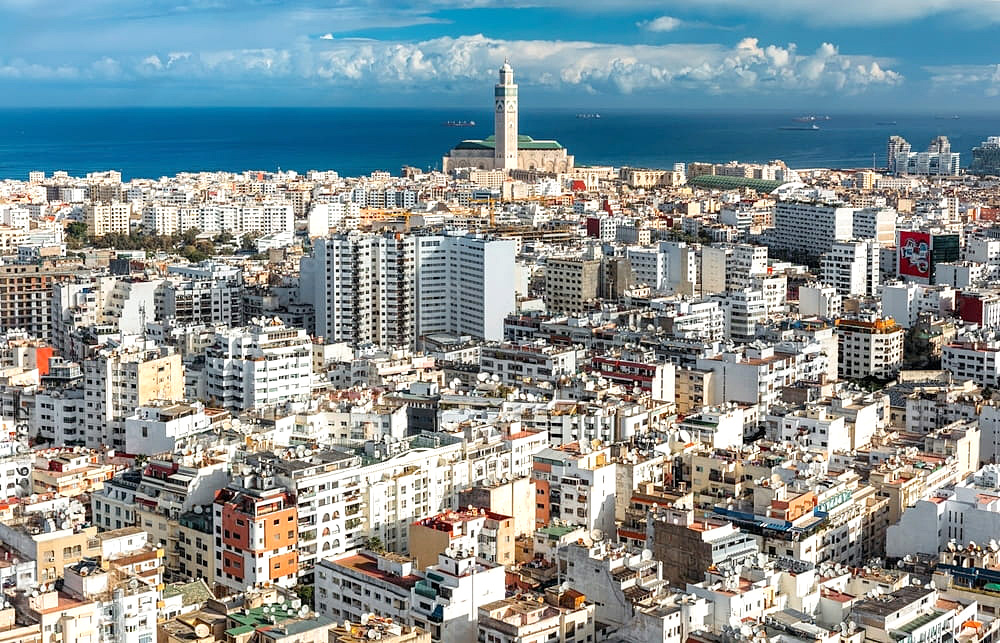
Three regions produced nearly 60% of the country’s economic output in 2024, showing that wealth remains heavily concentrated despite strong growth in several smaller regions, according to new figures from the High Commission for Planning (HCP).
Casablanca-Settat, Rabat-Salé-Kénitra and Tanger-Tétouan-Al Hoceima together generated 58.4% of the country’s Gross Domestic Product (GDP).
Casablanca-Settat was the biggest contributor, accounting for 32.3% of national GDP. Rabat-Salé-Kénitra followed with 15.5%, while Tanger-Tétouan-Al Hoceima contributed 10.7%.
The HCP said these regions dominate because they have the largest concentration of industry, trade, services and major infrastructure.
The economy grew by 4.4% in real terms in 2024. At current prices, GDP rose by 8.7% to MAD 1.61 trillion.
Five regions generated another 33.8% of GDP. Marrakech-Safi contributed 8.7%, followed by Fès-Meknès at 8.2%, Souss-Massa at 6.6%, Béni Mellal-Khénifra at 5.3% and the Oriental region at 5.1%.
Drâa-Tafilalet, Guelmim-Oued Noun, Laâyoune-Sakia El Hamra and Dakhla-Oued Eddahab together accounted for the remaining 7.8%.
The report also found that the gap between richer and poorer regions widened. The average difference in regional GDP increased from MAD 83.6 billion in 2023 to MAD 90.9 billion in 2024.
Casablanca-Settat remained the country’s biggest industrial and business hub. It produced 45.9% of industrial value added and 28.6% of services. The region is home to Casablanca Finance City, the ports of Casablanca and Jorf Lasfar, major chemical and petrochemical industries, and the aeronautics hub in Nouaceur. It recorded economic growth of 4.3%.
Rabat-Salé-Kénitra grew by 3.5%. Alongside government services, it has become a major automotive manufacturing centre through the Atlantic Free Zone in Kénitra. It also accounted for 18.3% of the country’s services sector and 17.8% of primary sector activity, including agriculture.
Tanger-Tétouan-Al Hoceima expanded by 4.9%. The region generated 14% of industrial value added, driven by the Tanger Med port, automotive factories, electronics, textiles, logistics and international trade.
Among the other regions, Marrakech-Safi grew by 5.1%, helped by a recovery in tourism, hotels and handicrafts, as well as chemical industries and phosphate processing in Safi.
Fès-Meknès, the country’s largest farming region, grew by 1.6%. It produces 18.8% of the country’s primary sector value added, but drought and water shortages affected agricultural output.
Souss-Massa recorded one of the strongest growth rates at 6.8%, supported by export agriculture, tourism in Agadir and the fishing industry.
Béni Mellal-Khénifra grew by 2.1%. Its economy depends largely on agriculture, livestock and food processing, with drought slowing growth.
The Oriental region expanded by 5.9%, driven by industry, trade and infrastructure projects, including work on the Nador West Med port.
The fastest-growing regions were in the south.
Laâyoune-Sakia El Hamra recorded the highest growth rate at 7.6%, supported by construction, public works, fishing and renewable energy projects.
Dakhla-Oued Eddahab grew by 7%, driven by fishing, aquaculture, tourism and investment linked to the Dakhla Atlantic Port.
Drâa-Tafilalet expanded by 6.2%, helped by mining, date farming, film tourism and renewable energy projects such as the Noor Ouarzazate Solar Complex.
Guelmim-Oued Noun grew by 4.6%, supported by public services, livestock farming and investment in renewable energy and green hydrogen.


