

Spain’s Moroccan community now plays a key role in keeping parts of the country’s economy running. But a new report says many people in that community remain among the most exposed workers in the labour market.
The analysis, published by the Elcano Royal Institute, looks at how immigrant workers are doing in Spain.
Using official population data and labour survey figures from late 2024, the report estimates that about 1.52 million people born in Africa were living in Spain at the start of 2024. That is around 3 percent of the total population and 17 percent of all foreign-born residents.
Morocco dominates African migration
Most African migrants in Spain come from Morocco. The report says Moroccan migration has been Spain’s main African flow since the 1980s. Today, Moroccan nationals make up nearly three-quarters, or 72 percent, of all African immigrants. That puts the Moroccan community at about 1.1 million people.
Elcano says African-origin migrants make up 17 percent of all immigrants in Spain and 20% of those from outside the EU, with Moroccans forming “almost three quarters” of the African total.
In some places, their presence is especially clear. In Melilla, 21 percent of residents were born in Morocco. In Ceuta, the figure is 11 percent. When people of Moroccan background are counted more broadly, they are thought to make up between 40 percent and 55 percent of the population in the two cities.
Struggles in the job market
Despite their numbers, the report finds that African migrants have a harder time in the labour market than both Spanish-born workers and other immigrant groups. Moroccans face the weakest results.
One key reason is the low number of Moroccan women in paid work. While 73 percent of women from sub-Saharan Africa are either working or looking for work, only 42 percent of Moroccan women are.
Unemployment is also much higher. The report calls the African-origin unemployment rate “extremely high” at 25 percent. For Moroccans, it rises to 27 percent. That compares with 8 percent for Spanish-born workers and 16 percent for sub-Saharan Africans.
Education gaps
Education plays a big part in this picture. Among African migrants aged 25 to 59, one in five did not finish primary school. The share is similar for Moroccans (21 percent) and sub-Saharan Africans (19 percent). The report also says 9 percent of Moroccans and 6 percent of sub-Saharans cannot read or write.
Only 10 percent of African-origin migrants have a university degree. The report says “no other group of immigrants shows results this low in education”.
Heavy reliance on farm work
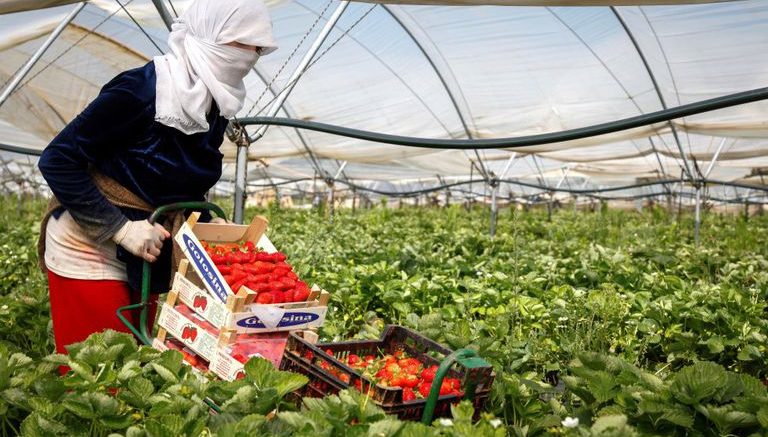
Africans make up just 3 percent of all workers in Spain, but 15 percent of those working in agriculture. Elcano describes their role as “basic” in areas with intensive farming.
In Murcia, 36 percent of farm workers are African migrants. In Almería, the figure is 34 percent. In Huelva, it is 24 percent.
For Moroccans, 15 percent work in agriculture, compared with just 3 percent of Spanish-born workers. Many others work in construction or in factories linked to food production.
Lowest pay levels
The report also looks at income, using Social Security data from December 2024.
It shows that Moroccan workers pay contributions based on an average monthly wage of €1,554. That is 32 percent lower than the average for Spanish workers.
The gap is even wider for women. Moroccan women have an average contribution base of €1,288, compared with €2,082 for Spanish women. The report notes that “the lowest female contribution base is that of Moroccan women”.
Growing second generation
Elcano also warns about long-term effects, especially for young people.
Among 16- to 20-year-olds of Moroccan origin who were born abroad, 26 percent are not in education. The gap between boys and girls is large: 37 percent of males are not studying, compared with 16 percent of females.
Moroccan migrants make up 11 percent of all immigration but account for 20 percent of births to immigrant mothers. The report also says that 31 percent of Spain’s second-generation immigrants, those born in Spain to two foreign-born parents, have Moroccan-born parents.
This is linked to higher birth rates. Moroccan women have more children on average than any other migrant group, meaning people of Moroccan origin make up a larger share of Spain’s second generation than of its first.
A policy challenge
Overall, the report paints a picture of a community that keeps farms, food factories and building sites running, while remaining stuck in low-paid and insecure work.
The issue has become more urgent as the government of Prime Minister Pedro Sánchez prepares a special move to regularise around 500,000 undocumented migrants. The plan would give them legal status and work rights, to fill labour gaps in farming, construction and services, and bringing more workers into the formal economy.


