

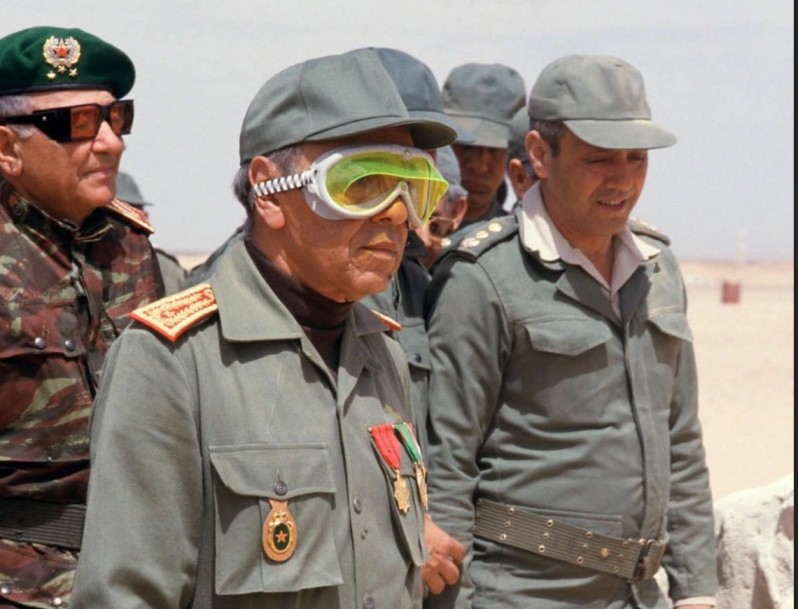
People across Morocco are marking the 47th anniversary of the recovery of Oued Ed-Dahab on Friday, 14 August. The anniversary marks the day in 1979 when tribal leaders and representatives from Oued Ed-Dahab travelled to Rabat and renewed their allegiance to King Hassan II.
The delegation included tribal sheikhs, scholars, local leaders and other representatives from the region. They presented a pledge of allegiance to the late king and reaffirmed their support for the Alaouite monarchy and national unity.
The pledge said: “Our nobles, scholars, notables, men, women, elders, and youth have gathered. Our unanimous view is unshakeable, and our united voice stands on truth. We renew to the Commander of the Faithful and Protector of the Faith, our Master Hassan II, May God preserve him, the pledge of allegiance that our fathers and grandfathers gave to his noble forefathers.”
Hassan II accepted the pledge and told the tribal representatives: “We have received your allegiance today, and we will cherish and protect it as our most precious trust. From this day forward, our allegiance rests upon your necks. From this day forward, our duty is to defend your safety, maintain your security, and constantly work toward your happiness.”
The king also said the event had reunited families and strengthened ties between the north and south.
The anniversary comes as Dakhla-Oued Ed-Dahab goes through a major development push, with large projects planned or under way in transport, ports, water, agriculture, fishing and renewable energy.
New port and road links
The Dakhla Atlantic Port is one of the biggest projects in the region.
The port, planned about 40km north of Dakhla, has an estimated cost of between 12.4bn and 13.6bn dirhams ($1.2bn-$1.4bn).
It will have a 1,330m sea bridge, a 7km access road and berths able to handle ships with a draft of up to 16m.
The first phase is expected to handle more than 2.2m tonnes of cargo a year. Full capacity could reach 35m tonnes a year.
A 1,650-hectare industrial and logistics zone is also planned around the port. It will include activities linked to trade, seafood processing, ship repair and green hydrogen.
The 1,055km Tiznit-Dakhla expressway is another major project.
The road links Tiznit with Dakhla through Laâyoune and has a budget of about 10bn dirhams. It includes 16 major bridges, including a 1,648m viaduct over Oued Sakia El Hamra.
Construction has generated more than 2.5m workdays. The project is also expected to create more than 30,000 direct jobs and 150,000 indirect jobs.
Water and renewable energy
Dakhla also faces a major challenge: securing enough water for its growing population and agricultural activity.
A desalination plant developed by Nareva and Engie is designed to produce 113,376 cubic metres of water a day.
The plant will provide about 30m cubic metres a year for irrigation across 5,000 hectares of farmland. Another 7m cubic metres will supply drinking water to Dakhla and nearby areas.
A dedicated 40MW wind farm will provide power for the plant. The project has an estimated investment of 1.7bn dirhams.
The region is also being developed as a potential centre for green hydrogen and green ammonia. Planned projects could attract nearly 200bn dirhams in investment.
Fishing remains a major industry
Fishing is another important part of the local economy.
Dakhla-Oued Ed-Dahab has about 667km of Atlantic coastline. The area produces around 600,000 tonnes of fish each year, mainly sardines and other small pelagic fish.
The fishing sector employs about 40,000 people.
Aquaculture is also expanding around Dakhla Bay. Fish and shellfish farms cover almost 400 square kilometres and supply export markets with oysters and other seafood.
Anniversary events
A ceremony will take place in Dakhla on Friday to mark the anniversary.
Former resistance fighters and members of the liberation army will be honoured during the event. Financial and social assistance will also be given to eligible families.
A foundation stone will also be laid for a historical memory centre dedicated to the resistance and liberation movement in Dakhla.
The anniversary comes 47 years after the 1979 allegiance ceremony, but the focus today is also on what has happened since then.
Large projects are changing the region’s roads, ports, water supply and economy, while authorities aim to make Dakhla a major trade and business centre for the wider Sahel and West Africa.


