

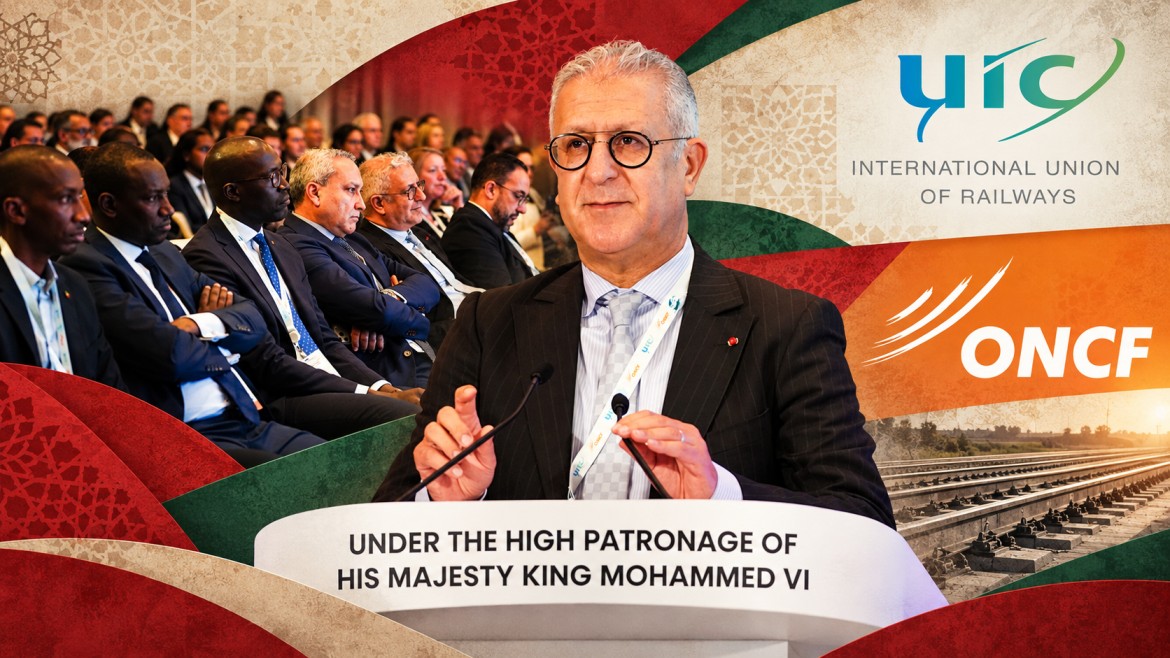
Morocco has hosted a meeting of more than 250 delegates from 20 countries, who have adopted a new strategy to attract investment into African railways and launched a carbon market initiative that could generate up to $72bn by 2050. The Rabat Declaration was adopted at a two-day forum on 14 and 15 October, organised by Morocco’s National Railways Office (ONCF) and the International Union of Railways (UIC).
The meeting brought together representatives of 10 national railway networks, government officials, institutional lenders and industrial stakeholders.
The declaration builds on commitments made at a similar forum in Dakar in 2023. It calls for better-prepared infrastructure projects and new financing models, including public-private partnerships, blended finance, green bonds and investment linked to sustainability targets.
“The Declaration reaffirms the strategic role of rail in sustainable economic growth, regional integration, supply chain resilience, climate action, and inclusive development,” the organisers said in a joint statement.
A key outcome was the launch of MoveCredits, an international coalition established by the UIC to help transport operators access carbon markets and generate revenue from emissions reductions when passengers and freight move from road to rail.
According to UIC estimates, expanding rail transport in low- and middle-income countries could prevent up to 1.8 gigatonnes of carbon dioxide emissions by 2050.
The resulting carbon revenues could range from $27bn to $72bn, depending on market prices. MoveCredits will initially focus on urban transit, high-speed rail and freight transport.
However, the initiative faces challenges, including volatile carbon prices, the need for reliable emissions measurements and differences in national regulations. Railway operators will also need to develop projects that meet the requirements of investors and carbon markets.
Morocco’s rail expansion
The initiative comes as Morocco prepares a major expansion of its railway network ahead of the 2030 FIFA World Cup, which it will co-host with Spain and Portugal.
The Moroccan government and ONCF have outlined an investment plan worth 134bn dirhams, equivalent to about €10bn. The programme includes new high-speed lines, regional commuter networks, modern trains and improved connections to industrial ports.
One of its main projects is a high-speed railway extension linking Kenitra, Rabat, Casablanca and Marrakech over more than 430km. The project is intended to reduce travel time between Tangier and Marrakech to less than three hours, while laying the groundwork for a future extension towards Agadir.
The plan also includes expanded regional express networks in Casablanca, Rabat-Salé-Kénitra and Marrakech, as well as improved rail links to Mohammed V International Airport.
ONCF plans to acquire 168 new trains, including high-speed, intercity, regional and urban commuter services. International industrial partnerships are expected to include local manufacturing components.
Freight infrastructure is another priority, with plans to connect the deep-water port of Nador West Med to the railway network and improve links between ports, mining sites, agricultural centres and industrial zones.
To reduce reliance on public borrowing, the government and ONCF are seeking to attract private investors and use climate finance, carbon credits and land value capture. The latter allows transport operators to recover some of the increase in property values created by new railway stations and infrastructure.
Closing Africa’s infrastructure funding gap
Across Africa, railway expansion has been constrained by limited public finances, fragmented regulations and a shortage of projects ready for investment.
The African Union’s Agenda 2063 and its African Integrated High-Speed Railway Network envisage major improvements to continental transport links, but many projects have struggled to move beyond feasibility studies.
The Rabat Declaration seeks to address that problem by improving project preparation and widening access to private and international financing.
The opening session included Britel, secretary-general of Morocco’s Ministry of Transport and Logistics; Mohamed Rabie Khlie, director-general of ONCF; François Davenne, director-general of the UIC; Eric Ntagengerwa of the African Union Commission; and Asmae Boureddaya of AUDA-NEPAD.
The initiative’s success will depend on whether the proposed financing mechanisms can turn railway plans into viable projects and deliver measurable emissions reductions. Carbon revenues remain estimates rather than guaranteed funding, with returns dependent on carbon prices, verification standards and market demand.


