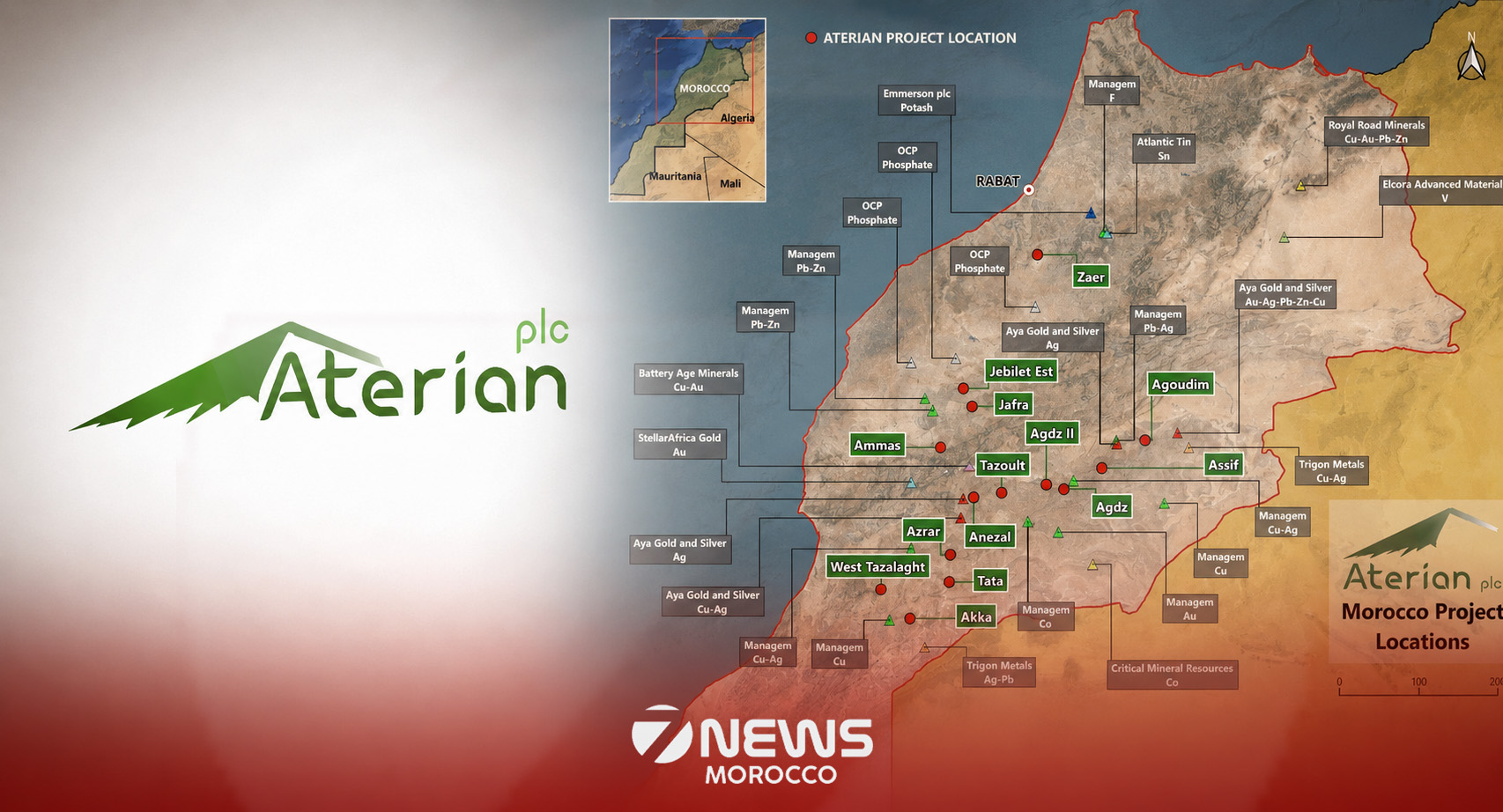
British mining company Aterian has identified signs of copper mineralisation stretching across 2.5km at its Azrar exploration project in the Anti-Atlas region of Morocco, as it prepares for its first drilling campaign later in 2026. The company said initial fieldwork had expanded the known mineralised zone at the Amane target, where exposed rock formations show apparent thicknesses of up to seven metres. Further work is needed to establish how far the mineralisation extends underground and whether it could support commercial mining.
Aterian announced the findings after completing four of 22 planned geological surveys. The programme is being funded by French partner Lithosquare.
In the northern part of Amane, geologists identified possible mineralisation extending over 1km to 1.2km, compared with about 250m in the western section identified in earlier work. The latest surveys also uncovered historic mining workings associated with visible signs of copper.
The apparent thickness of the mineralised rock reaches up to seven metres in the western section and two metres in the north. These are surface measurements, and the true thickness and depth of the mineralisation have yet to be established.
At a second target, Tifrit, within the same exploration licence, teams found signs of mineralisation across an apparent width of three metres and a length of 50m. The mineralisation occurs in layers of conglomerate, a rock made up of fragments of other rocks, and fine-grained sandstone.
Aterian plans to complete 22 geological traverses, covering a combined distance of 8.2km, to map the distribution of mineralisation in the area’s Adoudou sedimentary rock formations. The programme also includes systematic sampling, topographic surveys and work to prepare access to priority exploration areas.
The company is preparing an initial drilling campaign for the fourth quarter of 2026 and has begun discussions with specialist local contractors.
Aterian executive chairman Charles Bray said: “The initial mapping results expand the known zone of copper mineralisation at Amane and allow for the identification of several copper indicators, particularly in sectors that had not yet been explored.”
He said further surveys would help establish whether the mineralised formations continued across the area before the company selected locations for its first drill holes.
The exploration programme also includes the collection of hyperspectral data, which can help identify minerals by measuring how rocks reflect light. The results will be combined with existing geological information to help rank potential drilling sites.
Lithosquare is contributing artificial intelligence-based analysis tools to help identify and prioritise promising areas.
The Azrar project covers 76.9 sq km in the Western Anti-Atlas. Aterian holds an 85% interest, while Lithosquare owns the remaining 15%. The current exploration work is fully funded under their partnership. Neither the exact cost of the campaign nor the budget for the planned drilling has been disclosed.
The project is about 45km east of Tizert, a copper project operated by Moroccan mining group Managem. Tizert is a major development in the region, but its proximity does not establish the size or commercial potential of any deposit at Azrar.
The geology of the Western Anti-Atlas includes sedimentary rock formations that host copper and silver deposits. The Adoudou Formation, which is being investigated at Azrar, contains rock types associated with sediment-hosted copper mineralisation.
Previous exploration at Azrar identified several areas with signs of copper and silver, as well as gold in some locations. Earlier surface sampling produced rock-chip results of up to 3.41% copper and 56g of silver per tonne in breccia zones. Channel samples also returned 0.63% copper and 0.82g of gold per tonne over a 9m interval.
These results relate to earlier sampling and do not establish the overall grade or size of a potential deposit.
Aterian has 17 exploration projects covering nearly 900 sq km across the Anti-Atlas, High Atlas and central parts of Morocco. Its portfolio targets copper, silver, gold and other base metals, including the Agdz and Tata projects.
The company is using partnerships to advance exploration across its holdings. At Azrar, the next steps include completing the remaining 18 geological traverses, analysing hyperspectral data and finalising topographic surveys before selecting drilling targets.
The planned drilling in the fourth quarter of 2026 is intended to test the mineralisation below the surface. The results will help determine whether the copper indications identified so far warrant further development.