

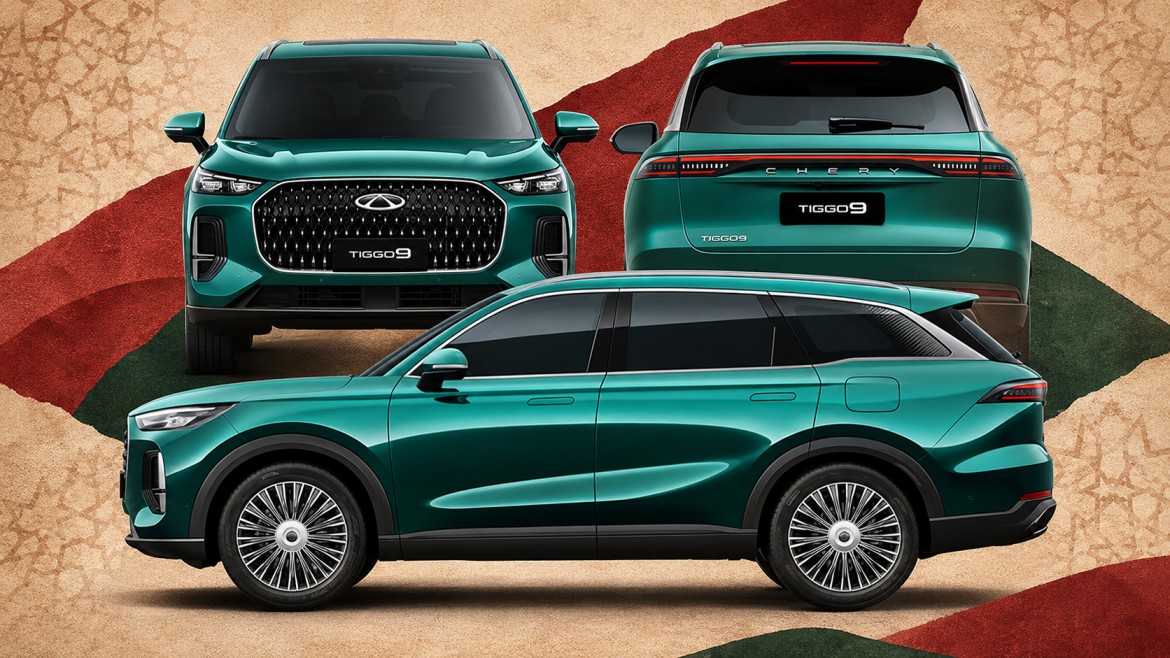
Families looking for a spacious SUV with lower fuel consumption will soon have another option in Morocco. Chinese carmaker Chery has launched the seven-seat Tiggo 9 plug-in hybrid, priced at 369,000 dirhams, as it steps into a more expensive segment of the car market. The new model is Chery’s flagship vehicle in the country. It combines a petrol engine with an electric motor, offers up to 90km of electric-only driving and has room for seven passengers.
The launch also comes as the company reports a sharp rise in sales. Chery sold 2,194 vehicles between January and October 2026, compared with 612 during the same period last year. That represents a 258.5% increase.
The brand, represented by Africa Motors, a subsidiary of Auto Hall, wants to sell 2,990 vehicles by the end of 2026 and 4,800 in 2027.
The Tiggo 9 was presented to the national press at an event held between Rabat and Benslimane. The version currently available is front-wheel drive, while a four-wheel-drive model is planned for 2027.
A seven-seat SUV with 306 horsepower
The Tiggo 9 is 4.81m long, 1.93m wide and has a wheelbase of 2.80m. Its three rows of seats follow a 2+3+2 layout, giving it room for seven people.
Families who need extra luggage space can fold down the third row, increasing the boot capacity to 819 litres.
The exterior features a large front grille, 20-inch wheels, retractable door handles and rear lights connected by a full-width light bar.
Chery is offering the vehicle in one specification, called Luxury.
The cabin includes a 15.6-inch central touchscreen and a 10.25-inch digital instrument display. Apple CarPlay and Android Auto are also available.
Standard equipment includes heated front seats, an electrically adjustable driver’s seat with memory settings, dual-zone automatic climate control and an opening panoramic sunroof.
The SUV also comes with an eight-speaker Sony sound system, a 50W wireless phone charger, a powered tailgate and a 540-degree camera system. The camera provides views around the vehicle and beneath its front section to help drivers spot obstacles.
Safety and driver-assistance features include adaptive cruise control, automatic emergency braking, blind-spot monitoring and lane-keeping assistance.
Up to 90km on electric power
The Tiggo 9 uses Chery’s fifth-generation Super Hybrid technology, combining a 1.5-litre turbocharged petrol engine with an electric motor.
The petrol engine produces 143 horsepower, while the electric motor delivers 163 horsepower. Their advertised combined output is 306 horsepower.
A dedicated hybrid automatic transmission manages the power from both engines. Drivers can choose between Eco, Normal and Sport modes, depending on their driving needs.
Chery says the SUV can accelerate from 0 to 100km/h in 8.9 seconds.
Its 19.43kWh battery provides an advertised electric-only range of up to 90km. That could cover many daily journeys without using petrol, provided the vehicle is charged regularly.
Charging from 30% to 80% takes a claimed 19 minutes using a DC fast charger. A full charge using a 6.6kW AC wallbox takes about three hours.
The manufacturer also reports average fuel consumption of 1.2 litres per 100km. This is a standardised plug-in hybrid figure that assumes regular battery charging. Actual consumption can be considerably higher once the battery’s electric range has been used.
With a 70-litre fuel tank, the vehicle can continue running on petrol for longer journeys without relying on charging stations.
A theoretical combined driving range could exceed 1,100km on a full tank and battery charge. This estimate assumes an electric range of 90km and petrol consumption of about 6.8 litres per 100km once the battery is depleted.
Chery wants to more than double sales by 2027
The launch is part of a wider expansion plan for Chery in Morocco.
The company sold 612 vehicles during the first ten months of 2025. Sales rose to 2,194 during the same period in 2026, an increase of 1,582 vehicles, or 258.5%.
Chery expects to finish 2026 with 2,990 sales. To reach that figure, it needs to sell another 796 vehicles in November and December.
That means averaging 398 sales a month during the final two months of the year, compared with an average of 219 a month between January and October. The company would therefore need to increase its monthly sales pace by about 81%.
Its 2027 target is 4,800 vehicles, which would represent another 60.5% increase on the projected 2026 total.
Chery expects several vehicle categories to help deliver that growth.
B-segment SUVs are expected to account for an additional 776 sales, making them the biggest contributor. D-segment SUVs, including the Tiggo 9 family, are expected to add 458 vehicles, while pick-ups should contribute another 349.
The remaining 227 additional sales are expected to come from sedans, C-segment SUVs and compact electric vehicles.
The figures suggest that smaller SUVs will do much of the work in terms of sales volume, while larger models such as the Tiggo 9 could help the brand move into more expensive parts of the market.
Competition from Korean and European brands
The Tiggo 9 enters a segment that already includes several established seven-seat SUVs.
Its competitors include the Hyundai Santa Fe Hybrid, distributed by Global Engines, with estimated prices ranging from 490,000 to 610,000 dirhams.
The Kia Sorento Hybrid and diesel versions, distributed by Binome, are priced at around 475,000 to 590,000 dirhams.
The Peugeot 5008, distributed by Stellantis Maroc, costs an estimated 410,000 to 495,000 dirhams, depending on the version.
The Tiggo 9’s introductory price of 369,000 dirhams puts it below these models.
Another competitor is the BYD Seal U DM-i, distributed by Auto Nejma. It is a five-seat plug-in hybrid with 218 horsepower and an electric range of up to 80km. Its estimated price ranges from 359,000 to 399,000 dirhams.
The Chery offers more seats and greater advertised power, although the two vehicles occupy different positions in terms of size and passenger capacity.
Tax rules give hybrid imports an advantage
The price of the Tiggo 9 also needs to be understood in the context of import duties.
Morocco has free-trade agreements with the European Union, the United States and Turkey. Vehicles manufactured in these markets can benefit from duty-free access, subject to the relevant rules of origin.
China does not have a similar free-trade agreement with Morocco. Conventional petrol vehicles imported from China therefore face standard customs duties, historically ranging from 17.5% to more than 30%.
Hybrid and electric vehicles, however, benefit from a reduced customs duty of 2.5%, regardless of their country of origin. Eligible vehicles are also exempt from the annual vehicle tax, known as the vignette, and the luxury vehicle surcharge.
These tax advantages can make a Chinese plug-in hybrid more competitive than an equivalent petrol-powered import.
The Tiggo 9 is imported as a completely built-up vehicle rather than assembled locally. Africa Motors must therefore also manage the impact of exchange-rate movements, as purchases settled in US dollars or Chinese yuan expose the distributor to currency fluctuations against the Moroccan dirham.
The dirham is pegged to a basket made up of 60% euros and 40% US dollars.
A growing role for Chinese carmakers
Chery’s expansion comes as Chinese manufacturers increase their presence in the Moroccan automotive market.
The company first entered the country in the late 2000s with small, budget-friendly cars before withdrawing. Its return under Auto Hall’s Africa Motors in 2023-2024 brought a new range of Tiggo SUVs, including the Tiggo 2 Pro, Tiggo 4 Pro, Tiggo 7 Pro and Tiggo 8 Pro.
The partnership has given Chery access to Auto Hall’s distribution and after-sales network, which includes more than 50 branches and workshops across the country. The group also represents other Chinese manufacturers, including DFSK, Dongfeng and Seres.
Chery is part of a much larger Chinese automotive industry. Headquartered in Wuhu, Anhui province, the company is state-backed and has been one of China’s leading vehicle exporters for more than two decades.
The group sold more than 2.6 million vehicles worldwide in 2024, including over 1.14 million exports. Overseas markets have become increasingly important as Chinese carmakers face fierce price competition at home.
Chery’s approach differs across North Africa. Import restrictions and local manufacturing requirements in markets such as Egypt and Algeria have encouraged manufacturers to explore local assembly. In Morocco, Chery currently relies on imports, while Renault Group and Stellantis dominate domestic vehicle production for local and export markets.
The wider Moroccan new-vehicle market sold 161,504 vehicles in 2023 and more than 176,000 in 2024, according to figures from the Association of Vehicle Importers in Morocco (AIVAM). The market is estimated to be running at between 161,000 and 180,000 vehicles a year.
Assuming a market of 180,000 vehicles in 2026 and 185,000 in 2027, Chery’s projected sales would give it a market share of about 1.66% this year and 2.59% next year.
Charging infrastructure remains a challenge
The Tiggo 9’s plug-in hybrid system could appeal to drivers who want electric driving for daily commutes without depending entirely on charging stations.
Public fast-charging points remain concentrated mainly along the Tangier-Rabat-Casablanca-Marrakech corridor. This can make fully electric vehicles less convenient for some long-distance journeys, particularly towards Agadir, Oujda and inland areas.
The Tiggo 9 combines an advertised 90km electric range with a 70-litre petrol tank, allowing drivers to switch to petrol when the battery runs low.
The vehicle’s price and equipment could help Chery attract families looking for a large SUV without paying the prices of established Korean and European rivals.
But the company’s next challenge will be turning its rapid sales growth into a sustained increase in market share. Its 4,800-vehicle target for 2027 will depend on expanding its range, maintaining competitive prices and delivering the promised new models.
The planned four-wheel-drive Tiggo 9, as well as the new B-segment SUVs and pick-ups, remain future launches. Their final specifications, prices and arrival dates have yet to be confirmed.


