

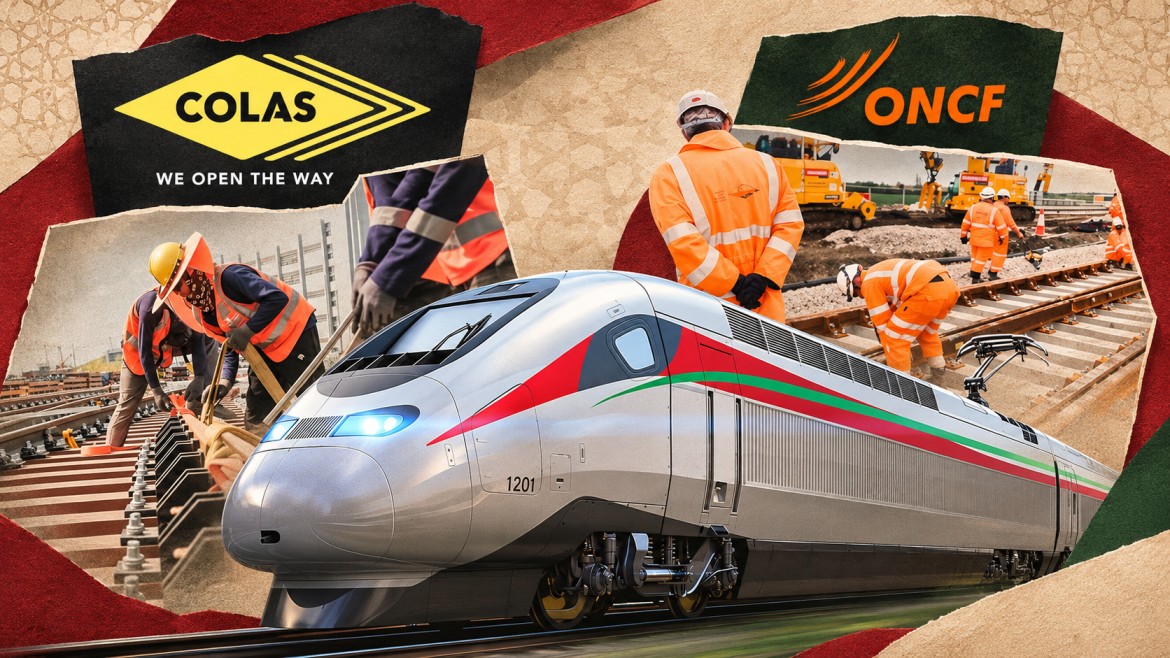
French railway infrastructure company Colas Rail has secured a contract worth about €29m ($31m; 310m Moroccan dirhams) from Morocco’s state-owned railway operator, ONCF, to carry out track, electrification and civil engineering works in Casablanca. The contract covers the railway section between Roches-Noires station in northern Casablanca and the Nouaceur Technicentre, near Mohammed V International Airport. The work includes rehabilitating existing tracks, building new railway lines, installing overhead electrification systems and carrying out related civil engineering works.
The award expands Colas Rail’s involvement in Morocco’s 430km Kenitra-Marrakesh high-speed rail project, which is expected to cost about 53bn dirhams (€4.95bn).
The company had already secured two contracts worth a combined €250m in January 2025 for work on the same project. The latest award brings its total contracts on the corridor to approximately €279m, an increase of 11.6%.
“Morocco is a strategic market for Colas Rail. This new contract with the ONCF is part of a long-term partnership and reaffirms our commitment to supporting the development of high-speed rail in the Kingdom”, says Hervé Le Joliff, Executive Vice President, Railways.
The Casablanca section is an important part of the wider project, which aims to extend Morocco’s existing high-speed railway from Kenitra to Marrakesh.
The planned 430km corridor includes about 390km of new high-speed railway designed for trains travelling at up to 320km/h, alongside around 40km of upgraded urban approaches and bypasses around Rabat and Casablanca.
The Casablanca works are intended to improve railway capacity in the country’s largest city, where high-speed, commuter and freight services share a busy network.
The Nouaceur Technicentre, which is included in the new contract’s geographical scope, is a key maintenance facility for the railway network.
The expansion is part of Morocco’s wider transport investment programme ahead of the 2030 FIFA World Cup, which the country will co-host with Spain and Portugal.
The government is also pursuing a longer-term railway development plan that envisages 1,300km of high-speed lines and 3,800km of conventional railway by 2040.
Colas Rail has operated in Morocco for more than 17 years. It employs about 550 people across 12 business areas and says it has completed more than 40 projects in the country.
Its work has included railway modernisation programmes and projects linked to the development of Morocco’s high-speed network.
The company is part of Colas Group, which is majority-owned by French conglomerate Bouygues.
Colas reported revenue of €16bn in 2025, with operating profit from activities reaching €586m and an operating margin of 3.7%.
Its railway division, Colas Rail, generated €1.48bn in revenue in 2025, representing growth of 13% year on year, or 14% at constant scope and exchange rates. More than 73% of its revenue came from international markets.
Bouygues reported group revenue of €56.9bn in 2025, up 1.3% at constant exchange rates. Its current operating profit from activities rose by €120m to €2.655bn, while net profit attributable to the group reached €1.138bn.
The group also reduced its net debt by €1.86bn to €4.2bn, supported by free cash flow of €1.81bn.
In the first half of 2026, Bouygues recorded revenue of €26.3bn and operating profit from activities of €829m. Its construction division had an order book of €33.4bn.
Colas’s order book stood at €14.78bn by mid-2026.
Competition for Morocco’s railway contracts
The Kenitra-Marrakesh project has attracted several international and Moroccan construction companies.
ONCF has divided the project into separate contracts covering civil engineering, railway systems and rolling stock.
Moroccan companies, including TGCC, SGTM and Jet Contractors, have secured civil engineering work alongside Chinese state-backed groups such as China Railway Construction Corporation and China Railway Group.
French engineering firms Egis and Systra have also secured project management and design assignments.
For the railway fleet, ONCF has launched a tender for 168 trains, including 18 high-speed trainsets. Companies involved in the bidding process include France’s Alstom, Spain’s CAF and Talgo, and South Korea’s Hyundai Rotem.
The division of contracts reflects the different strengths of international contractors. Chinese companies have played a major role in large-scale civil engineering, including earthworks and viaduct construction, while Colas Rail is responsible for specialised railway systems, including track installation and electrification.
The work also requires the integration of track, power supply and signalling systems with the technical standards used on Morocco’s existing Al Boraq high-speed railway.
Morocco inaugurated Al Boraq, its first high-speed railway, in November 2018. The 200km line connects Tangier and Kenitra and cost about 22.9bn dirhams (€2.1bn).
It was the first high-speed railway in Africa. The service carried more than five million passengers annually by 2023.
The Kenitra-Marrakesh extension builds on that network and is intended to connect four major cities: Tangier, Rabat, Casablanca and Marrakesh.
The project’s estimated cost of €4.95bn works out at about €11.5m per kilometre. That compares with approximately €10.5m per kilometre for the original Tangier-Kenitra line.
By comparison, Egypt’s first phase of its Green Line high-speed rail project covers 660km at an estimated cost of €4.15bn, or about €6.3m per kilometre. The French Sud Europe Atlantique high-speed line, which covers 302km, cost approximately €7.8bn, equivalent to €25.8m per kilometre.
The comparisons should be treated with caution, as the projects differ in design, operating speeds, terrain and the proportion of urban infrastructure involved.
Morocco’s new line is designed for speeds of up to 320km/h, while Egypt’s Green Line is a mixed passenger-and-freight railway designed for speeds of up to 250km/h.


