

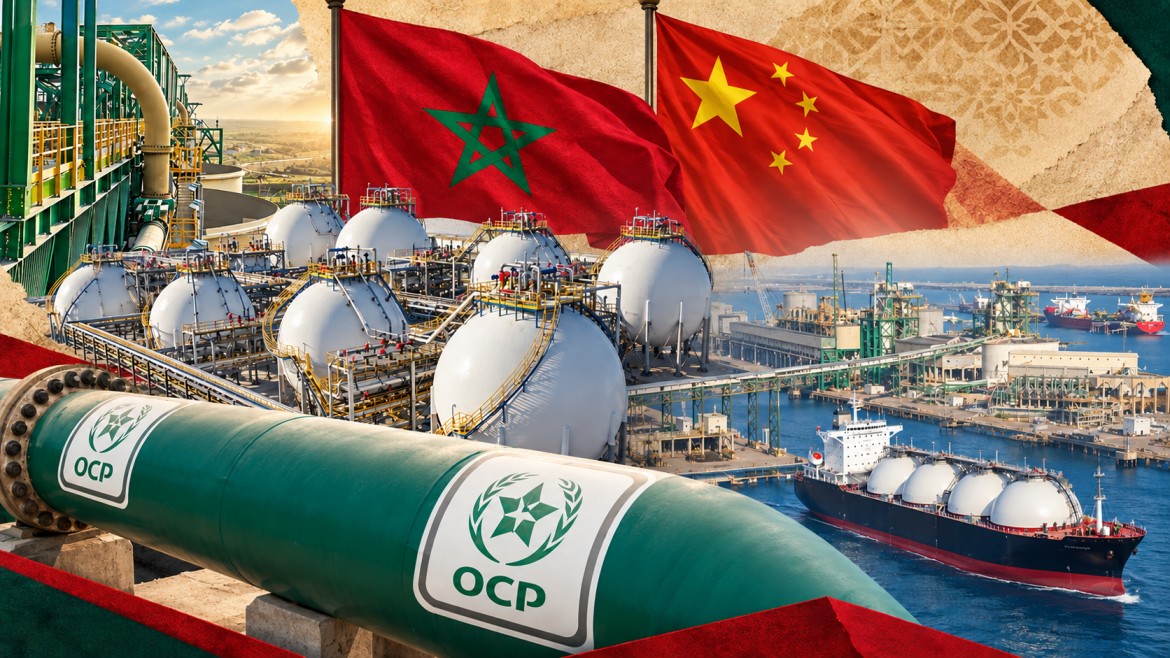
Morocco had to look for ammonia from China this year after supplies from the Middle East were disrupted. The change was unusual because China has not traditionally been a major source of ammonia for Morocco. The new trade is part of a much bigger shift. Chinese companies are now becoming involved in renewable energy, green hydrogen and green ammonia projects across Morocco, while the country tries to reduce its dependence on imported fossil fuels. Ammonia is essential to the fertiliser industry. OCP Group, the state-owned phosphate company, uses it to produce fertilisers such as diammonium phosphate (DAP) and monoammonium phosphate (MAP).
Morocco has about 70% of the world’s known phosphate rock reserves and is one of the world’s biggest fertiliser exporters. OCP needs almost 2 million tonnes of imported ammonia each year.
The country has very little natural gas, which is normally used to make conventional, or “grey”, ammonia. That means the fertiliser industry has long depended on foreign suppliers.
In 2023, Morocco imported about $872m worth of anhydrous ammonia. The bill rose to about $1.59bn in 2024, making Morocco the world’s largest single-country importer of ammonia, with about 18.6% of global imports.
The main suppliers in 2023 and 2024 were Trinidad and Tobago, Saudi Arabia and the United States.
Trinidad and Tobago supplied ammonia worth about $377m in 2023 and $438m in 2024.
Saudi Arabia supplied about $244m in 2023 and $399m in 2024.
The United States supplied about $104m in 2023 and $280m in 2024.
Libya supplied about $47m in 2023, while Qatar supplied about $38m.
Russia had also been an important supplier before the war in Ukraine began in 2022. Sanctions and problems around Black Sea ports disrupted that trade, forcing Moroccan buyers to rely more heavily on suppliers in the Caribbean and Middle East.
That dependence became a problem again in 2026.
Why China suddenly supplied so much ammonia
Fighting and rising security risks in the Middle East disrupted shipping through the Strait of Hormuz, the Red Sea and the Gulf of Aden.
Those routes are important for ammonia, urea and other fertiliser shipments from Gulf producers. Delays reduced the supply available to Moroccan buyers.
China faced a different problem at the same time.
Chinese imports of elemental sulphur fell by 58% during the first half of 2026. Sulphur is needed to produce sulphuric acid, which is then used to make ammonium sulphate and to process phosphate fertilisers.
Sulphur prices rose to about $1,000 a tonne, compared with a historical average of roughly $100-$200.
Chinese chemical companies also produce large amounts of ammonia as a by-product of caprolactam and coke production.
Normally, much of that ammonia is converted into ammonium sulphate. China exported 8.37 million tonnes of ammonium sulphate between January and May 2026, almost 60% of its total fertiliser exports.
The sulphur shortage made that conversion harder.
China also tightened exports of finished fertilisers, including urea, DAP and other NPK products, as the government focused on domestic food security and agricultural prices.
The result was a surplus of raw ammonia inside China.
Chinese producers then found buyers abroad, including Morocco.
China exported 185,000 tonnes of ammonia in May 2026. That was a 163.36% increase from April and the highest monthly level recorded.
Morocco received 51,050 tonnes, the largest amount sent to any country.
Australia received 34,344 tonnes, South Africa 24,997 tonnes and India 24,683 tonnes.
OCP used the Chinese supplies to help maintain production at industrial sites such as Jorf Lasfar while shipments from Saudi Arabia and Qatar faced delays.
Transporting ammonia is not simple. The chemical is hazardous and needs specialised ships and storage systems.
China also introduced new safety requirements. Its updated Hazardous Chemicals Safety Law came into force on 1 May 2026.
The Chinese government later tightened controls on other fertiliser exports. On 9 July, the General Administration of Customs issued Announcement No. 97, requiring statutory inspections for ammonium sulphate exports under specific customs codes from 16 July.
The May ammonia surge may therefore have been a response to a temporary surplus rather than the beginning of a permanent Chinese ammonia export boom.
Morocco wants to stop importing ammonia
The 2026 supply shock exposed a problem that has existed for years.
Every tonne of imported ammonia leaves the fertiliser industry exposed to natural gas prices, shipping costs and geopolitical crises.
OCP has been trying to address that problem by producing ammonia inside the country using renewable energy.
The company announced a $13bn green investment programme covering 2023 to 2027.
The plan aims to move OCP’s industrial operations to 100% renewable energy and produce 1 million tonnes of green ammonia a year by 2027.
The target rises to 3 million tonnes a year by 2032.
One major project is a planned $7bn ammonia facility near Tarfaya in the south. The project is designed to use 3.8GW of wind and solar power.
Initial plans call for 200,000 tonnes of green ammonia a year from 2026, with production increasing later.
The wider plan links renewable electricity production in the south with industrial centres such as Jorf Lasfar and the Oriental region. Ports including Nador West Med and Tanger Med could be used to move the products inside and outside the country.
Renewable power creates another problem: the sun does not always shine and the wind does not always blow.
Large batteries can help keep electricity supplies stable.
OCP Green Energy energised a 25MW/125MWh lithium iron phosphate battery storage system at the Benguerir mine in September 2026. The technology is widely produced in China and is increasingly used to balance renewable electricity.
The government wants foreign investment
The government launched the “Morocco Offer”, or Offre Maroc, in 2024 to attract foreign investment into the green hydrogen industry.
The programme covers the whole supply chain, including renewable power, water desalination, hydrogen production and the manufacture of ammonia, methanol and synthetic aviation fuel.
National hydrogen plans estimate that building the industry could require between 140bn dirhams ($13bn) and 1,000bn dirhams ($95bn) of investment by 2050.
The government wants the country to capture about 4% of global green hydrogen demand by 2030.
The state has identified about 1 million hectares of public land for potential projects. An initial 300,000 hectares was made available in large plots of between 10,000 and 30,000 hectares.
Investors can receive VAT and customs-duty exemptions. The Moroccan Agency for Sustainable Energy, known as MASEN, provides a central role in the programme.
The plan has three broad stages.
The first, covering 2020-2030, focuses on using green hydrogen locally, particularly green ammonia for OCP, alongside early exports to Europe.
The second, from 2030 to 2040, aims to reduce production costs and expand large industrial projects.
The third, from 2040 to 2050, envisages wider use of green hydrogen in transport, homes and aviation.
Chinese companies are moving in
European companies and institutions are also involved.
Germany’s KfW PtX Fund, for example, provided a €30m grant for the Jorf Hydrogen Platform.
Chinese companies, however, are becoming increasingly important because China has a large manufacturing base for electrolysers, solar panels and batteries.
The International Energy Agency estimates that renewable hydrogen in Morocco could eventually cost as little as $3.20 per kilogram if capital costs are kept under control.
Chinese manufacturers can provide much of the equipment needed for these projects at competitive prices.
The government approved six major green hydrogen projects under the Offre Maroc framework in March 2025. Together, they represent about 319bn dirhams ($32.8bn) in planned investment.
The projects involve companies from Morocco, China, Saudi Arabia, the UAE, Spain, Germany, the US and France.
One consortium includes UEG and China Three Gorges and plans to produce green ammonia.
Other approved projects involve Ortus, Acciona and Nordex; TAQA and Cepsa; Nareva; ACWA Power; and TotalEnergies.
TotalEnergies has committed €9.4bn to a project involving 10GW of clean electricity and green hydrogen and ammonia production.
A major Chinese green ammonia project
Energy China International Construction Group, or CEEC, has signed a memorandum of understanding with Saudi company Ajlan Brothers and Moroccan renewable-energy developer Gaia Energy.
The group plans to build a large green ammonia facility in southern Morocco.
The project is designed to produce 1.4 million tonnes of green ammonia a year.
It would require about 320,000 tonnes of green hydrogen.
The planned energy system includes 2GW of solar power and 4GW of onshore wind.
The ammonia could be used by OCP to reduce the carbon emissions linked to fertiliser production. Some of it could also be exported to Europe.
The project follows a model already used by Chinese companies in large renewable-energy and chemical projects in Inner Mongolia and Jilin.
Envision Energy has developed one of the best-known examples in China.
Its Chifeng Net Zero Hydrogen Industrial Park in Inner Mongolia produces about 320,000 tonnes of renewable ammonia each year.
The site operates off-grid and combines wind, solar power, batteries and artificial intelligence systems to manage changes in renewable electricity supply.
The technology helps maintain the steady power needed for ammonia production.
Such a system could reduce the need for major upgrades to Morocco’s national electricity grid.
It could also help projects meet European rules on renewable hydrogen.
The Chifeng facility has received ISCC PLUS certification for green liquid ammonia and verification linked to the EU’s rules for renewable fuels of non-biological origin, known as RFNBOs.
Chinese equipment is also being made in Morocco
Jiangsu Guofu Hydrogen Energy Equipment, known as Guofuhee, is taking the relationship further.
The company announced a $30m investment in a 1GW electrolyser manufacturing plant in Morocco.
Construction is expected to start in 2027.
The factory would allow Morocco to produce some of the equipment needed for future hydrogen projects instead of importing everything from abroad.
Guofuhee has already signed contracts in Morocco.
In April 2026, it signed a $6.2m agreement to supply a 20MW hydrogen production system to GF Hydrogen Africa, an associated company.
The system will demonstrate alkaline water electrolysis and proton exchange membrane technology in North African conditions.
Guofuhee is also working with GF Hydrogen Africa and the École Hassania des Travaux Publics in Casablanca.
The partners opened Morocco’s first integrated clean hydrogen laboratory at the university in May 2026.
The laboratory includes a 10kW PEM electrolyser, a fuel cell and solar power. It is designed as a small system showing the full chain from production to storage and use.
Europe is changing the economics
The European Union’s Carbon Border Adjustment Mechanism, or CBAM, is another reason Morocco is moving towards green ammonia.
The mechanism entered its definitive phase in 2026.
It applies to products including fertilisers and puts a carbon cost on imports with high greenhouse-gas emissions.
Grey ammonia has historically cost between $400 and $700 a tonne, although prices vary.
Q1 2026 estimates put grey ammonia at about $679 a tonne in north-west Europe and $674 a tonne in Africa, including Morocco.
The estimated CBAM cost is between $50 and $200 a tonne, depending on emissions and the EU carbon price.
Green ammonia was estimated at about $860 a tonne in Germany in Q1 2026.
That means renewable ammonia remains more expensive to produce, but the carbon cost attached to conventional ammonia can narrow the gap in the European market.
For OCP, producing ammonia with renewable electricity could therefore reduce both exposure to fossil-fuel prices and the carbon costs linked to European exports.
Morocco could become a shipping fuel hub
Green ammonia has another potential market: shipping.
The International Maritime Organization has set targets to reduce emissions from global shipping.
More than 100 ammonia-capable ships were on order by mid-2026, including vessels linked to Eastern Pacific Shipping and Mitsui O.S.K. Lines.
Morocco sits close to major shipping routes between Europe, Asia and the Americas.
The World Bank estimates that global shipping could need about 0.2 million tonnes of hydrogen equivalent by 2030 and almost 2.83 million tonnes by 2050.
Tanger Med and Jorf Lasfar are being considered for future green-energy and ammonia bunkering operations.
China is already testing this technology.
Envision Energy completed an ammonia bunkering operation at COSCO Shipping Heavy Industry’s terminal in Dalian in 2025, using renewable ammonia produced at its Chifeng project.
Similar technology could eventually be used at Moroccan ports.
A relationship moving beyond trade
The 51,050 tonnes of ammonia sent from China to Morocco in May 2026 came from a short-term supply problem.
The larger relationship is more permanent.
Morocco needs a reliable source of ammonia for its fertiliser industry. It also needs to reduce its exposure to natural gas prices, shipping disruptions and geopolitical shocks.
China has the equipment, engineering companies and manufacturing capacity needed to help build a renewable hydrogen and ammonia industry.
That combination is bringing the two countries closer.
The immediate result is more Chinese ammonia arriving at Moroccan ports.
The longer-term change could be more significant: Chinese companies helping build the renewable power, electrolysers, batteries and ammonia plants that allow Morocco to produce much more of its own ammonia at home.


