

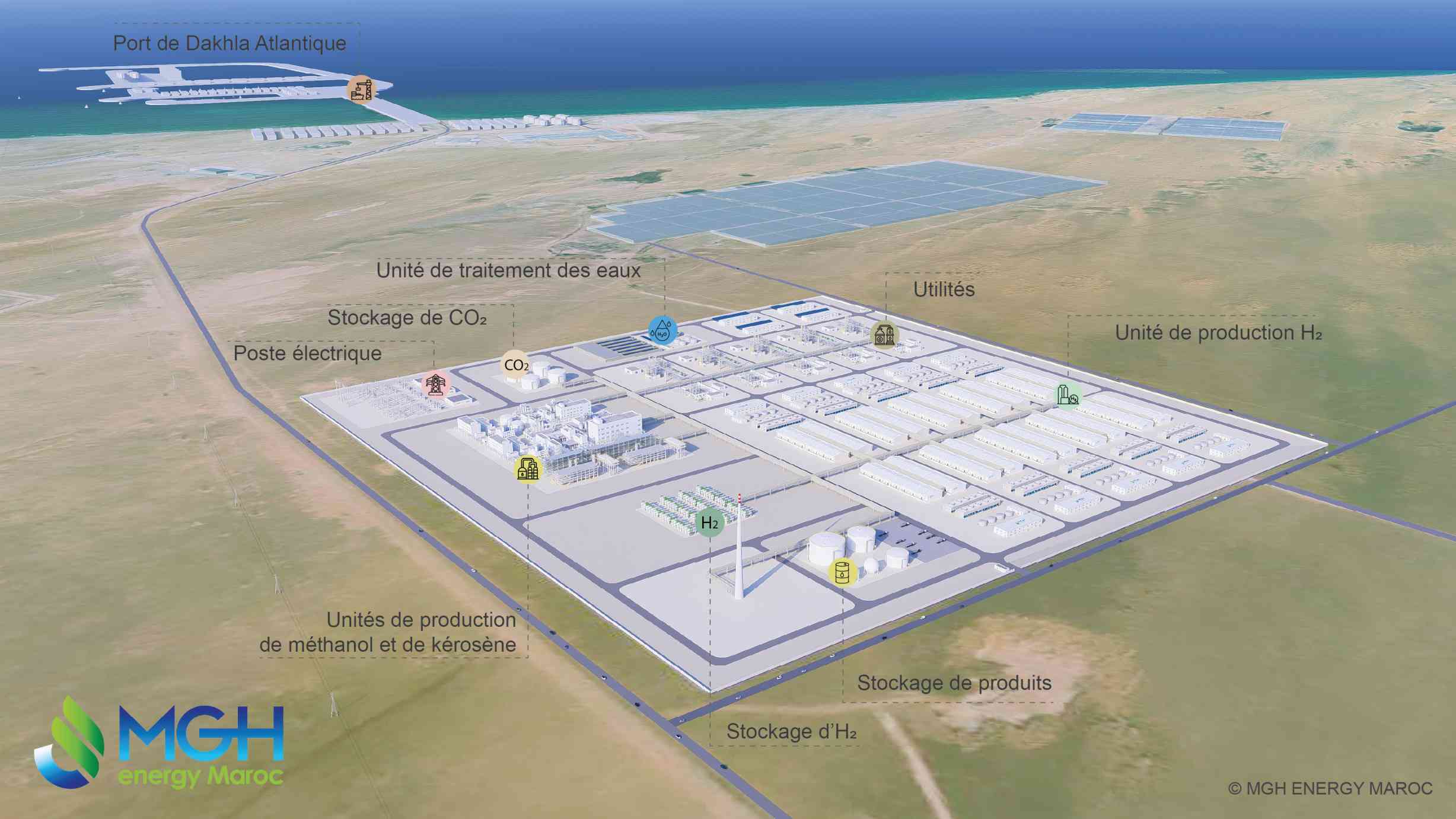
A €4.5bn project to produce cleaner fuel for planes and ships in southern Morocco has received a boost after the European Commission selected a related project in France for funding support. French energy company MGH Energy says the decision will strengthen the development of Janassim, a planned green fuel plant in the Dakhla-Oued Ed-Dahab region. The project is being developed with Moroccan partner HOLSATEK, the parent company of fuel distributor PETROM.
The European Commission selected MGH Energy’s synthetic fuel plant in Laudun-l’Ardoise, southern France, under the Large-Scale Projects category of its Innovation Fund on Monday, 16 November. The selection opens the door to substantial European financial support.
The French facility requires an investment of nearly €1.1bn (£915m) and is expected to start operating in 2031. It will produce 70,000 tonnes of synthetic aviation fuel, known as e-kerosene, and 40,000 tonnes of e-methanol for ships every year.
MGH Energy says the technical expertise, industrial experience and partnerships developed through the French project will help its Moroccan subsidiary, MGH Energy Maroc, move Janassim forward.
The Dakhla project is valued at around €4.5bn, equivalent to 50bn Moroccan dirhams. It aims to produce approximately 300,000 tonnes of synthetic fuel annually, nearly three times the planned output of the French plant.
Janassim will use 2.2 gigawatts of combined wind and solar power. That is roughly comparable to the generating capacity of two large nuclear reactors.
The electricity will power several stages of production, including turning seawater into fresh water, producing green hydrogen through electrolysis and manufacturing synthetic fuels.
Once fully operational, the project is expected to provide about 600 permanent jobs. More than 2,500 direct jobs are expected during construction.
MGH Energy estimates that the plant could also prevent around 724,000 tonnes of carbon dioxide emissions every year.
Jean-Michel Germa, president of MGH Energy, said the European Commission’s decision recognised the work of the company’s teams and their ability to develop complex industrial projects.
“The selection of our French project by the European Commission is a major recognition of the work accomplished by our teams and our ability to develop complex industrial projects in the field of synthetic fuels,” he said.
“This progress benefits our entire international strategy. The skills and experience acquired at Laudun-l’Ardoise constitute valuable assets to support the development of Janassim.”
Germa said the country’s wind and solar resources could make it a competitive producer of synthetic fuels.
“Morocco has exceptional conditions to produce competitive synthetic fuels, thanks to the abundance and complementarity of its wind and solar resources. We now wish to transform this potential into a large-scale industrial reality, alongside our Moroccan partners,” he said.
“It is time to mobilise investors, industrialists, and future buyers to make Janassim a structuring project for Morocco and for the decarbonisation of international transport.”
Why synthetic fuels matter
Synthetic fuels, also called e-fuels, are seen as one way to cut pollution from industries that cannot easily switch to electricity.
Large passenger aircraft and cargo ships, for example, still need energy-dense fuels to travel long distances. Batteries remain a major challenge for powering these forms of transport.
E-fuels are made using renewable electricity to split water into hydrogen and oxygen. The hydrogen is then combined with captured carbon dioxide to produce liquid fuels.
E-kerosene is designed for aviation, while e-methanol can be used in maritime transport.
The European Union is encouraging their production through two regulations, ReFuelEU Aviation and FuelEU Maritime. They require airlines and shipping companies to gradually increase their use of sustainable fuels over the coming decades, creating a growing market for producers.
Why Dakhla?
The Dakhla region has two resources that are important for producing green fuels: strong sunshine and consistent Atlantic winds.
Solar panels can generate electricity during the day, while wind turbines can continue producing power when sunlight is unavailable, including at night.
The plant’s coastal location will also allow it to use seawater. This will be desalinated before being used to produce hydrogen through electrolysis.
The combination of renewable electricity, water and access to the Atlantic is expected to support large-scale fuel production, with the finished products potentially supplying European markets.
Janassim is also aligned with the national green hydrogen strategy known as Offre Maroc, which aims to turn the country into a major producer of green hydrogen and related products.
The government has earmarked around one million hectares of land, largely in the Southern Provinces, for investment by international energy companies and consortia.


