

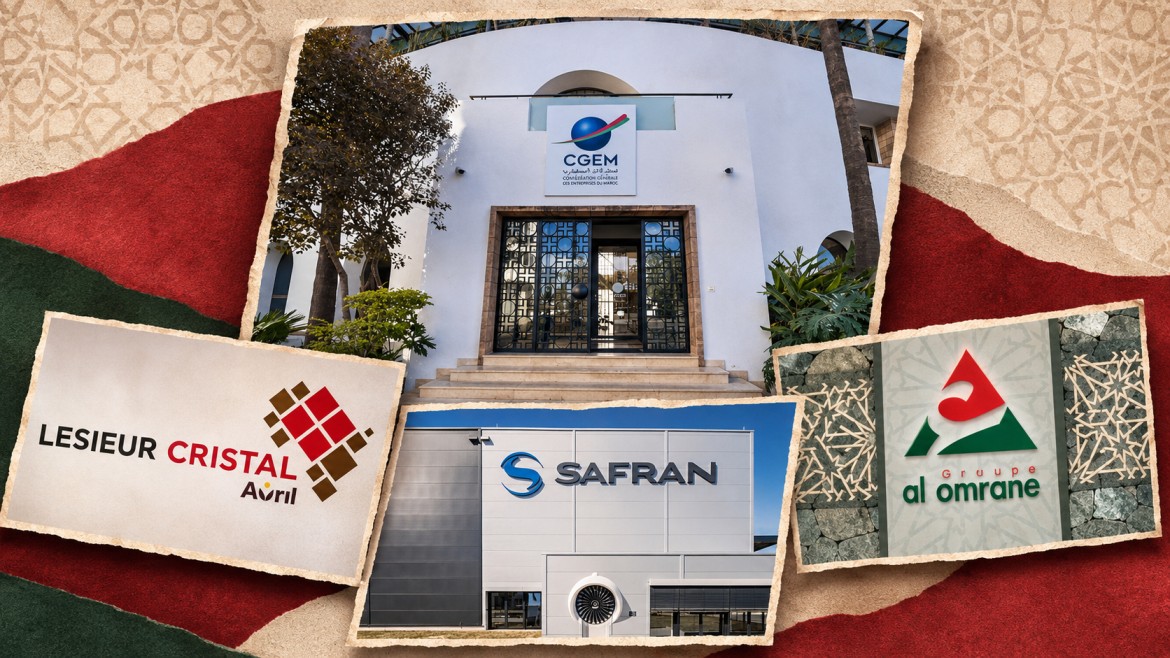
Morocco’s main employers’ federation has awarded its Corporate Social Responsibility (CSR) label to Lesieur and Safran Aircraft Engine Services Morocco, while renewing the certification for state-owned developer Holding Al Omrane. The General Confederation of Moroccan Enterprises (CGEM) announced the decisions on 12 November, following a meeting of its CSR Label Attribution Committee on 11 November 2026.
The three companies have received or renewed a certification valid for three years, covering the period from November 2026 to November 2029.
The CGEM label recognises companies that integrate social and environmental responsibility into their management and business strategies, taking into account the interests of employees, customers, suppliers and other stakeholders.
Lesieur Cristal, one of Morocco’s leading producers of edible oils, soaps and condiments, is majority-owned by French agro-industrial group Avril, which holds a 65.3% stake. The company is listed on the Casablanca Stock Exchange and operates major refining and bottling facilities in Ain Harrouda, near Casablanca.
Its annual revenue averaged MAD 6.02bn in the 2023-2024 reporting period.
Safran Aircraft Engine Services Morocco operates in the Nouaceur aerospace cluster, near Mohammed V International Airport. Established in 1999, the company is a joint venture between France’s Safran Aircraft Engines, which holds 51%, and Royal Air Maroc, which owns 49%.
It specialises in the maintenance, repair and overhaul of CFM56 and LEAP aircraft engines and has an estimated workforce of about 400 employees.
Holding Al Omrane, which is wholly owned by the Moroccan state, coordinates public housing and urban development projects through 10 regional subsidiaries. Its activities include social housing, urban development and programmes to improve living conditions in underserved areas.
The holding company recorded an average annual turnover of MAD 4.1bn and an investment budget of MAD 4.5bn in the 2023-2024 period.
How the certification works
The CGEM CSR label is awarded by the confederation’s president following a recommendation from its attribution committee and an assessment carried out by an independent expert accredited by the organisation.
The assessment examines a company’s overall management against the CGEM CSR Charter, which is based on nine areas of commitment.
These include respect for human rights, working conditions and industrial relations, environmental protection, preventing corruption, compliance with competition rules, corporate governance transparency, consumer interests, responsible supply chains and community engagement.
The certification is granted for three years. The assessment is intended to establish whether a company’s management practices comply with the objectives set out in the charter, which is aligned with Moroccan social legislation and international principles of corporate social responsibility.
The CGEM introduced the label in December 2006, drawing on the principles of ISO 26000, the international guidance standard on social responsibility. Unlike a formal regulatory requirement, the label is a voluntary certification based on an external assessment.
About 120 companies are estimated to hold an active CGEM CSR label in Morocco. Against an estimated 330,000 active formal enterprises, this represents roughly 0.036% of the country’s registered business landscape.
A growing focus on corporate responsibility
The latest awards come as Moroccan companies face increasing pressure to demonstrate responsible business practices, particularly those linked to international groups and supply chains.
Lesieur’s parent company, Avril, and Safran are both subject to European sustainability reporting and due-diligence requirements, including the Corporate Sustainability Reporting Directive (CSRD) and the Corporate Sustainability Due Diligence Directive (CSDDD), which increase scrutiny of environmental and human rights practices across corporate operations and supply chains.
Morocco’s own policy framework is also placing greater emphasis on corporate governance and accountability.
For Holding Al Omrane, the renewal comes amid reforms affecting state-owned enterprises under Law 82-20, adopted in July 2021. The reforms seek to improve governance, financial transparency and performance across public holdings.
The company’s role has also evolved following the launch of Morocco’s Direct Housing Aid programme in 2024, which shifted state support towards homebuyers rather than property developers.
The CGEM certification may also strengthen companies’ positioning with lenders, investors and international business partners, as environmental, social and governance (ESG) standards become increasingly important in financing and commercial relationships.
For Morocco’s industrial sector, the awards bring together three different areas of economic activity: agribusiness, aerospace maintenance and urban development.
The next major test will be whether the companies translate the certification into measurable improvements in their operations, particularly in environmental performance, workplace conditions and corporate governance.


